
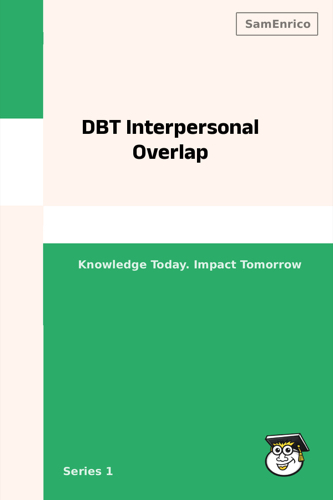
Non-FictionSelf-HelpInterpersonalDBT
DBT Interpersonal Overlap eBook
Balance emotion regulation with relationship effec
by Booker Brady
Balance emotion regulation with relationship effectiveness skills.
Formats
Free sample
Chapter 1: The Flooded Engine...--–- You are in the middle of a conversation that started calmly. Perhaps you are asking your partner to remember to take out the trash, or you are explaining to a coworker why their comment bothered you. For the first thirty seconds, you feel fine. Your voice is steady. You remember the skills you have read about: be clear, be kind, state your need.
But then something shifts. The other person’s expression changes—maybe they roll their eyes, or interrupt, or say “You’re overreacting.” Suddenly, your chest tightens. Your face grows hot. Words you did not plan to say leave your mouth. You hear yourself attacking, or crying, or shutting down entirely.
The conversation is no longer about the trash or the comment. It is now about your reaction. And you are left wondering: what just happened?This experience is not a sign that you are broken, weak, or incapable of healthy relationships. It is a sign that your nervous system has done exactly what evolution designed it to do. Millions of years of survival wiring have prioritized physical protection over social connection.
When your brain perceives a threat—and in the absence of saber-toothed tigers, social rejection, criticism, or invalidation register as threats—it hijacks your higher reasoning centers and prepares you to fight, flee, or freeze. In that state, no amount of “communication skills” will work. You cannot negotiate from a flooded engine any more than you can drive a car whose radiator is boiling over.This chapter is the foundation of everything that follows in DBT Interpersonal Overlap. Before you learn how to ask for what you need (DEAR MAN), how to preserve a relationship (GIVE), or how to maintain self-respect (FAST), you must first understand the biological reality of interpersonal conflict. You must learn to recognize the precise moment when your arousal level moves from “productive discomfort” to “neural blackout.” And you must build a set of emergency protocols—what we will call the Pre-Game Pause and TIPP skills—that allow you to down-regulate your nervous system before you open your mouth.
Without this foundation, every other skill in this book will fail you precisely when you need it most.The Unified Arousal Framework: Your Internal Speedometer Throughout this book, we will use a single, consistent tool to measure your emotional intensity: the Unified Arousal Framework, introduced in the book’s introduction and referenced in every subsequent chapter. Think of it as a speedometer for your nervous system, calibrated from 1 to 100.Zone Green (1 to 50): You are calm, curious, and cognitively flexible. Your prefrontal cortex—the part of your brain responsible for logic, empathy, impulse control, and strategic thinking—is fully online. In this zone, you can listen without defensiveness, hold two opposing ideas at once, and choose your response rather than reacting automatically. All interpersonal effectiveness skills (DEAR MAN, GIVE, FAST) work optimally here.
Most of your daily functioning should occur in this zone.Zone Yellow (51 to 70): You are agitated, alert, and emotionally activated, but still capable of reasoning. Your heart rate is elevated. You may feel urgency or irritation. Your prefrontal cortex is beginning to lose blood flow as your amygdala (the brain’s alarm system) ramps up. In this zone, you can still use skills, but they require more effort.
You might forget a step of DEAR MAN, or you might speak faster than you intend. This is the zone of “warning lights”—you are not yet flooded, but you are approaching the edge. The Pre-Game Pause (introduced later in this chapter) is designed specifically for Zone Yellow.Zone Red (71 to 100): You are physiologically flooded. Your amygdala has effectively seized control of your brain. Your prefrontal cortex is largely offline.
You cannot learn new information, you cannot accurately read social cues, and you cannot access empathy for someone you perceive as a threat. In Zone Red, you will do one of three things: attack (fight), withdraw (flight), or go silent and numb (freeze). You may say things you later regret, or you may say nothing at all while your mind races with catastrophic interpretations. No interpersonal skill works in Zone Red. Trying to use DEAR MAN or GIVE at 80 is like trying to solve a calculus problem during a heart attack.
The only appropriate response in Zone Red is physiological down-regulation.This framework is not a judgment of your character. It is a description of your biology. Everyone—from the most emotionally regulated monk to the most volatile person you know—moves through these zones. The difference between people who succeed in relationships and those who repeatedly rupture them is not that the former never enter Zone Red. It is that the former recognize Zone Yellow earlier, and they have practiced interventions that bring them back to Zone Green before they cross the threshold into Zone Red.To make this concrete, let us consider two scenarios.Scenario A: The Slow Burn.
You receive a text from your friend that reads, “We need to talk.” Your arousal moves from 20 to 45. That is Zone Green. You are curious but not alarmed. You reply, “Sure, what’s up?” When they do not respond for an hour, your arousal moves to 55—Zone Yellow. You notice your heart beating a little faster.
You have the urge to send another text: “Hello?” Instead, you recognize the yellow zone, take three slow breaths, and decide to wait until you can speak on the phone. By the time you call, you are back at 40. The conversation goes well.Scenario B: The Flash Flood. You receive the same text. Your arousal jumps from 20 to 75 in under ten seconds because your history includes being ghosted by someone who used the phrase “we need to talk.” You are now in Zone Red.
You do not notice the jump because it happened so fast. You send a series of panicked texts. When your friend finally responds, you accuse them of ignoring you on purpose. You hear yourself saying things that do not sound like you. Later, you feel ashamed and confused.
You cannot understand why you overreacted.The difference between Scenario A and Scenario B is not that you are “too sensitive.” The difference is that your nervous system in Scenario B bypassed the yellow zone entirely. It went from Green to Red in a single leap, a phenomenon called emotional hijacking. This happens when a trigger is connected to a past wound. Your brain, trying to protect you from a repeat of that wound, sounds the alarm before you have time to think. The solution is not to shame yourself for having the wound.
The solution is to build skills that catch the hijack mid-flight—skills that give your prefrontal cortex a fighting chance to re-engage before you do lasting damage to a relationship you value.The Biology of the Argument: What Happens Inside Your Skull To truly understand why you cannot use relationship skills when you are flooded, you need a basic map of your brain’s conflict architecture. You do not need a neuroscience degree. You need only remember three characters: the Watchtower, the Alarm System, and the Highway.The Watchtower (Prefrontal Cortex): This is the part of your brain…
This is the end of the free sample. Get the eBook to keep going. Buy now
About this book
Details
- Author
- Booker Brady
- Publisher
- SamEnrico
- Language
- English
- Genre
- Non-Fiction, Self-Help, Interpersonal, DBT
- Released
- 2026-06-08
- Pages (approx.)
- 151
- Available as
- eBook, Audiobook

Read better in the ZLOADR app
Your eBooks on your phone or tablet. Sign in with your SamEnrico account and start reading.
More by Booker Brady
 The Student Group Project GuideBooker Brady$11.99
 The Active Listener's JournalBooker Brady$11.99
 The Gentle Parental Anger WorkbookBooker Brady$11.99
 The Email List Segmentation GuideBooker Brady$11.99
 The Blood of the Silk Road: Han China's War for the West (133 BC - 89 AD)Booker Brady$11.99
 Nekrasovite MiningBooker Brady$11.99
 Green Credit Penalty AvoidanceBooker Brady$12.99
 ARIPO Examination ProcessBooker Brady$12.99
 Understanding Tethered Spinal Cord DiseaseBooker Brady$17.99
 How to Start a NAAFI Headquarters Business (Beginners Guide)Booker Brady$11.99
You may also like
 Hong Kong Handover 1997Dunn Johnnie$11.99
 Zumba For Postnatal Recovery CourseNeal Christian$11.99
 Zumba for BeginnersLadner Nikia$11.99
 YouTube Comment Mining GuideHumes Pandora$12.99
 Worry Box MeditationCarlin Rudy$11.99
 Workplace Stress MeditationNguyen Lynn$11.99
 Workplace Stress and Sleep RepairHawley Ivory$11.99
 Workplace Perfectionism CureDelaney Jeffry$11.99
 Workplace Injustice Anger GuideWallen Isabelle$11.99
 Work Addiction and Burnout LinkGreenwood Ester$11.99
 Women in Yoga and WellnessBeattie Galina$11.99
 Women in Stand Up ComedyChun Evangeline$11.99