
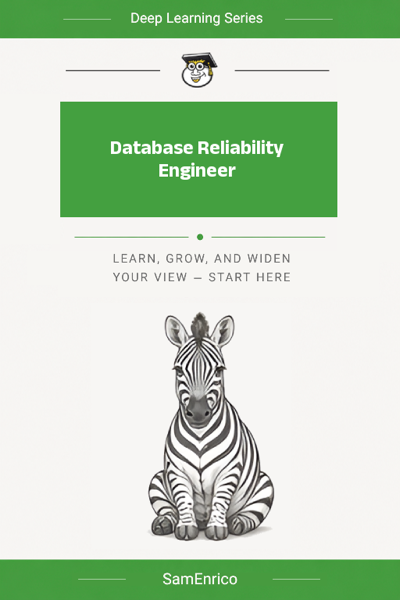
Non-FictionInformativeEducational
Database Reliability Engineer eBook
A Coursebook on Database Reliability Engineer
by Smoot Bernie
A Coursebook on Database Reliability Engineer
Formats
Free sample
Chapter 1: The Toil Trap...--Most database administrators will never admit it aloud, but deep down, they know the truth: their work is drowning in repetition. The same backup validation every Friday. The same replication lag investigation every Tuesday. The same panicked 2:00 AM page because a query that ran perfectly for six months suddenly decided to consume all available memory. Each of these tasks, taken in isolation, seems necessary.
Important, even. But stacked together, they form a wall of manual effort that prevents the very thing every DBA claims to want: time to improve the system.This is the Toil Trap, and it is the single greatest enemy of database reliability.Before we define the Database Reliability Engineer role, before we discuss service level objectives or chaos engineering, we must confront this fundamental reality. The traditional database administrator role, as it has been practiced for decades, is built on a foundation of toil. The industry has confused busyness with effectiveness. A DBA who manually restores a backup at 3:00 AM is celebrated as a hero.
A DBA who automates that restoration so that no human ever needs to be awake at 3:00 AM is often seen as "lazy" or "overengineering." This cultural bias toward reactive heroism is not just inefficient—it is dangerous.This book exists to dismantle that bias.The Genesis of a New Role The term "Database Reliability Engineer" did not emerge from an academic paper or a vendor marketing campaign. It emerged from pain. Specifically, it emerged from the realization that traditional DBAs, no matter how skilled, could not keep pace with modern systems. The rise of microservices, the explosion of data volumes, the shift to cloud infrastructure, and the expectation of continuous deployment created a new set of demands that the old model could not satisfy.Consider the mathematics of the problem. A traditional DBA might manage fifty databases.
That is already a substantial workload. But in a modern engineering organization, a single DBRE might be responsible for five hundred database instances—spread across multiple regions, multiple cloud providers, and multiple database engines. The ratio of human attention to database instances has inverted. The old model assumed that a human could be intimately familiar with every query, every index, every configuration parameter. The new reality assumes that most of those databases will run unattended, with automation handling routine tasks and humans intervening only when the automation cannot resolve an issue.This shift is not optional.
It is not a "best practice" that can be adopted or ignored at leisure. It is a survival mechanism. Organizations that fail to make this transition will find themselves outpaced by competitors who can deploy database changes in minutes rather than weeks, who can recover from failures in seconds rather than hours, and who can scale from one thousand to one million users without hiring twenty new DBAs.Defining the Database Reliability Engineer So what exactly is a DBRE? The shortest definition is this: a DBRE is an engineer who applies software engineering principles to database operations.Let us unpack that definition.A traditional DBA focuses on the database itself. They care about uptime, backup success rates, query performance, and storage utilization.
These are all important metrics. But a DBA typically approaches them as an operator—someone who runs commands, checks dashboards, and follows runbooks. The DBA's tools are often graphical interfaces (php My Admin, pg Admin, SSMS) or a collection of handwritten scripts that have been passed down through generations of administrators.A DBRE, by contrast, approaches the same problems as an engineer. They write code to provision databases, not click through cloud consoles. They store configuration in version control, not in tribal knowledge.
They treat failure as expected and design systems that recover automatically, rather than hoping that failures will not occur. They measure everything in terms of service level objectives, not vague promises of "high availability." And crucially, they consider any task that must be performed manually to be a bug in the system—something to be fixed through automation, not celebrated as diligence.This distinction has profound implications. A DBA who spends two hours tuning a single problematic query might feel productive. A DBRE who spends two hours writing a query analysis tool that automatically identifies and fixes the top ten problematic queries every day has produced far more leverage. The DBA's work is linear: one hour of effort produces one hour of value.
The DBRE's work is exponential: one hour of effort produces value that scales with every database instance under management.The Four Pillars of DBRE Philosophy The DBRE role rests on four foundational pillars. These pillars will appear throughout this book, and they form the backbone of every subsequent chapter. Understanding them now will make the rest of the journey coherent.Pillar One: Abandoning "Pet" Servers In the early days of system administration, a helpful metaphor emerged: servers are like pets, not cattle. You name your pets. You nurture them.
When they get sick, you nurse them back to health. When they die, you mourn them. This metaphor accurately described the relationship between administrators and their carefully tended database servers.The DBRE rejects this metaphor entirely.In the DBRE worldview, database instances are cattle. They have numbers, not names. When one gets sick, you do not nurse it—you replace it.
When one dies, you do not mourn—you spin up another from an automated image. This sounds brutal, and it requires a radical shift in mindset. But it is the only approach that scales. You cannot manually nurture five hundred database instances. You cannot have a personal relationship with each one.
You must build systems that treat instances as fungible, where the failure of any single instance is an unremarkable event handled by automation.Of course, databases present unique challenges to this philosophy. Unlike stateless web servers, databases contain durable state. You cannot simply terminate a database instance and spin up a replacement without also restoring its data. This is the core tension of database reliability engineering, and we will return to it repeatedly throughout this book. But the principle remains: you should design for replacement, not repair.
Even if you cannot always achieve true cattle-like disposability, you should move as far in that direction as your constraints allow.Pillar Two: Risk and Service Level Culture The second pillar is perhaps the most culturally transformative. Traditional database administration operates under an implicit assumption: downtime is unacceptable. This sounds noble, but it is mathematically and economically false. Perfect reliability is impossible, and the pursuit of it is destructive.Consider what it would take to achieve 100% availability for a database. You would need redundant power grids, redundant network paths, redundant storage, redundant compute, and redundant geographic regions.
You would need to handle every possible failure mode, including ones that have never occurred in the history of computing. The cost of this pursuit would be astronomical. And even then, you would fail, because software always has bugs and hardware always wears out.The DBRE approach acknowledges this reality and replaces the impossible goal of perfect uptime with a pragmatic framework: Service Level Objectives (SLOs) and Error Budgets.An SLO is a target for reliability, expressed as a percentage. For example, "99.95%…
This is the end of the free sample. Get the eBook to keep going. Buy now
About this book
Details
- Author
- Smoot Bernie
- Publisher
- SamEnrico
- Language
- English
- Genre
- Non-Fiction, Informative, Educational
- Released
- 2026-05-09
- Pages (approx.)
- 155
- Available as
- eBook, Audiobook

Read better in the ZLOADR app
Your eBooks on your phone or tablet. Sign in with your SamEnrico account and start reading.
More by Smoot Bernie
 Last Mile Delivery Batching And Zoning HandbookSmoot Bernie$11.99
 Grief Counseling Without ExpertsSmoot Bernie$11.99
 Self Esteem During Pregnancy GuideSmoot Bernie$11.99
 Post Pandemic Energy GuideSmoot Bernie$11.99
 Galahad's Lost Grail: The Knight Who Rejected the CupSmoot Bernie$11.99
 The Vanishing Billion: The Untold Story of the Missing IMF GoldSmoot Bernie$11.99
 Kickstarter Pre-Launch WorkbookSmoot Bernie$12.99
 2026-2030 Artificial Intelligence ForecastSmoot Bernie$12.99
 Understanding Herpetic KeratitisSmoot Bernie$17.99
 How to Start a Casings for Sausages Business (Beginners Guide)Smoot Bernie$11.99
You may also like
 Hong Kong Handover 1997Dunn Johnnie$11.99
 Zumba For Postnatal Recovery CourseNeal Christian$11.99
 Zumba for BeginnersLadner Nikia$11.99
 YouTube Comment Mining GuideHumes Pandora$12.99
 Worry Box MeditationCarlin Rudy$11.99
 Workplace Stress MeditationNguyen Lynn$11.99
 Workplace Stress and Sleep RepairHawley Ivory$11.99
 Workplace Perfectionism CureDelaney Jeffry$11.99
 Workplace Injustice Anger GuideWallen Isabelle$11.99
 Work Addiction and Burnout LinkGreenwood Ester$11.99
 Women in Yoga and WellnessBeattie Galina$11.99
 Women in Stand Up ComedyChun Evangeline$11.99