
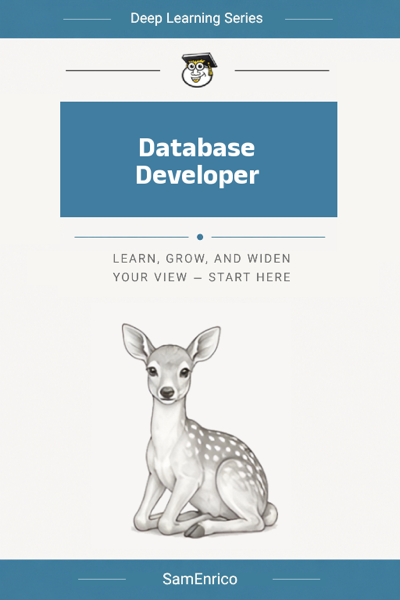
Database Developer eBook
A Coursebook on Database Developer
by Elam Lanita
A Coursebook on Database Developer
Formats
Free sample
Chapter 1: The Million-Dollar Mistake...-- Every database horror story begins the same way: with confidence. A team of smart engineers looks at their growing application, glances at the database, and says, "It's just storage. How hard can it be?" Six months later, they're explaining to their CEO why payouts duplicated, why the weekly report took forty-seven hours, and why migrating from Mongo DB to Postgre SQL will require three months and a small fortune. This book exists because I have been that engineer, I have sat through that CEO conversation, and I have watched too many developers learn the same painful lessons that a handful of foundational principles could have prevented.Welcome to The Composite Key: A Modern Coursebook for the Database Developer. This is not a reference manual you skim when something breaks.
It is a journey from knowing just enough SQL to be dangerous to understanding databases deeply enough that you stop causing emergencies. By the end of these twelve chapters, you will think in terms of data structures, not just queries. You will see a slow report and know exactly where to add an index. You will design schemas that survive your company's growth from a hundred users to a hundred million. And when someone proposes a No SQL database for financial transactions, you will be the person who raises their hand and says, "Let's talk about ACID first."But before we write a single SELECT statement or debate the merits of normalization, we need to answer a more fundamental question: What actually is a database developer?
And why does confusing this role with a DBA or a data engineer cost companies millions of dollars every year?The Three Roles You Must Not Confuse Walk into any tech company with more than fifty engineers, and you will find three distinct roles that outsiders (and many insiders) treat as interchangeable. They are not. Confusing them leads to broken systems, angry users, and career-limiting incidents.The Database Developer – that is you, or the person you are becoming – builds the queries, schemas, stored procedures, and data access layers that applications use. You ask questions like: "What is the fastest way to join these three tables?" "Should this column be indexed?" "Is this transaction isolation level correct for our payment flow?" You write code that talks to the database, and you design the database structures that code relies on. Your output is not backups or server metrics.
Your output is correct, fast, and maintainable data logic.The Database Administrator (DBA) focuses on the health of the database server itself. DBAs handle backups, restores, security, user permissions, high availability configurations, disaster recovery, and performance tuning at the infrastructure level. They ask: "Is the server's memory allocation correct?" "Are the logs rotating properly?" "What is the replication lag on the secondary node?" You do not need to become a DBA to be an excellent database developer, but you must understand enough of what DBAs do to not accidentally break their systems.The Data Engineer builds pipelines that move, transform, and aggregate data for analytics. Data engineers create ETL (Extract, Transform, Load) processes, maintain data warehouses, and ensure that business intelligence tools have clean, timely data. They ask: "How do we reliably extract millions of records from the production database without slowing down transactions?" "How do we join this customer data with marketing campaign data from a different source?" "Why does the weekly sales report take six hours to run?"Here is where the confusion becomes costly.
I have watched startups hire a data engineer expecting them to optimize slow application queries – and watched those data engineers struggle because they rarely tune OLTP (Online Transaction Processing) systems. I have watched companies without a DBA lose their only customer database because no one had configured automated backups. And I have watched database developers get pulled into firefighting server outages when they should have been building features.The clean division of labor looks like this: the database developer owns the schema and query logic. The DBA owns the server and its operations. The data engineer owns the movement and transformation of data for analytics.
They collaborate constantly, but they do not substitute for one another. As a database developer, you will write the queries. You will design the tables. You will decide where indexes go. You will not (except at tiny companies) manage the backup schedule or configure the replication topology.
Understanding these boundaries is your first professional skill.Where Databases Live in the Application Stack To understand your job, you must understand where databases fit in the architecture of modern applications. The answer has changed dramatically over the past fifteen years, and it continues to evolve.In the monolithic era (roughly 1995 to 2010), a typical application had one database server and one application server – or sometimes the database and application ran on the same machine. The database was a shared resource that every part of the application accessed directly. If the orders table needed to join with the customers table, it could, because both tables lived in the same database, often in the same schema. This simplicity made transactions easy: you could update three tables and commit or roll them back together.
But it also created tight coupling. A change to the customers table could break the shipping module, the billing module, and the support dashboard all at once.The microservices era (roughly 2010 to present) flipped this model. Instead of one database shared across the entire application, each microservice owns its own database or schema. The orders service has an orders database. The customers service has a customers database.
These services communicate through APIs, not through direct database access. The orders service cannot query the customers database. It must call the customers service API to retrieve customer data.This change solved some problems and created others. Services can now be deployed independently. A breaking change to the customers table does not crash the orders service because the orders service never queries that table directly.
But distributed transactions become essentially impossible. If an order requires updating inventory, charging a credit card, and deducting a gift card balance across three different databases, you cannot use a database transaction to ensure all three happen or none do. You must implement distributed transaction patterns like the Saga pattern or two-phase commit, both of which are vastly more complex than a simple ACID transaction.Here is what every database developer must internalize: the database is not just storage. It is the source of truth for your data. It enforces constraints that prevent garbage from entering your system.
It provides transactions that keep your data consistent under concurrent access. It offers indexes that make queries fast. When you treat the database as a dumb key-value store, you abandon all these benefits. You get the worst of both worlds: the complexity of a relational database without the guarantees that make relational databases valuable.ACID vs. BASE: The Fundamental Trade-off If you remember only one thing from this chapter – and you will remember more, because I will repeat this until it becomes instinct – remember the distinction between ACID and BASE.
It explains almost every database design decision you will ever make.ACID stands for Atomicity, Consistency, Isolation, and Durability. It describes…
This is the end of the free sample. Get the eBook to keep going. Buy now
About this book
Details
- Author
- Elam Lanita
- Publisher
- SamEnrico
- Language
- English
- Genre
- Non-Fiction, Informative, Educational
- Released
- 2026-05-11
- Pages (approx.)
- 146
- Available as
- eBook, Audiobook

Read better in the ZLOADR app
Your eBooks on your phone or tablet. Sign in with your SamEnrico account and start reading.
More by Elam Lanita
 Hypnotic Metaphor Language GuideElam Lanita$11.99
 Networking for Minorities in TechElam Lanita$11.99
 Decision Fatigue GuideElam Lanita$11.99
 Menstrual Health NonBinary GuideElam Lanita$11.99
 Grade Pressure Relief CourseElam Lanita$11.99
 The Silent Plague: How Ancient India Unlocked the Secrets of GermsElam Lanita$11.99
 Laughing Shadows: The Carnival’s Last ClownElam Lanita$11.99
 Understanding Ectodermal Dysplasia Adrenal CystElam Lanita$17.99
 Indian Data Breach GuideElam Lanita$12.99
 Voiceover Cold Email ScriptsElam Lanita$12.99
 How to Become a Car-dumper OperatorElam Lanita$11.99