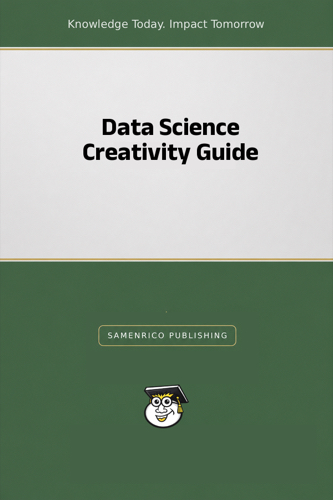
Data Science Creativity Guide eBook
Apply creative thinking to feature engineering, mo
Apply creative thinking to feature engineering, model selection, and insight discovery.
Formats
Free sample
Chapter 1: The Curiosity Mandate--–- The email arrived at 11:47 PM on a Tuesday. Sarah had just finished tuning her XGBoost model for the seventh time, squeezing out an additional 0.3% in AUC. Her manager’s message was brief: “Great model. But we already knew all of this. Can we talk tomorrow?” The next morning, Sarah learned that her “perfect” churn prediction model would not be deployed.
Not because it was wrong—it was technically flawless—but because it told leadership nothing they didn’t already know. The junior data scientist who had spent the week asking “What if we’re measuring churn backward?” got the promotion instead.This book is for the Sarahs of the world who want to become that junior. It is not another guide to algorithms, syntax, or Auto ML. Those books teach you how to execute. This book teaches you how to see.The Creativity Gap: Why Smart People Build Boring Models Every day, thousands of data scientists open their laptops, import pandas and scikit-learn, and run the same sequence: check for missing values, engineer a few standard features, split the data, train a Random Forest or XGBoost model, evaluate with accuracy or RMSE, and call it done.
This is not data science. This is data assembly. And it is failing us.Consider these numbers: 78% of data scientists admit to copying solutions from Git Hub or Kaggle notebooks on a weekly basis. Only 12% of models ever produce a genuinely new business insight that changes strategy or behavior. The rest simply confirm what executives already suspected or automate what junior analysts could have done with a pivot table.
Meanwhile, Auto ML systems are now capable of testing thousands of feature combinations and hyperparameter settings in minutes—tasks that used to take data scientists weeks. The machines have learned to optimize. What they have not learned is to question.This gap between technical execution and genuine discovery is what I call the creativity gap. It is the space between knowing how to build a model and knowing what to build a model of. Closing this gap is the only defensible advantage a human data scientist has left.The creativity gap manifests in four predictable ways:First, the Copy-Paste Epidemic.
A data scientist finds a winning Kaggle notebook for a vaguely similar problem. They adapt the code, change the column names, and run it on their own data. The results are… fine. Not terrible. Not revolutionary.
Just fine. The problem is not the code—it is the thinking. That notebook was optimized for a different question, different constraints, and a different business context. Using it without adaptation is like using a heart surgery manual to fix a broken leg. The tools are right.
The problem is wrong.Second, Metric Myopia. Teams obsess over improving RMSE by 0.01 or accuracy by 0.5%. They celebrate when their model beats the baseline by two percentage points. But when asked “What did you learn about the business?” they go silent. A model that predicts customer churn with 95% accuracy but cannot tell you why customers leave or what to do about it is a party trick, not a business asset.Third, The Baseline Trap.
A data scientist spends three weeks building a complex ensemble model that finally beats a simple linear regression by 1%. The linear regression took thirty minutes to build and was perfectly interpretable. The ensemble takes four seconds per prediction and requires a Ph D to debug. The marginal gain in accuracy was not worth the enormous loss in simplicity, speed, and explainability. But no one stopped to ask that question because everyone was too busy winning the leaderboard.Fourth, Feature Hoarding.
Datasets grow wider every year. More columns, more sources, more possibilities. The default reaction is to keep everything. “We might need it later.” “It can’t hurt to include it.” But features are not free. Each additional column adds noise, multicollinearity, and overfitting risk.
More importantly, each column is a hypothesis about what matters—and most hypotheses are wrong. The creative data scientist knows that deleting a feature is often more valuable than adding one. But deletion takes courage. Hoarding is cowardice disguised as diligence.These four patterns are not failures of technical skill. They are failures of creative nerve.
And they can be unlearned.The Three (And a Half) Modes of Thinking Every Data Scientist Needs Before we can become more creative, we need to understand how we think in the first place. Most data science training emphasizes two modes of thinking. This book adds two more.Deductive Thinking: The Logic Engine Deduction moves from general rules to specific conclusions. If A is true and B is true, then C must be true. This is the thinking of mathematics, code execution, and formal logic.
It is powerful for verifying hypotheses and building reliable systems. But deduction cannot generate new ideas. It can only test them.In data science, deduction appears when you write a function, debug a pipeline, or prove that your model’s predictions sum to the correct total. It is essential but insufficient. A purely deductive data scientist will never discover anything surprising because surprise, by definition, breaks the rules.Inductive Thinking: The Pattern Matcher Induction moves from specific observations to general patterns.
The sun has risen every morning, so it will probably rise tomorrow. This is the thinking of machine learning itself: find patterns in training data and apply them to new data.Induction is powerful for prediction. A random forest does not “know” why customers churn—it simply learns that certain combinations of features are associated with churn. But induction cannot tell you about causation, hidden variables, or alternative explanations. It can only tell you what usually happens, not why it happens or what else could explain it.Abductive Thinking: The Explanation Generator Abduction moves from an observation to the most likely explanation for that observation.
You see wet grass in the morning. Deduction says: if it rained, the grass would be wet. Induction says: whenever the grass is wet in the morning, it has usually rained. Abduction says: what else could have made the grass wet? A sprinkler?
Morning dew? A dog? A burst pipe?Abduction is the engine of scientific discovery and medical diagnosis. A doctor does not just memorize symptoms (induction) or apply known rules (deduction). They generate possible explanations and test them.
“This patient has a fever and a rash. It could be measles, an allergic reaction, or a rare autoimmune condition. Let’s test for each.”In data science, abduction is the ability to look at a surprising correlation and ask: What else could explain this? Your model shows that customers who call support are more likely to churn. Deduction tests the relationship.
Induction confirms it is real. But abduction asks: Maybe calling support is not causing churn. Maybe something else—like a product defect—causes both calling and churning. Or maybe the most loyal customers call support because they care more, and only then leave when the issue is unresolved.Abductive thinking is the single most underrated skill in data science. And almost no one teaches it.Counterfactual Thinking: Abduction’s Sharpest Tool Counterfactual thinking is a specific type of abduction.
It asks: What if the opposite were true? What if customers who call support were less likely to churn? What…
This is the end of the free sample. Get the eBook to keep going. Buy now
About this book
Details
- Author
- Tibbs Shanelle
- Publisher
- SamEnrico
- Language
- English
- Genre
- Non-Fiction, Self-Help, Data Science
- Released
- 2026-06-10
- Pages (approx.)
- 130
- Available as
- eBook, Audiobook

Read better in the ZLOADR app
Your eBooks on your phone or tablet. Sign in with your SamEnrico account and start reading.
More by Tibbs Shanelle
 Opioid Withdrawal Timeline GuideTibbs Shanelle$11.99
 The Process Praise WorkbookTibbs Shanelle$11.99
 White Persuasion TechniqueTibbs Shanelle$11.99
 The Loomis Chaffee InsiderTibbs Shanelle$11.99
 Tower of the Titans: The Cyclopes' Forgotten ForgeTibbs Shanelle$11.99
 Understanding Turner's SyndromeTibbs Shanelle$17.99
 Diversion Program FacilitationTibbs Shanelle$11.99
 VAT and Mergers & AcquisitionsTibbs Shanelle$12.99
 Pre Seed Pitch Deck LondonTibbs Shanelle$12.99
 How to Start a Petroleum Coke Business (Beginners Guide)Tibbs Shanelle$11.99