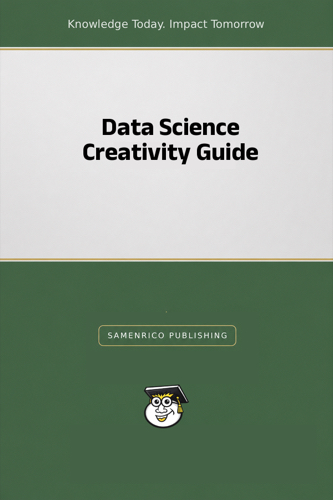
Data Science Creativity Guide
Apply creative thinking to feature engineering, mo
Apply creative thinking to feature engineering, model selection, and insight discovery.
Formats
About this book
Free sample
Chapter 1: The Curiosity Mandate--–- The email arrived at 11:47 PM on a Tuesday. Sarah had just finished tuning her XGBoost model for the seventh time, squeezing out an additional 0.3% in AUC. Her manager’s message was brief: “Great model. But we already knew all of this. Can we talk tomorrow?” The next morning, Sarah learned that her “perfect” churn prediction model would not be deployed.
Not because it was wrong—it was technically flawless—but because it told leadership nothing they didn’t already know. The junior data scientist who had spent the week asking “What if we’re measuring churn backward?” got the promotion instead.This book is for the Sarahs of the world who want to become that junior. It is not another guide to algorithms, syntax, or Auto ML. Those books teach you how to execute. This book teaches you how to see.The Creativity Gap: Why Smart People Build Boring Models Every day, thousands of data scientists open their laptops, import pandas and scikit-learn, and run the same sequence: check for missing values, engineer a few standard features, split the data, train a Random Forest or XGBoost model, evaluate with accuracy or RMSE, and call it done.
This is not data science. This is data assembly. And it is failing us.Consider these numbers: 78% of data scientists admit to copying solutions from Git Hub or Kaggle notebooks on a weekly basis. Only 12% of models ever produce a genuinely new business insight that changes strategy or behavior. The rest simply confirm what executives already suspected or automate what junior analysts could have done with a pivot table.
Meanwhile, Auto ML systems are now capable of testing thousands of feature combinations and hyperparameter settings in minutes—tasks that used to take data scientists weeks. The machines have learned to optimize. What they have not learned is to question.This gap between technical execution and genuine discovery is what I call the creativity gap. It is the space between knowing how to build a model and knowing what to build a model of. Closing this gap is the only defensible advantage…
This is the end of the free sample. Get the eBook to keep going. Buy now
Contents
- Chapter 1
- Chapter 2
- Chapter 3
- Chapter 4
- Chapter 5
- Chapter 6
- Chapter 7
- Chapter 8
- Chapter 9
- Chapter 10
- Chapter 11
- Chapter 12
Details
- Author
- Tibbs Shanelle
- Publisher
- SamEnrico
- Language
- English
- Genre
- Non-Fiction, Self-Help, Data Science
- Released
- 2026-06-10
- Pages (approx.)
- 130
- Available as
- eBook, Audiobook

Read better in the ZLOADR app
Your eBooks on your phone or tablet. Sign in with your SamEnrico account and start reading.
More by Tibbs Shanelle
 Opioid Withdrawal Timeline GuideTibbs Shanelle$11.99
 The Process Praise WorkbookTibbs Shanelle$11.99
 White Persuasion TechniqueTibbs Shanelle$11.99
 The Loomis Chaffee InsiderTibbs Shanelle$11.99
 Tower of the Titans: The Cyclopes' Forgotten ForgeTibbs Shanelle$11.99
 Understanding Turner's SyndromeTibbs Shanelle$17.99
 Diversion Program FacilitationTibbs Shanelle$11.99
 VAT and Mergers & AcquisitionsTibbs Shanelle$12.99
 Pre Seed Pitch Deck LondonTibbs Shanelle$12.99
 How to Start a Petroleum Coke Business (Beginners Guide)Tibbs Shanelle$11.99