
Non-FictionInformativeEducational
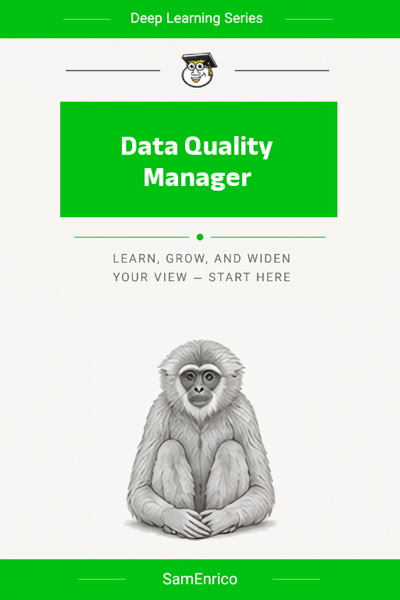
Data Quality Manager eBook
A Coursebook on Data Quality Manager
A Coursebook on Data Quality Manager
Formats
Free sample
Chapter 1: The Million-Dollar Meeting--The CEO looked around the conference room table and asked a simple question: "Why do I have three different numbers for our total revenue?"The Chief Financial Officer pointed at the Enterprise Resource Planning system. The Chief Marketing Officer pointed at the Customer Relationship Management system. The Head of Data pointed at the data warehouse. Each number was different. Each person insisted their number was correct.
And the CEO, who had built a career on making data-driven decisions, realized that none of the numbers could be trusted.That meeting cost the company $1.2 million. Not directly – no one wrote a check. But over the next six weeks, the leadership team held eleven more meetings to reconcile the discrepancy. Engineers spent three hundred hours tracing pipelines. Analysts built six different reconciliation spreadsheets.
A strategic pricing decision was delayed by two months, allowing a competitor to capture market share. By the time someone discovered that a single lookup table had been joined incorrectly for eighteen months, the damage was done.This is not a cautionary tale about bad technology. It is a cautionary tale about bad management of data quality. The technology worked perfectly – every system did exactly what it was told. The problem was that no one had been telling them the same thing.
No one had been measuring whether the data was fit for purpose. And no one had been asking the essential question that this entire book answers: How do we build trust in our data when the consequences of mistrust are measured in millions of dollars?This first chapter is not an introduction. It is a manifesto. It is the foundation upon which every subsequent chapter will build. If you cannot articulate the business case for data quality, you will never have the budget, the authority, or the organizational support to implement the technical solutions in the rest of this book.
You will remain a firefighter – extinguishing one crisis after another – rather than a strategic leader building a reliable, trusted data asset.So let us begin with the hard truths. How much is bad data actually costing you? Why do executives ignore the problem until it is too late? And what do you say to a CFO who asks, "Why should I spend money on something that has not broken yet?"Welcome to the journey. The million-dollar meeting is waiting.
Your job is to make sure it never happens again.The Economics of Error: Why Bad Data Is More Expensive Than You Think In most organizations, the cost of bad data is invisible. Not because it does not exist, but because no one measures it. When a server goes down, the monitoring dashboard turns red, engineers are paged, and the finance team calculates lost revenue per minute. When a data pipeline produces slightly wrong numbers, nothing turns red. No one is paged.
And the lost value accumulates silently.This asymmetry is dangerous. It creates a false sense of security: "We have not had any major data incidents, so our data must be fine." But the absence of detected incidents is not evidence of quality. It is evidence of poor detection.The economics of data quality follow a predictable pattern that economists call the "Iceberg Model." Above the waterline are the visible costs – the ones that appear on budgets and invoices. Below the waterline are the hidden costs – the ones that erode value without ever being tallied.Above the waterline (visible costs):Hours spent manually fixing data errors Engineering time debugging pipelines Support tickets related to incorrect data Third-party data quality tools Below the waterline (hidden costs):Opportunity cost of decisions made on incorrect data Compounding errors across interconnected systems Customer churn due to poor experiences Regulatory penalties from non-compliance Strategic paralysis from lack of trust in data Employee frustration and attrition from fighting data fires Research across industries suggests that hidden costs are typically three to ten times larger than visible costs. A company that spends $500,000 annually on visible data fixes is likely losing $1.5 million to $5 million in hidden costs.
Yet few organizations have ever attempted to calculate this number. They prefer the comfort of ignorance.This chapter will strip away that comfort. By the time you finish reading, you will have a defensible, executive-ready estimate of your organization's total cost of bad data. And you will have the tools to build a business case that no reasonable leader can ignore.Critical Data Elements: The 20% That Drives 80% of Value Before you can calculate the cost of bad data, you must define what "bad" means in your specific context. Not all data is created equal.
The product description on an internal wiki matters less than the product price on a checkout page. The mailing address for a low-value email newsletter matters less than the mailing address for a regulatory filing.This is why this book introduces the concept of Critical Data Elements (CDEs) – a term that will appear in every subsequent chapter and serve as the backbone of your entire data quality program.A Critical Data Element is a specific data field that meets one or more of the following criteria:Financial impact. If this field is incorrect, the organization will lose money directly. Examples: Product price, invoice amount, tax rate, discount percentage.Regulatory impact. If this field is incorrect, the organization faces fines, penalties, or legal liability.
Examples: Customer consent status, financial reporting figures, patient diagnosis codes.Strategic impact. If this field is incorrect, the organization will make wrong strategic decisions. Examples: Customer lifetime value, market share percentage, churn prediction score.Operational impact. If this field is incorrect, core operations will fail. Examples: Inventory count, shipping address, employee payroll ID.Reputational impact.
If this field is incorrect, customer trust will be damaged. Examples: Personalization preferences, order status, loyalty points balance.Notice what is not on this list: data that is merely "nice to have." Data that is used for exploratory analysis. Data that can be wrong without anyone noticing or caring. These data fields are not critical. They will receive less attention, less investment, and less rigorous quality standards.
That is not laziness – it is prioritization.The 80/20 rule for data quality. In most organizations, approximately 20% of data fields drive 80% of business value. The remaining 80% of fields are important but not critical. Your job as a Data Quality Manager is to identify that 20% and focus your limited resources accordingly.How to identify your CDEs. Begin with three questions for each major business process:What decision depends on this data field?
Trace the field from its source to its point of consumption. Every CDE should be linked to at least one specific business decision.What is the financial impact of that decision being wrong? Estimate the magnitude. A range is acceptable – we are prioritizing, not auditing.How frequently is this field used? A rarely used CDE with high impact deserves attention.
A frequently used CDE with low impact may not be critical at all.Document your CDEs in a simple inventory. For each one, record: name, business owner, source system, criticality tier (Critical, High, Medium), estimated financial impact of error, and current quality status (if known).A worked example. A Saa S company identifies "Customer Subscription Status" as a CDE.…
This is the end of the free sample. Get the eBook to keep going. Buy now
About this book
Details
- Author
- Bozeman Rosenda
- Publisher
- SamEnrico
- Language
- English
- Genre
- Non-Fiction, Informative, Educational
- Released
- 2026-06-02
- Pages (approx.)
- 159
- Available as
- eBook, Audiobook

Read better in the ZLOADR app
Your eBooks on your phone or tablet. Sign in with your SamEnrico account and start reading.
More by Bozeman Rosenda
 Reinhard Bonnke Gospel CrusadesBozeman Rosenda$11.99
 The Complicated Grief for ChaplainsBozeman Rosenda$11.99
 Pet Loss And Identity CrisisBozeman Rosenda$11.99
 Beginner Mindfulness for EmetophobiaBozeman Rosenda$11.99
 The Remote Feedback Delivery GuideBozeman Rosenda$11.99
 The Hippocratic Legacy: How Ancient Greece Laid the Foundations of Modern MedicineBozeman Rosenda$11.99
 How to Become a Shearing-machine OperatorBozeman Rosenda$11.99
 Understanding Subacute Cerebellar DegenerationBozeman Rosenda$17.99
 Intangible Asset Valuation Brand IP GuideBozeman Rosenda$12.99
 Fairtrade Coffee ExportBozeman Rosenda$12.99
You may also like
 Hong Kong Handover 1997Dunn Johnnie$11.99
 Zumba For Postnatal Recovery CourseNeal Christian$11.99
 Zumba for BeginnersLadner Nikia$11.99
 YouTube Comment Mining GuideHumes Pandora$12.99
 Worry Box MeditationCarlin Rudy$11.99
 Workplace Stress MeditationNguyen Lynn$11.99
 Workplace Stress and Sleep RepairHawley Ivory$11.99
 Workplace Perfectionism CureDelaney Jeffry$11.99
 Workplace Injustice Anger GuideWallen Isabelle$11.99
 Work Addiction and Burnout LinkGreenwood Ester$11.99
 Women in Yoga and WellnessBeattie Galina$11.99
 Women in Stand Up ComedyChun Evangeline$11.99