
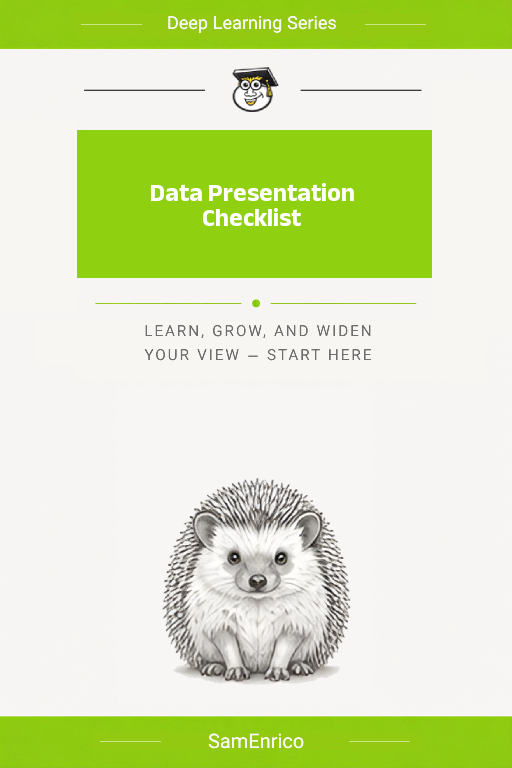
Non-FictionProfessional's Cheat SheetQuality Checklist
Data Presentation Checklist eBook
Verify every data slide against a quality checklis
Verify every data slide against a quality checklist before presenting to stakeholders.
Formats
Free sample
Chapter 1: The One-Sentence Test...--–- The conference room was silent. Fourteen people stared at the screen. On it hung a chart—dense, colorful, and utterly incomprehensible. The presenter, a senior analyst named Sarah, had spent three weeks building this deck. Her data was flawless.
Her analysis was correct. Her conclusion was brilliant. And no one in the room understood a word of it.The VP of Sales finally spoke. "So… what exactly am I looking at?"Sarah froze. She had fifteen slides of beautiful visualizations, but she could not answer that question in one sentence.
The meeting ended twenty minutes early. The project was postponed. Sarah was not promoted that year.This is not a story about bad data. This is a story about missing purpose. Every day, in thousands of conference rooms, smart people present correct analysis that fails because they never asked the most important question before they built their first slide:What is the one thing this slide is supposed to do?This chapter is about that question.
It is about moving from being a data supplier to being a business partner. It is about the single most important habit you will develop as a presenter: the One-Sentence Test. Master this, and you will never again stand in front of a silent room wondering why no one understands your brilliance.The Data Dump Epidemic Let me describe a disease you have seen a hundred times. I call it The Data Dump.A data dump is any slide that presents numbers without a purpose. It says, "Here is the data," instead of, "Here is what the data means." It is the default setting of most corporate presentations.
You know it when you see it:A table with twelve rows and eight columns A pie chart with nine slices A line chart with seventeen lines A slide whose title is "Q3 Performance" (a subject label, not a conclusion)A slide that leaves you thinking, "Okay… and?"Data dumps are not malicious. They are almost always the result of a well-intentioned presenter who confused effort with impact. You worked hard to get the data. You analyzed it thoroughly. You want to show your work.
So you put everything on the slide.But here is the hard truth your stakeholders will never say out loud: Your effort does not matter. Your insight matters.The VP of Sales does not care how many hours you spent cleaning the data. The CFO does not want to see every row of the spreadsheet. The CEO will not read your methodology appendix during the meeting. They want one thing: a clear, specific, actionable takeaway that helps them make a decision.Every slide that does not deliver that takeaway is not just useless.
It is harmful. It wastes time. It dilutes your message. It makes you look like someone who does not understand what matters.The WIIFT Principle: What's In It For Them?Before we get to the One-Sentence Test, we need to understand the only question your audience is actually asking. They will never say it out loud.
But it is the filter through which every word, every number, and every chart passes.The question is: "What's In It For Me?"I call this the WIIFT Principle. It is not selfishness. It is not rudeness. It is simply the reality of business attention. Your stakeholders have limited time, limited cognitive bandwidth, and limited patience.
They are not in the room to admire your data visualization skills. They are in the room to make decisions that affect their bonuses, their careers, and their departments.Every slide you build must answer the WIIFT question. Not indirectly. Not implicitly. Explicitly.Let me give you an example.
Suppose you are presenting sales data to a regional sales director. Two slides:Slide A (Data Dump):Title: "Q3 Sales by Region"Content: A bar chart showing all six regions, with no highlights, no annotations, no conclusion.Slide B (WIIFT):Title: "West region is 22% behind target—we need to intervene before Q4"Content: A bar chart where the West region bar is highlighted in red, all others in gray, with a dotted line showing the target.Which slide answers "What's In It For Me?" The second one. The sales director now knows exactly where to focus attention, what the problem is, and what action is required. The first slide just makes them do the work of figuring that out themselves.The WIIFT Principle is not a nicety. It is a competitive advantage.
The presenter who answers the audience's unspoken question before they ask it will always win against the presenter who merely shows data.The One-Sentence Test: Your New Best Friend Now we arrive at the core of this chapter: The One-Sentence Test.Here is the rule, stated as simply as possible:Before you build a single chart, write one complete sentence that states the single takeaway of that slide. If you cannot write that sentence, do not build the slide.That is it. That is the entire test. It sounds almost too simple. But let me tell you why it is devastatingly effective.When you write the takeaway first, you force yourself to know what you are trying to say before you get distracted by colors, fonts, and chart types.
You cannot hide behind "interesting data." You must commit to a point of view.The takeaway sentence must be:Specific – "Sales are up" is not specific. "Sales are up 8% driven by the West region" is specific.Actionable – The audience should know what to do or think differently after reading it.Single – One sentence, one idea. If you need two sentences, you need two slides.Complete – A full sentence with a subject and a verb. "Sales trends" is not a sentence. "Sales are trending upward" is.Here is the most important nuance, and it is one that most presenters miss: The takeaway you write before building the slide should become the title of the slide.
If the title of your finished slide is different from the takeaway you wrote at the start, you have made a mistake. Either your analysis changed (in which case you should rewrite the takeaway) or you lost focus (in which case you should delete the slide and start over).This creates a powerful feedback loop. The takeaway is not just a pre-design exercise. It is the slide's title, its thesis, and its quality check. If you can honestly say that your slide title is the single most important thing your audience needs to know, you have passed the One-Sentence Test.Why Most Presenters Fail This Test If the One-Sentence Test is so simple, why do so few presenters use it?
I have observed three psychological barriers.Barrier #1: The Fear of Being Wrong When you write a specific takeaway before seeing the final visualization, you are making a claim. What if the data does not support it? What if you are wrong? Many presenters prefer to show "neutral" data and let the audience draw their own conclusions. This is cowardice disguised as objectivity.Stakeholders do not pay you to be neutral.
They pay you to have a point of view that is supported by evidence. If you are wrong, you will…
This is the end of the free sample. Get the eBook to keep going. Buy now
About this book
Details
- Author
- Jarrell Stefan
- Publisher
- SamEnrico
- Language
- English
- Genre
- Non-Fiction, Professional's Cheat Sheet, Quality Checklist
- Released
- 2026-05-30
- Pages (approx.)
- 139
- Available as
- eBook, Audiobook

Read better in the ZLOADR app
Your eBooks on your phone or tablet. Sign in with your SamEnrico account and start reading.
More by Jarrell Stefan
 Cognitive Restructuring Child Voices WorkbookJarrell Stefan$11.99
 Speaker's Social Threat ScaleJarrell Stefan$11.99
 The Weekly Burnout Prevention AuditJarrell Stefan$11.99
 Healing Self Worth After AdoptionJarrell Stefan$11.99
 Anger After Career ChangeJarrell Stefan$11.99
 The Healers of the Olmec: Africa's Forgotten Medical PioneersJarrell Stefan$11.99
 Agriculture Cold Chain GuideJarrell Stefan$12.99
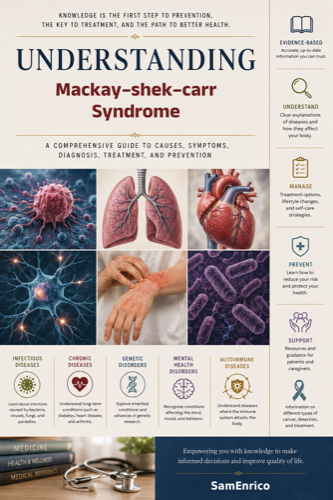 Understanding Mackay–shek–carr SyndromeJarrell Stefan$17.99
 Lab ManagerJarrell Stefan$11.99
 How to Become a Coil ConnectorJarrell Stefan$11.99
You may also like
 Hong Kong Handover 1997Dunn Johnnie$11.99
 Zumba For Postnatal Recovery CourseNeal Christian$11.99
 Zumba for BeginnersLadner Nikia$11.99
 YouTube Comment Mining GuideHumes Pandora$12.99
 Worry Box MeditationCarlin Rudy$11.99
 Workplace Stress MeditationNguyen Lynn$11.99
 Workplace Stress and Sleep RepairHawley Ivory$11.99
 Workplace Perfectionism CureDelaney Jeffry$11.99
 Workplace Injustice Anger GuideWallen Isabelle$11.99
 Work Addiction and Burnout LinkGreenwood Ester$11.99
 Women in Yoga and WellnessBeattie Galina$11.99
 Women in Stand Up ComedyChun Evangeline$11.99