
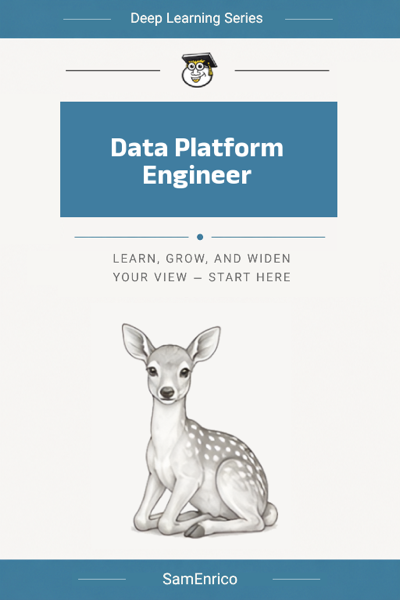
Non-FictionInformativeEducational
Data Platform Engineer eBook
A Coursebook on Data Platform Engineer
A Coursebook on Data Platform Engineer
Formats
Free sample
Chapter 1: The 2 AM Page--I was jolted awake by the sound every data engineer dreads: the Pager Duty alert tone.It was 2:14 AM on a Tuesday. The room was dark. My phone, face-up on the nightstand, glowed with an angry orange light. My wife stirred beside me, murmured something unintelligible, and rolled over. She was used to this.
That was the saddest part.I grabbed the phone and read the alert:"CRITICAL: CFO Dashboard Revenue Mismatch – Actual vs. Expected Delta > $2.4M"My stomach dropped.The Chief Financial Officer of a publicly traded company was looking at a dashboard that said revenue was off by over two million dollars. That dashboard would be the first thing she saw when she walked into the office in five hours. If it was wrong – and I knew it was wrong – there would be hell to pay.I stumbled out of bed, pulled on a hoodie, and walked to my home office. The house was silent except for the hum of my workstation.
I opened Slack. Twenty-three messages. Four direct messages from my manager. Fourteen from the VP of Finance. Five from panicked analysts.The CFO herself had already commented in the #data-alerts channel:"Can someone please explain why our revenue numbers are suddenly showing a 12% drop?
We have an earnings call in 48 hours."I took a deep breath. Then I started digging.The Cost of the Pipeline Builder Mindset Before I tell you how this story ends – and I promise I will – let me explain how I got here.I was a senior data engineer at a fast-growing fintech company. We had grown from 20 to 400 employees in three years. Our data team had grown from two people (me and a contractor) to thirty-five. We had built hundreds of pipelines, dozens of dashboards, and a reputation for being the "data heroes" who could answer any question.But here's what no one tells you about being a data hero: heroes are always putting out fires.My team was spending 60% of our time on operational firefighting.
Broken pipelines. Schema changes that broke downstream models. Access requests that took two weeks. Dashboards that stopped updating because someone renamed a column without telling anyone. We were constantly on call, constantly exhausted, and constantly apologizing.We were pipeline builders, not platform architects.
And there is a world of difference between the two.The Pipeline Builder vs. The Platform Architect Let me define these two roles clearly, because this distinction is the entire foundation of this book.The Pipeline Builder focuses on individual data pipelines. They ask questions like:How do I extract data from this API?How do I transform this table correctly?How do I load this into the warehouse?Why did my DAG fail at 3 AM?Pipeline builders are essential. They get things done. They move data from point A to point B.
They make the dashboard work. But pipeline builders operate in a world of bespoke, one-off solutions. Every new data source becomes a new pipeline built from scratch. Every transformation is written uniquely. Every failure is investigated manually.The Platform Architect, by contrast, asks different questions:How do I build reusable components that 50 teams can leverage?How do I create self-service tools so I'm not the bottleneck?How do I enforce guardrails automatically so bad data never reaches the dashboard?How do I design for failure so that a broken pipeline doesn't wake me up at 2 AM?Platform architects think in terms of leverage.
They build once, and hundreds of pipelines benefit. They automate toil so they can focus on high-value work. They design systems that degrade gracefully, alert proactively, and heal automatically.The difference is not technical skill. It is a mindset shift.The Four Pillars of Platform Thinking After years of firefighting, dozens of post-mortems, and one too many 2 AM pages, I finally understood what was missing. A data platform – a real platform – rests on four pillars.Pillar 1: Reliability Your pipelines need to run on time, every time.
But reliability isn't about building perfect pipelines. It's about designing for failure. Idempotent operations that can be safely retried. Backfill strategies that don't corrupt history. Alerting that tells you what broke and why, not just that something is wrong.A reliable platform doesn't eliminate failures.
It makes failures boring. Routine. Expected. When something breaks, it self-heals or pages a human with all the context they need. No 2 AM mystery hunts.Pillar 2: Scalability Your platform will grow.
More data sources. More users. More queries. More everything. A platform architect designs for growth by building decoupled components that scale independently.
Storage that scales without downtime. Compute that scales up and down based on demand. Orchestration that handles thousands of tasks without falling over.But scalability isn't just about handling more. It's about handling more without more toil. A platform that requires a linear increase in headcount to handle linear growth in data volume has failed.Pillar 3: Governance This is the pillar that everyone hates to talk about.
Governance sounds like bureaucracy. Like approvals. Like being told "no."But real governance is the opposite. It's about making data easy to use safely. A catalog that automatically documents every table.
Quality tests that run before data is served. Access controls that grant permissions based on attributes, not tickets. Column-level lineage that shows you exactly where a number came from.Good governance is invisible. It's the guardrail on the highway – you only notice it when you need it, and you're grateful it's there.Pillar 4: Self-Service This is the most important pillar, and the one that most teams get wrong.Self-service doesn't mean "anyone can do anything." It means that users – analysts, data scientists, product managers – can get what they need without waiting for your team. A self-service platform provides:Pre-built, documented data products (tables, views, APIs) that are ready to use Tooling and templates that let teams build their own pipelines safely Automated access requests that grant permissions based on policies, not manual approvals Clear SLAs and error budgets that set expectations on both sides If your users have to file a ticket and wait three days for you to grant access, you don't have a platform.
You have a bottleneck with a fancy name.The Anatomy of a Disaster Let me return to that 2 AM page. I want to walk you through what I found when I started investigating, because every mistake I made is a mistake you can avoid.I opened our orchestration tool – Airflow, in our case – and looked at the DAG that fed the CFO dashboard.It was a monster. Seventy-three tasks. Thirty-one dependencies. Fourteen cross-DAG references.
It had been built over eighteen months by six different engineers, each adding their own patterns, their own naming conventions, and their own assumptions.The DAG had succeeded on its 2 AM run. No failures. No warnings. So why was the data wrong?I started tracing the data lineage manually. That was mistake number one – manual lineage tracing should never be necessary.
I opened the table that fed the dashboard: finance_revenue_gold. I looked at the last updated timestamp. 2:47 AM. That seemed right.Then I looked at the row count. 187,423 rows.
Yesterday, there were 312,891 rows. A 40% drop.Someone had deleted data. Not a whole table – that would have been…
This is the end of the free sample. Get the eBook to keep going. Buy now
About this book
Details
- Author
- Cheney Willette
- Publisher
- SamEnrico
- Language
- English
- Genre
- Non-Fiction, Informative, Educational
- Released
- 2026-06-02
- Pages (approx.)
- 157
- Available as
- eBook, Audiobook

Read better in the ZLOADR app
Your eBooks on your phone or tablet. Sign in with your SamEnrico account and start reading.
More by Cheney Willette
 Global E Commerce Talent MigrationCheney Willette$11.99
 Blue Zones Sun Exposure GuideCheney Willette$11.99
 Suicide Loss Support GroupCheney Willette$11.99
 Photograph Reparenting MethodCheney Willette$11.99
 The Nencini Appeal Guilty VerdictCheney Willette$11.99
 Shadows of the Iron SerpentCheney Willette$11.99
 One Page Community Building WorkbookCheney Willette$12.99
 Vietnam Manufacturing Opportunity GuideCheney Willette$12.99
 Understanding LeukoplakiaCheney Willette$17.99
 A Beginners Guide to Elfenland (Volume 1)Cheney Willette$11.99
You may also like
 Hong Kong Handover 1997Dunn Johnnie$11.99
 Zumba For Postnatal Recovery CourseNeal Christian$11.99
 Zumba for BeginnersLadner Nikia$11.99
 YouTube Comment Mining GuideHumes Pandora$12.99
 Worry Box MeditationCarlin Rudy$11.99
 Workplace Stress MeditationNguyen Lynn$11.99
 Workplace Stress and Sleep RepairHawley Ivory$11.99
 Workplace Perfectionism CureDelaney Jeffry$11.99
 Workplace Injustice Anger GuideWallen Isabelle$11.99
 Work Addiction and Burnout LinkGreenwood Ester$11.99
 Women in Yoga and WellnessBeattie Galina$11.99
 Women in Stand Up ComedyChun Evangeline$11.99