
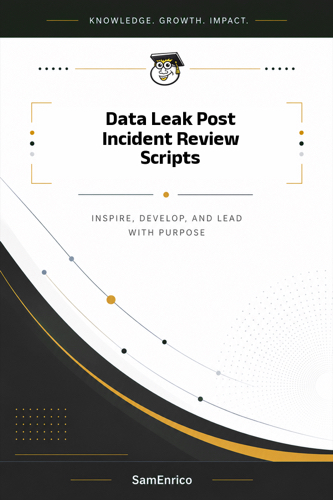
Non-FictionCrisis ManagementPost Incident Review
Data Leak Post Incident Review Scripts eBook
Conduct internal post mortem interviews after brea
by Ahern Allen
Conduct internal post mortem interviews after breach notification using these lessons learned templates.
Formats
Free sample
Chapter 1: The $10 Million Silence--–- Maria stared at the alert on her screen for exactly forty-seven seconds. It was 2:14 AM in Bangalore. The alert was labeled “medium priority” – the same label as the four hundred and twelve other alerts she had triaged that week that turned out to be nothing. She documented it in the ticketing system, as required. She noted that the source IP was unfamiliar, that the volume of outbound data was anomalous, and that the time of day was outside normal business hours.
Then she moved to the next alert. Her shift ended at 8 AM. She went home, slept, and did not think about the alert again until three weeks later, when her manager called her into a conference room with legal counsel present. A journalist had just published a story about a data breach affecting fifty million customer records. The forensic investigation traced the initial access to the exact alert Maria had documented.
She was not fired. But she quit six weeks later, unable to shake the feeling that she had somehow failed. The company spent $10 million on breach response, regulatory fines, and lawsuits. Not a single person ever asked Maria what information she was missing that would have changed her decision. No one ever asked her why the dismissal seemed logical at the time.
The forensic report concluded that the root cause was an unpatched server. That was technically true. It was also a lie.The seduction of technical certainty Every data breach investigation begins with the same seductive promise: if we just look hard enough at the logs, the packets, the binaries, we will find the answer. The exploited vulnerability will have a CVE number. The attacker will leave behind an IP address, a malicious payload, a digital fingerprint.
These are concrete, measurable, objective facts. They feel like truth. They are not.The technical root cause of a breach is almost always trivial to identify after the fact. An unpatched server. A misconfigured S3 bucket.
A phishing email that bypassed the filter. A weak password. These are the “cause” in the same way that gravity is the cause of a plane crash – technically accurate, completely useless for prevention. The question is not what technical condition allowed the breach. The question is why that technical condition existed despite the presence of people whose entire job was to prevent it.
And that question cannot be answered by logs. It can only be answered by interviews.This is the central argument of this book, and it is the foundation upon which every script, every template, and every chapter that follows is built. The technical root cause is a forensic artifact. The behavioral root cause is the only thing that prevents recurrence. Organizations that conduct post-incident reviews that stop at the technical root cause are not learning.
They are performing a ritual of blame avoidance disguised as analysis. They identify a server, patch it, declare victory, and wait for the next breach. The server was never the problem. The server was the symptom. The problem was the human and organizational system that allowed an unpatched server to exist in a production environment for three hundred days despite weekly vulnerability scans.
The problem was the help desk analyst who saw the alert and did not escalate because the playbook was designed for a world that no longer exists. The problem was the manager who hesitated to wake the CISO at 2 AM because the last three false alarms had been met with anger. The problem was the budget process that prioritized a new customer relationship management system over a security control that had no direct revenue impact. The problem was the culture that punished honesty and rewarded silence.This book exists because most organizations will never ask the questions that matter. They will hire forensic accountants.
They will issue press releases. They will fire a sysadmin. And they will be breached again within eighteen months, because they treated the symptom and ignored the disease. The scripts in this book are not about finding someone to blame. They are about finding the truth – the messy, uncomfortable, often banal truth about how ordinary people in ordinary organizations made rational decisions that, in hindsight, look catastrophic.
The goal of a post-incident review is not to reconstruct the past. It is to change the future. And you cannot change what you do not understand.The DRAMA model – a framework for human failure To understand how breaches actually happen, we need a framework that accounts for human behavior across the entire lifecycle of an incident. Technical models like the Cyber Kill Chain or MITRE ATT&CK are excellent for tracking attacker behavior. They are useless for tracking organizational failure.
For that, we turn to the DRAMA model, adapted from Sherri Davidoff’s seminal work Data Breaches: Crisis and Opportunity.DRAMA stands for five phases that every breach moves through, often recursively, sometimes unpredictably. Develop is the phase where vulnerabilities and weaknesses accumulate. An unpatched server sits in a corner of the network. A developer hardcodes credentials into a configuration file. A vendor changes their security posture without notifying anyone.
These are the seeds of the breach, planted weeks, months, or years before any attacker arrives. Realize is the moment when someone – an analyst, a customer, an attacker – recognizes that something is wrong. An alert fires. A login fails. Data appears where it should not be.
This is the phase where most post-mortems begin, but it is rarely where the breach began. Act is the response. The Incident Commander is called. The playbook is opened. Decisions are made under time pressure, incomplete information, and extreme stress.
Maintain is the phase that almost every organization skips entirely. It is the long, unglamorous work of ensuring that fixes actually stick – that the server stays patched, that the policy is actually followed, that the training is not forgotten. Adapt is the final phase, where the organization learns from the incident and changes its behavior, culture, and systems to prevent recurrence. Most organizations never reach Adapt. They cycle between Act and Maintain, patching and forgetting, until the next breach forces them to Act again.This book is organized around the DRAMA model.
Chapters 1 through 4 cover the Develop phase – understanding how vulnerabilities accumulate and why no one notices. Chapters 5 through 8 cover the Realize phase – the scripts for interviewing everyone from the help desk to the C-suite about how detection failed. Chapter 9 covers the Act phase – the retrospective that analyzes the response itself. Chapters 10 and 11 cover the Maintain phase – why fixes fail and how to keep them alive. And Chapter 12 covers the Adapt phase – the thirty-day follow-up that separates genuine learning from performative remediation.
Each chapter includes the scripts, templates, and question banks you need to conduct interviews that uncover the behavioral root cause. But before we get to the scripts, we need to understand why the technical root cause is such an alluring lie.The prodromal phase – what everyone saw and no one said In infectious disease epidemiology, the prodromal phase is the period between the first appearance of symptoms and the full development of the disease. It is the moment when something feels wrong but is not yet diagnosable. A…
This is the end of the free sample. Get the eBook to keep going. Buy now
About this book
Details
- Author
- Ahern Allen
- Publisher
- SamEnrico
- Language
- English
- Genre
- Non-Fiction, Crisis Management, Post Incident Review
- Released
- 2026-06-06
- Pages (approx.)
- 151
- Available as
- eBook, Audiobook

Read better in the ZLOADR app
Your eBooks on your phone or tablet. Sign in with your SamEnrico account and start reading.
More by Ahern Allen
 The CEO Inbox Management PlanAhern Allen$11.99
 Pinterest VA For Interior DesignersAhern Allen$11.99
 Mindfulness for Tennis ElbowAhern Allen$11.99
 Breast Cancer Survivorship PlanAhern Allen$11.99
 Soulful Rebellion: The Rise of Motown’s Hidden Protest SongsAhern Allen$11.99
 The Arctic Highway: How Geese Defied the Cold WarAhern Allen$11.99
 Understanding Coloboma of Choroid and RetinaAhern Allen$17.99
 Customer Experience SpecialistAhern Allen$11.99
 Technology Refresh BlockingAhern Allen$12.99
 Founder Vesting Schedule GuideAhern Allen$12.99
 How to Start a Brandy Business (Beginners Guide)Ahern Allen$11.99
You may also like
 Hong Kong Handover 1997Dunn Johnnie$11.99
 Zumba For Postnatal Recovery CourseNeal Christian$11.99
 Zumba for BeginnersLadner Nikia$11.99
 YouTube Comment Mining GuideHumes Pandora$12.99
 Worry Box MeditationCarlin Rudy$11.99
 Workplace Stress MeditationNguyen Lynn$11.99
 Workplace Stress and Sleep RepairHawley Ivory$11.99
 Workplace Perfectionism CureDelaney Jeffry$11.99
 Workplace Injustice Anger GuideWallen Isabelle$11.99
 Work Addiction and Burnout LinkGreenwood Ester$11.99
 Women in Yoga and WellnessBeattie Galina$11.99
 Women in Stand Up ComedyChun Evangeline$11.99