
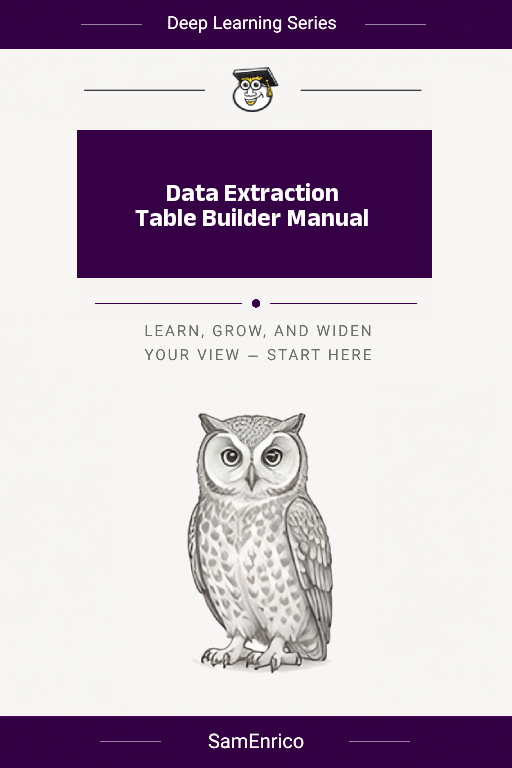
Non-FictionAI OperatorIntelligence GatheringData Guide
Data Extraction Table Builder Manual eBook
Convert unstructured research text into structured
by Blais Belva
Convert unstructured research text into structured tables of findings, statistics, and comparisons using AI. Includes column detection, value extraction, and citation linking prompts.
Formats
Free sample
Chapter 1: The Spreadsheet Cemetery--–- Every researcher knows the graveyard. It lives on shared drives, in forgotten project folders, under filenames like final_FINAL_literature_review_v7.xlsx. The columns are there—Study ID, Intervention, Sample Size, Effect Size, p-value—but half the cells are empty. The other half contain contradictions: “50 mg” in one row, “fifty milligrams” in another, “50mg” in a third. The citations are missing.
Nobody remembers which sentence justified which number. The person who built the table left for another job eighteen months ago.This is the Spreadsheet Cemetery. And if you have ever conducted a systematic literature review, synthesized clinical trial data, coded interview transcripts, or built a market intelligence report from scattered PDFs, you have visited this cemetery. You may have built a grave yourself.The problem is not laziness or incompetence. The problem is that research text resists tabulation.
Academic papers, clinical notes, interview transcripts, business reports, and social media data are written for human readers, not for databases. They use paraphrasing, context-dependent meaning, domain jargon, and narrative flow. A human can read “the intervention group showed significant improvement (p < 0.05) compared to controls” and understand exactly what belongs in the Effect Size column, the p-value column, and the Comparison column. A regular expression cannot. A rule-based system cannot.
And until very recently, even the most sophisticated natural language processing tools struggled.But something has changed. Large language models (LLMs) have transformed what is possible. For the first time, we have AI systems that can read unstructured research text the way a human does—understanding context, resolving paraphrases, handling implicit information—and output structured, typed, citable data at scale. A task that once required two hundred hours of manual coding can now be completed in two hours of pipeline design and two hours of model execution. The catch is that you cannot simply upload a folder of PDFs and say “extract everything.” That fails spectacularly.
You need a methodology.This book is that methodology. It is a practitioner’s manual for converting unstructured research text into structured tables of findings, statistics, and comparisons using AI. It assumes no machine learning background. It assumes you know how to write basic Python and read JSON. And it assumes you have a problem that looks something like this: you have fifty clinical trial reports, and you need a table of every reported adverse event with its incidence rate, severity, and attribution statement.
Or you have three hundred interview transcripts, and you need a table of every mention of “satisfaction” with a sentiment score and supporting quote. Or you have two thousand abstracts from a systematic review, and you need a table of PICO elements (Population, Intervention, Comparison, Outcome) with citation links back to the source.These are extraction problems. And they are solvable.The Three Pillars of Modern Extraction Before we write a single line of code or a single prompt, we need to understand the architecture that makes AI-driven extraction work. Every successful extraction project rests on three pillars. These pillars structure this entire book.The first pillar is schema design.
You cannot extract what you cannot name. Before you ask an AI to find anything, you must define exactly what you are looking for. A schema is a formal description of your target table: the column names, the data types (string, number, boolean, array, object, enum), the descriptions of what belongs in each column, and the constraints that valid data must satisfy. Chapter 3 provides a complete methodology for schema design, including field type selection trade-offs, writing effective descriptions that models can follow, handling nested structures (like interventions with multiple outcomes), and avoiding common pitfalls that silently corrupt your data. A well-designed schema is the difference between a table you can analyze and a table you must debug for three weeks.The second pillar is prompt engineering.
Even with a perfect schema, you need to tell the model how to extract. Prompts are the instructions you give to the LLM. They include system prompts (role definition, output format, quality constraints), user prompts (context, entity highlighting, formatting instructions), and few-shot examples (demonstrations of correct extraction). Chapter 5 provides a complete prompt engineering toolkit, including a core prompt template that works across most extraction tasks, temperature guidelines for deterministic vs. creative outputs, negative prompting to reduce false positives, and explicit handling of missing data using JSON null (never omit a field).
A well-engineered prompt is the difference between accurate extraction and hallucinations.The third pillar is validation. Every extraction system makes mistakes. The question is not whether errors exist but whether you know where they are and how to fix them. Validation is the systematic process of measuring extraction quality (using precision, recall, and F1 scores), identifying error patterns, refining your schemas and prompts, and re-extracting until performance meets your requirements. Chapter 10 provides a complete quality assurance protocol, including gold standard development (200–500 human-annotated examples), automated validation rules (type checking, cross-field consistency, range checks), confidence calibration (thresholds for auto-accept, flag-for-review, and reject), and human-in-the-loop workflows that prioritize the most uncertain extractions.
A validated extraction pipeline is the difference between publishable results and a spreadsheet cemetery.These three pillars are not sequential. You will iterate. You will design a schema, write prompts, run extraction on a small sample, validate the results, discover that your schema missed a critical field or your prompt misinterpreted your instructions, refine both, and extract again. Chapter 10 shows you exactly how to drive F1 scores from initial values of 0.40–0.75 to final values above 0.85 through structured iteration. This is not guesswork.
This is engineering.What This Book Is and Is Not This book is a practical manual. It contains executable code examples, ready-to-use prompt templates, YAML pipeline configurations, JSON schemas, and validation protocols. You can adapt these directly to your own projects. The appendices alone provide twenty prompt templates, schema patterns for common domains (clinical trials, social science surveys, product specifications, economic evaluations), a validation set development protocol, an API cost calculator spreadsheet, and a tool comparison matrix.This book is not a theoretical introduction to natural language processing. It does not explain the architecture of transformers, the mathematics of attention mechanisms, or the history of language models.
Those topics are fascinating and important, but they are not necessary for building extraction pipelines. You do not need to understand how a combustion engine works to drive a car. You do not need to understand how an LLM works to use one effectively.This book is also not a comprehensive survey of every extraction tool on the market. It references three representative implementations—Sculpt, GABRIEL, and Lang Extract—as examples of working systems. The principles in this book apply to any LLM (GPT-4o, Claude, Gemini, Llama, Mistral) and any extraction framework.
When you see a YAML example from Sculpt, you can translate it to your preferred tool. When you see a prompt template from Claude documentation, you can adapt it to any model. The book is tool-agnostic by design.The Audience for This Book This book is written for four groups of people.First, researchers conducting systematic literature reviews, meta-analyses, or evidence syntheses. You have hundreds or thousands of papers. You need tables of findings, statistics, and comparisons.
You currently do this manually, spending weeks or months. This book will teach you how to automate 80% of that…
This is the end of the free sample. Get the eBook to keep going. Buy now
About this book
Details
- Author
- Blais Belva
- Publisher
- SamEnrico
- Language
- English
- Genre
- Non-Fiction, AI Operator, Intelligence Gathering, Data Guide
- Released
- 2026-05-29
- Pages (approx.)
- 124
- Available as
- eBook, Audiobook

Read better in the ZLOADR app
Your eBooks on your phone or tablet. Sign in with your SamEnrico account and start reading.
More by Blais Belva
 Academic Professor Tenure Pressure CourseBlais Belva$11.99
 Mushroom Polysaccharides Brain HealthBlais Belva$11.99
 Resentment After Miscarriage GuideBlais Belva$11.99
 Scientology Exposé Survivor StoryBlais Belva$11.99
 Gambling Addiction and Bankruptcy GuideBlais Belva$11.99
 The Frozen Symphony: How a 1912 Shipwreck Reshaped Modern MusicBlais Belva$11.99
 A Beginners Guide to Diplomacy (Volume 1)Blais Belva$11.99
 Ocean Freight Rate OutlookBlais Belva$12.99
 Understanding Larsen Syndrome, Recessive TypeBlais Belva$17.99
 Business Development OperationsBlais Belva$11.99
You may also like
 Hong Kong Handover 1997Dunn Johnnie$11.99
 Zumba For Postnatal Recovery CourseNeal Christian$11.99
 Zumba for BeginnersLadner Nikia$11.99
 YouTube Comment Mining GuideHumes Pandora$12.99
 Worry Box MeditationCarlin Rudy$11.99
 Workplace Stress MeditationNguyen Lynn$11.99
 Workplace Stress and Sleep RepairHawley Ivory$11.99
 Workplace Perfectionism CureDelaney Jeffry$11.99
 Workplace Injustice Anger GuideWallen Isabelle$11.99
 Work Addiction and Burnout LinkGreenwood Ester$11.99
 Women in Yoga and WellnessBeattie Galina$11.99
 Women in Stand Up ComedyChun Evangeline$11.99