
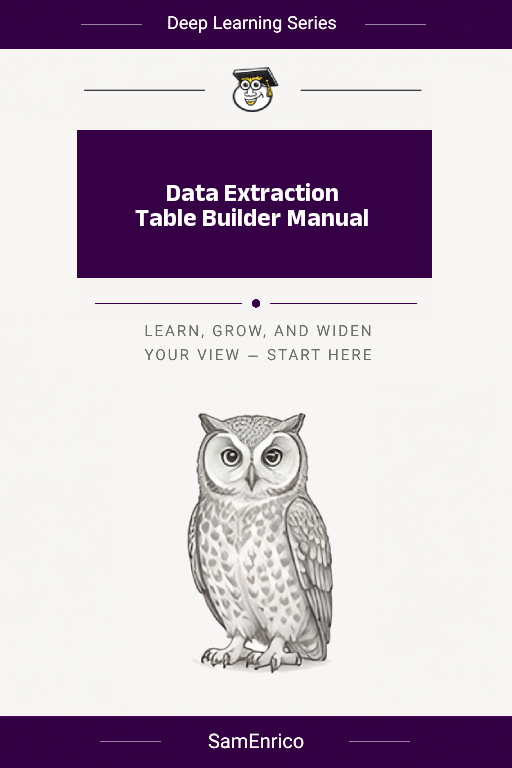
Non-FictionAI OperatorIntelligence GatheringData Guide
Data Extraction Table Builder Manual Audiobook
Convert unstructured research text into structured
by Blais Belva
Convert unstructured research text into structured tables of findings, statistics, and comparisons using AI. Includes column detection, value extraction, and citation linking prompts.
Formats
Free sample
Chapter 1: The Spreadsheet Cemetery--–- Every researcher knows the graveyard. It lives on shared drives, in forgotten project folders, under filenames like final_FINAL_literature_review_v7.xlsx. The columns are there—Study ID, Intervention, Sample Size, Effect Size, p-value—but half the cells are empty. The other half contain contradictions: “50 mg” in one row, “fifty milligrams” in another, “50mg” in a third. The citations are missing.
Nobody remembers which sentence justified which number. The person who built the table left for another job eighteen months ago.This is the Spreadsheet Cemetery. And if you have ever conducted a systematic literature review, synthesized clinical trial data, coded interview transcripts, or built a market intelligence report from scattered PDFs, you have visited this cemetery. You may have built a grave yourself.The problem is not laziness or incompetence. The problem is that research text resists tabulation.
Academic papers, clinical notes, interview transcripts, business reports, and social media data are written for human readers, not for databases. They use paraphrasing, context-dependent meaning, domain jargon, and narrative flow. A human can read “the intervention group showed significant improvement (p < 0.05) compared to controls” and understand exactly what belongs in the Effect Size column, the p-value column, and the Comparison column. A regular expression cannot. A rule-based system cannot.
And until very recently, even the most sophisticated natural language processing tools struggled.But something has changed. Large language models (LLMs) have transformed what is possible. For the first time, we have AI systems that can read unstructured research text the way a human does—understanding context, resolving paraphrases, handling implicit information—and output structured, typed, citable data at scale. A task that once required two hundred hours of manual coding can now be completed in two hours of pipeline design and two hours of model execution. The catch is that you cannot simply upload a folder of PDFs and say “extract everything.” That fails spectacularly.
You need a methodology.This book is that methodology. It is a practitioner’s manual for converting unstructured research text into structured tables of findings, statistics, and comparisons using AI. It assumes no machine learning background. It assumes you know how to write basic Python and read JSON. And it assumes you have a problem that looks something like this: you have fifty clinical trial reports, and you need a table of every reported adverse event with its incidence rate, severity, and…
This is the end of the free sample. Get the Audiobook to keep going. Buy now
About this book
Details
- Author
- Blais Belva
- Publisher
- SamEnrico
- Language
- English
- Genre
- Non-Fiction, AI Operator, Intelligence Gathering, Data Guide
- Released
- 2026-05-29
- Pages (approx.)
- 124
- Available as
- eBook, Audiobook

Listen in the VoxFlicks app
Audiobooks and audio dramas wherever you go. Sign in with your SamEnrico account and press play.
More by Blais Belva
 Academic Professor Tenure Pressure CourseBlais Belva$11.99
 Mushroom Polysaccharides Brain HealthBlais Belva$11.99
 Resentment After Miscarriage GuideBlais Belva$11.99
 Scientology Exposé Survivor StoryBlais Belva$11.99
 Gambling Addiction and Bankruptcy GuideBlais Belva$11.99
 The Frozen Symphony: How a 1912 Shipwreck Reshaped Modern MusicBlais Belva$11.99
 A Beginners Guide to Diplomacy (Volume 1)Blais Belva$11.99
 Ocean Freight Rate OutlookBlais Belva$12.99
 Understanding Larsen Syndrome, Recessive TypeBlais Belva$17.99
 Business Development OperationsBlais Belva$11.99
You may also like
 Hong Kong Handover 1997Dunn Johnnie$11.99
 Zumba For Postnatal Recovery CourseNeal Christian$11.99
 Zumba for BeginnersLadner Nikia$11.99
 YouTube Comment Mining GuideHumes Pandora$12.99
 Worry Box MeditationCarlin Rudy$11.99
 Workplace Stress MeditationNguyen Lynn$11.99
 Workplace Stress and Sleep RepairHawley Ivory$11.99
 Workplace Perfectionism CureDelaney Jeffry$11.99
 Workplace Injustice Anger GuideWallen Isabelle$11.99
 Work Addiction and Burnout LinkGreenwood Ester$11.99
 Women in Yoga and WellnessBeattie Galina$11.99
 Women in Stand Up ComedyChun Evangeline$11.99