
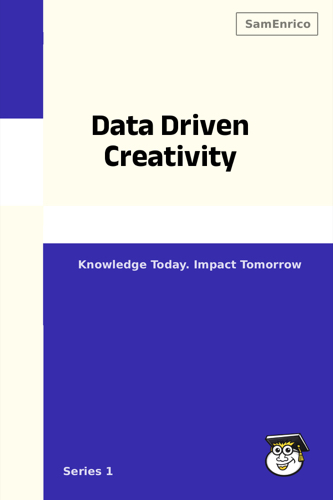
Data Driven Creativity eBook
Use analytics to identify opportunities for innova
by Bundy Laine
Use analytics to identify opportunities for innovation.
Formats
Free sample
Chapter 1: The 80% Graveyard–- Every year, across every industry, over 1.5 million new products launch into the world. Within twelve months, more than 1.2 million of them will fail. Not fade quietly—fail catastrophically. They will be discontinued, written off, or quietly buried in the back pages of corporate annual reports. And here is the most painful part: the people who built those products were not stupid, lazy, or untalented.
They were, by every conventional measure, creative professionals who believed they were solving real problems for real customers.This chapter is about why they were wrong—and why you probably are too.The Funeral of a Good Idea Let me tell you about a product called the Juicero. If you do not remember it, consider yourself lucky. If you do, you probably flinched.In 2016, a company called Juicero raised $120 million from some of the smartest venture capitalists in Silicon Valley. Their product was a beautiful, Wi-Fi-connected, $700 juicer. You would place a proprietary packet of pre-cut fruits and vegetables into the machine, press a button, and the machine would apply four tons of force to extract fresh juice.
The marketing materials called it "the future of nutrition." The design was so elegant that it won awards before it even shipped.There was only one problem. A few months after launch, Bloomberg reporters discovered that you could squeeze the same juice packets—by hand—with more force and in less time than the $700 machine. The Juicero was not just overpriced. It was completely unnecessary. The company folded.
Investors lost everything. And at least a dozen highly creative people spent years of their lives building a product that solved a problem nobody had.Here is what haunts me about the Juicero story. Every single person involved was smart. Every single person believed they were doing something innovative. And every single person ignored a question that would have saved them $120 million: What does the data actually say about what customers want?Not what customers say they want.
Not what customers might want in a perfect world. But what customers actually do, actually struggle with, and actually pay for.The Juicero is not an outlier. It is the rule.The Statistic That Should Terrify You Let me give you the number that drives everything in this book.Eighty-four percent. That is the failure rate of new products within their first year of launch, according to Harvard Business School professor Clayton Christensen's research on innovation. Other studies put the number between 75 and 90 percent, depending on the industry.
But the consensus is brutal: roughly four out of five new ideas that make it to market will die there.Now consider what that number actually means.It means that for every ten products your team launches this year, eight will fail. It means that for every million dollars you spend on innovation, eight hundred thousand dollars will buy nothing but tuition at the School of Hard Knocks. It means that for every hour of creative energy you pour into a new feature, a new campaign, or a new business line, eighty percent of that time will be, in retrospect, wasted.And here is the part that most leaders refuse to accept: this failure rate has not improved in fifty years.Despite all our advances in design thinking, agile methodologies, customer development, and big data analytics, the failure rate of new products is roughly the same today as it was when your grandfather was in business school. We have more tools than ever. More data than ever.
More creative talent than ever. And we are still failing at the same rate.Why?Because we are using the wrong model of creativity.The Myth of the Lone Genius Close your eyes and imagine a creative person. What do you see?If you are like most people, you see someone alone. Perhaps they are sitting in a coffee shop, staring out a window, waiting for a lightning bolt of inspiration to strike. Perhaps they are in a garage, tinkering with prototypes by the light of a single bulb.
Perhaps they are a genius like Steve Jobs, pacing an empty stage before unveiling a product that changes the world.This image—the Lone Genius—is the most seductive and destructive myth in business.The myth says that creativity is a mysterious gift, not a learnable skill. It says that innovation comes from sudden "eureka" moments, not systematic discovery. It says that the best ideas emerge from the gut, not from the data. And it says that you cannot teach creativity—you can only hire creative people and hope for the best.Every single part of that myth is wrong.Let me prove it to you with a story you probably know.In the early 2000s, Netflix was a DVD-by-mail company. Blockbuster was the giant.
Every business analyst assumed Blockbuster would crush Netflix because Blockbuster had more stores, more inventory, and more customers. But Blockbuster had a problem: they believed in the Lone Genius model of innovation. They hired brilliant executives, gave them big budgets, and waited for lightning to strike.Netflix did something different. They looked at the data. They noticed that customers hated late fees—not because they were expensive, but because they created a feeling of anxiety and guilt.
They noticed that customers wanted more control over their viewing schedules. They noticed that streaming technology was getting faster and cheaper every year.And then they did something that looked insane at the time: they decided to become a streaming company before streaming was profitable.Blockbuster's "creative geniuses" laughed at them. The data, they said, showed that people still wanted physical DVDs. And they were right about the data—in the short term. But Netflix was using a different kind of data.
They were not asking, "What do customers want today?" They were asking, "What will customers want tomorrow, based on the patterns we see today?"By the time Blockbuster realized they were wrong, Netflix had already built the future. Blockbuster filed for bankruptcy in 2010. Netflix is now worth over $200 billion.The difference between Netflix and Blockbuster was not talent, budget, or intelligence. It was a model of creativity.Netflix believed that creativity could be systematic. Blockbuster believed it was mystical.
One of them was right.The Insight-Driven Problem Solving Loop So what is the alternative to waiting for lightning?This book is built on a single framework: the Insight-Driven Problem Solving Loop. It has four stages, and you will use them every time you try to create something new.Stage 1: Observe The first stage is about gathering behavioral signals. Not opinions. Not surveys. Not focus groups.
What people do. Every click, every call, every return, every abandoned cart, every frustrated search query. These are not just data points. They are the fossilized footprints of unmet needs.Observation is not passive. It is active and intentional.
You are not waiting for inspiration to find you. You are hunting for patterns. You are looking for friction, frustration, and failure—because those are the places where innovation hides.Stage 2: Analyze Once you have observed behavioral signals, you need to find the patterns within them. This is where most teams go wrong. They look at a single…
This is the end of the free sample. Get the eBook to keep going. Buy now
About this book
Details
- Author
- Bundy Laine
- Publisher
- SamEnrico
- Language
- English
- Genre
- Non-Fiction, Self-Help, Analytics
- Released
- 2026-06-10
- Pages (approx.)
- 140
- Available as
- eBook, Audiobook

Read better in the ZLOADR app
Your eBooks on your phone or tablet. Sign in with your SamEnrico account and start reading.
More by Bundy Laine
 HIIT for Military FitnessBundy Laine$11.99
 Heist Blueprint TheftBundy Laine$11.99
 Closed Captioning and AccessibilityBundy Laine$11.99
 Smoking Cessation for Surgery PrepBundy Laine$11.99
 The Double Shadow: The Twin Lives of Cleopatra SeleneBundy Laine$11.99
 Echoes of the Infinite: The Untold Story of the First Deepfake ScandalBundy Laine$11.99
 Logistics B2B Middle EastBundy Laine$12.99
 Examplify Software Mastery GuideBundy Laine$12.99
 Unarmed Security OfficerBundy Laine$11.99
 Understanding Cardiogenital SyndromeBundy Laine$17.99
 How to Start a Fancy Goods (wholesale) Business (Beginners Guide)Bundy Laine$11.99
You may also like
 Hong Kong Handover 1997Dunn Johnnie$11.99
 Zumba For Postnatal Recovery CourseNeal Christian$11.99
 Zumba for BeginnersLadner Nikia$11.99
 YouTube Comment Mining GuideHumes Pandora$12.99
 Worry Box MeditationCarlin Rudy$11.99
 Workplace Stress MeditationNguyen Lynn$11.99
 Workplace Stress and Sleep RepairHawley Ivory$11.99
 Workplace Perfectionism CureDelaney Jeffry$11.99
 Workplace Injustice Anger GuideWallen Isabelle$11.99
 Work Addiction and Burnout LinkGreenwood Ester$11.99
 Women in Yoga and WellnessBeattie Galina$11.99
 Women in Stand Up ComedyChun Evangeline$11.99