
Non-FictionBusiness BriefEuropean Markets
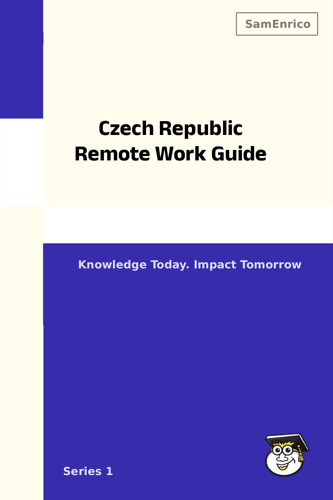
Czech Republic Remote Work Guide eBook
Analyzes Prague's cost to quality ratio for the zi
Analyzes Prague's cost to quality ratio for the zivno trade license.
Formats
Free sample
Chapter 1: The €800 Question--–- The email arrived on a Tuesday, three weeks after Martin had submitted his visa application. His Czech girlfriend, Petra, translated it over breakfast. "They want to know why your freelance income is lower than the average Prague rent," she said, sliding her phone across the table. Martin stared at the numbers. He had claimed €1,200 per month—enough to live on in Budapest, where he had spent the previous year.
In Prague, after health insurance, social payments, and a modest apartment in Žižkov, he would have exactly €147 left each month for food, transport, and everything else. The visa officer had done the math Martin had refused to do.That email is the reason this book exists. Martin eventually got his visa after Petra co-signed a financial guarantee, but six months later he was back in Budapest, defeated. "I wasn't living," he told me over a beer last winter. "I was surviving in one of the most beautiful cities in Europe.
That's not why I left America."Martin's story is not unique. It is not even unusual. It is the quiet catastrophe of the remote work dream—the gap between the Instagram reel and the spreadsheet. And it is happening right now, in 2026, to thousands of digital nomads who arrived in Prague believing the myth that Central Europe is a bargain basement for Western salaries.This chapter exists to shatter that myth. Not cruelly, but precisely.
Because the truth is better than the myth—if you understand it. Prague is not cheap. It may never be cheap again. But for the right person, with the right income and the right expectations, it offers a quality of life that rivals cities twice its price. The question is not "Is Prague affordable?" The question is "Are you the right person?"Let us begin with a simple exercise.
Write down your monthly after-tax income in euros. Not your gross salary. Not what you hope to earn after you "build your client base." Your actual, reliable, month-after-month income. Got it? Good.
Now subtract €1,200. That is the minimum cost of a private one-bedroom apartment in Prague's city center in 2026. Not a luxury apartment. Not Vinohrady with a balcony. A basic, functional, likely pre-renovation unit in Žižkov, Holešovice, or Smíchov.
If the number remaining is less than €500, you are Martin. You are not ready for Prague.If the number is between €500 and €800, you can live in Prague, but you will live in a shared apartment or on the outskirts. You will cook at home. You will say no to most social invitations. You will watch your friends go to concerts while you stay home.
This is not failure—it is a choice. But it is a choice you should make with open eyes.If the number is above €800, you are in the conversation. Prague becomes a question of priorities rather than survival. And that conversation—between your income, your lifestyle expectations, and the reality of 2026 Czechia—is what the rest of this book will guide you through.But first, we need to understand how we arrived here. Because the Prague of 2026 is not the Prague of 2019.
And pretending otherwise is the fastest path to financial disappointment.The Myth and Its Funeral For nearly two decades, Prague occupied a magical position in the European imagination. It had the architecture of Vienna, the beer culture of Munich, and the prices of Budapest. Western Europeans came for weekend trips and left wondering why they paid four times as much at home. Americans arrived with dollars and felt like royalty. Remote workers discovered arbitrage heaven—earn in dollars, spend in korunas, and live like a king.That era ended sometime between 2021 and 2023.
The precise date is debatable. The fact of its death is not.Consider the numbers. In 2019, a one-bedroom apartment in Prague's city center rented for approximately €650 per month. In 2026, that same apartment rents for €1,100 to €1,300. That is a 70 to 100 percent increase in seven years.
Wages for Czech workers have increased too, but not by 100 percent. The average gross monthly wage in Prague is approximately CZK 52,000 (about €2,100). After taxes and social insurance, the average Pražan takes home approximately €1,600. That means the average local worker spends 70 to 80 percent of their income on rent alone if they live alone in the center. They do not.
They live with partners, roommates, or in the suburbs. The math does not work otherwise.Now layer in the remote worker. You are not earning Czech wages. You are earning German, British, or American wages. In theory, this is your advantage.
In practice, the rental market has absorbed your advantage. Landlords know that foreigners earn more. They price accordingly. The same apartment listed for CZK 25,000 (€1,000) on a Czech real estate site will magically cost CZK 32,000 (€1,300) when you inquire in English. This is not illegal.
It is not even unusual. It is the market responding to information asymmetry, and you are on the wrong side of that asymmetry.The EU Prosperity Index, which ranks Czechia 14th out of 27 member states, confirms what your wallet already suspects: Czechia is no longer a development story. It is a solidly middle-income European country, catching up to Western Europe faster than anyone predicted. The gap between Prague and Berlin is shrinking. The gap between Prague and Budapest is widening.
And you, dear reader, have arrived just as the convergence accelerates.But here is the nuance that most guides miss. Prague is expensive relative to its own past and relative to Eastern Europe. It is still moderately priced relative to Western Europe. A comparable apartment in Munich costs €2,000. In Vienna, €1,600.
In Berlin, €1,400. The "Prague Premium" is real—you will pay 40 to 60 percent more than in Ostrava or Ústí nad Labem—but the "Western European Discount" is also real. You are not getting a bargain. You are getting a discount.The question is whether that discount is sufficient for your income.The 2026 Turning Point Why 2026 specifically? Because three structural changes have converged to reshape the remote work landscape in Czechia, and all three took full effect on January 1 of this year.First, the minimum social insurance contributions for the self-employed jumped by 15 percent.
If you earn the minimum required for visa renewal (approximately CZK 120,000 in annual profit, though the exact figure depends on your expenses and deductions), you now pay approximately CZK 6,500 per month for health and social insurance combined. That is CZK 78,000 per year—money that does not go to rent, food, or savings. This change disproportionately affects low-income freelancers, exactly the people who were already struggling with Prague's rent increases.Second, the Digital Nomad Program, launched in 2023 and fully matured by 2026, has shifted the profile of incoming remote workers. The DNP explicitly targets highly skilled tech workers with minimum incomes of CZK 60,000 per month (approximately €2,400). These workers earn enough to absorb Prague's costs.
They are not hunting for bargains. They are hunting for lifestyle, and they are willing to pay for it. Their presence has bid up prices in previously affordable neighborhoods like Karlín and Holešovice, displacing the lower-income freelancers who made those neighborhoods vibrant a decade ago.Third, the Czech government has quietly raised the financial requirements for standard Živno-based visa renewals. Where once…
This is the end of the free sample. Get the eBook to keep going. Buy now
About this book
Details
- Author
- Boykin Rosalind
- Publisher
- SamEnrico
- Language
- English
- Genre
- Non-Fiction, Business Brief, European Markets
- Released
- 2026-06-09
- Pages (approx.)
- 149
- Available as
- eBook, Audiobook

Read better in the ZLOADR app
Your eBooks on your phone or tablet. Sign in with your SamEnrico account and start reading.
More by Boykin Rosalind
 Committee Of Public Safety GuideBoykin Rosalind$11.99
 Postpartum Depression Support Group GuideBoykin Rosalind$11.99
 Distraction Proof Teaching GuideBoykin Rosalind$11.99
 Anger in Polyamorous SystemsBoykin Rosalind$11.99
 Pelvic Floor ChecklistBoykin Rosalind$11.99
 The Crucial Conversations GuideBoykin Rosalind$11.99
 The Adopted Child in DysfunctionBoykin Rosalind$11.99
 Body Image For AlopeciaBoykin Rosalind$11.99
 The Stanford Prison Experiment: When Good Men Go BadBoykin Rosalind$11.99
 The Stanford Prison Experiment: Behind the Bars of MadnessBoykin Rosalind$11.99
 The Unseen Empire: How a Forgotten Broadcast War Shaped the Modern Media LandscapeBoykin Rosalind$11.99
 How to Start a Recreational Sports Center BusinessBoykin Rosalind$11.99
You may also like
 Hong Kong Handover 1997Dunn Johnnie$11.99
 Zumba For Postnatal Recovery CourseNeal Christian$11.99
 Zumba for BeginnersLadner Nikia$11.99
 YouTube Comment Mining GuideHumes Pandora$12.99
 Worry Box MeditationCarlin Rudy$11.99
 Workplace Stress MeditationNguyen Lynn$11.99
 Workplace Stress and Sleep RepairHawley Ivory$11.99
 Workplace Perfectionism CureDelaney Jeffry$11.99
 Workplace Injustice Anger GuideWallen Isabelle$11.99
 Work Addiction and Burnout LinkGreenwood Ester$11.99
 Women in Yoga and WellnessBeattie Galina$11.99
 Women in Stand Up ComedyChun Evangeline$11.99