
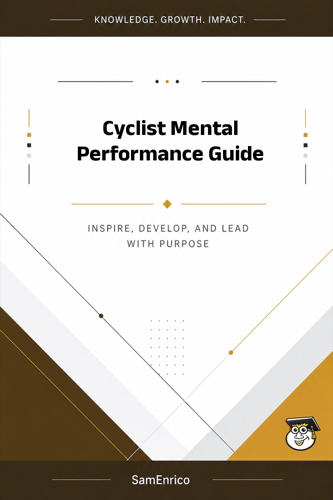
Cyclist Mental Performance Guide eBook
Applies self hypnosis for hill climbs, sprint fini
Applies self hypnosis for hill climbs, sprint finishes, and endurance rides.
Formats
Free sample
Chapter 1: The Hidden Limit--–- Every cyclist knows the sensation. You’re ten minutes into a climb that should be manageable. Your legs feel fine—no burning, no cramping. Your heart rate is exactly where it should be for this grade. Your power meter reads the number you’ve held a hundred times before on a trainer in your garage.
And yet, something inside you says stop. Not your lungs. Not your muscles. Something deeper. A voice that doesn’t speak in words but in feelings: heaviness, hesitation, a sudden certainty that you cannot continue.You unclip.
You stop. You tell yourself you were tired from yesterday’s ride, or that the grade was steeper than it looked, or that you just didn’t have it today. But deep down, you know the truth: your body had more to give. Your brain quit first.This is not a failure of character. It is not a lack of grit.
It is not something a coach can fix with more intervals or a stricter nutrition plan. This is the hidden limit that every cyclist eventually hits—the point where physical training stops working because the subconscious mind has taken over the controls. And the subconscious mind, left untrained, is a coward. It is conservative. It is designed to keep you safe, not to make you fast.This book exists because that hidden limit can be reprogrammed.
Not through positive thinking. Not through screaming at yourself to try harder. Not through motivational quotes taped to your handlebars. But through a specific, teachable, scientifically validated skill: self-hypnosis for athletic performance.Before you close this book—before you decide that hypnosis is for stage performers or people trying to quit smoking—hear this clearly. The hypnosis you will learn in these pages has nothing to do with swinging pocket watches, clucking like a chicken, or losing consciousness.
It is called Alert Hypnosis, and it is used by elite downhill mountain bikers, Olympic track cyclists, and World Tour pros who simply don’t talk about it because the word “hypnosis” still carries baggage. They call it “getting in the zone” or “autopilot” or “flow.” But those are descriptions of a result, not a method. This book gives you the method.In this first chapter, you will learn why physical training alone hits an unbreakable ceiling, how the subconscious mind secretly runs your performance, what the latest sports science reveals about hypnosis and heart rate variability, and why everything you think you know about mental toughness is probably wrong. By the end, you will understand why a three-minute trance can do what six months of intervals cannot.The Law of Diminishing Returns: Why More Training Stops Working Let’s start with an uncomfortable truth that most cycling coaches will never admit: after a certain point, adding more physical training does not produce proportional gains. Sports scientists call this the Law of Diminishing Returns.
In practical terms, it means that the difference between a Cat 3 racer and a Cat 1 racer is rarely physical. Both can hold similar wattages for similar durations. Both have similar VO2 max numbers. Both have done the intervals, the base miles, the hill repeats.What separates them is not the legs. It is what happens in the legs’ owner’s brain when things get hard.Consider this.
A 2023 meta-analysis published in Sports Medicine reviewed forty-two studies on performance plateaus in endurance athletes. The finding was stark: after approximately three to five years of structured training, further physical improvements slow to less than one percent per year for most athletes. Yet within the same study population, performance variance between athletes of similar physical ability remained as high as fifteen percent. The researchers concluded that the primary variable predicting who broke through a plateau was not a physiological metric but a psychological one—specifically, the athlete’s ability to regulate perceived effort and tolerate discomfort.In other words, two athletes with identical FTP numbers will produce different race results because one of them has a brain that says “keep going” and the other has a brain that says “stop.” And that difference is not a matter of willpower. It is a matter of programming.Your subconscious mind has been programmed since childhood.
Every time you pushed too hard in a workout and felt sick afterward, your subconscious learned that pushing hard leads to negative outcomes. Every time you crashed or bonked or got dropped, your subconscious filed that experience under “dangerous.” Every time a coach or a training partner told you to “listen to your body,” your subconscious interpreted that as permission to quit at the first sign of discomfort.These programs run automatically. You do not decide to feel panic on a steep climb. It just happens. You do not choose to hesitate in a sprint finish.
Your hand simply doesn’t shift into the big ring. The decision was made for you, by a part of your mind you cannot access through conscious effort alone.That is the Law of Diminishing Returns in action. You can train your legs until they are iron, but if your subconscious is still running the same protective programs, you will never access the full capacity of those legs. You are driving a Ferrari with the parking brake on. And you cannot release that brake by trying harder.
You can only release it by going around the conscious mind entirely.Automaticity: How the Subconscious Runs the Show To understand why self-hypnosis works, you first need to understand a concept called automaticity. Automaticity is the process by which a behavior becomes so practiced that it shifts from conscious control to subconscious execution. When you first learned to clip into your pedals, you had to look down, think about the motion, and often fumble. Now you do it without thinking. That is automaticity.
When you first learned to descend a corner, you consciously calculated braking points and lean angles. Now your body just does it. That is automaticity.Automaticity is the brain’s efficiency mechanism. It takes repetitive behaviors and moves them from the slow, energy-hungry prefrontal cortex (the conscious, analytical part of your brain) to the fast, energy-efficient basal ganglia and cerebellum (the subconscious, automatic part). This is a beautiful adaptation—until the automatic behavior is one you don’t want.What happens when the automatic behavior is fear?
What happens when the automatic response to a twenty-minute climb is not “maintain power” but “ease up, you’re going to blow”? What happens when the automatic response to a sprint finish is not “go now” but “wait, it’s too early, you’ll die before the line”? These are not decisions you make. They are programs that run automatically.Here is the critical insight that separates this book from every other cycling psychology guide you have ever read: you cannot change an automatic program by arguing with it. You cannot talk yourself out of a subconscious fear response any more than you can talk yourself out of pulling your hand back from a hot stove.
The fear response is faster than conscious thought. It has to be—that is how it kept your ancestors alive.So what do you do? You bypass…
This is the end of the free sample. Get the eBook to keep going. Buy now
About this book
Details
- Author
- Carnahan Taina
- Publisher
- SamEnrico
- Language
- English
- Genre
- Non-Fiction, Self-Help, Cycling
- Released
- 2026-06-09
- Pages (approx.)
- 149
- Available as
- eBook, Audiobook

Read better in the ZLOADR app
Your eBooks on your phone or tablet. Sign in with your SamEnrico account and start reading.
More by Carnahan Taina
 Automatic Savings HabitCarnahan Taina$11.99
 Collaborative Innovation Metrics GuideCarnahan Taina$11.99
 The Dubai Internship GuideCarnahan Taina$11.99
 OKR For Spiritual GoalsCarnahan Taina$11.99
 Oncology Massage GuideCarnahan Taina$11.99
 Acupuncture for AllergiesCarnahan Taina$11.99
 Self Hypnosis for Work AnxietyCarnahan Taina$11.99
 The Maori Warriors' Dance: A Colonial Olympic Revelation (1770)Carnahan Taina$11.99
 Kublai Khan's Ghost Fleet: The Divine Winds That Defied the MongolsCarnahan Taina$11.99
 How to Produce Deep Fryer AccessoriesCarnahan Taina$11.99
 One Page Marketing Blueprint for RoofersCarnahan Taina$12.99
 Polish Cybersecurity GuideCarnahan Taina$12.99
You may also like
 Hong Kong Handover 1997Dunn Johnnie$11.99
 Zumba For Postnatal Recovery CourseNeal Christian$11.99
 Zumba for BeginnersLadner Nikia$11.99
 YouTube Comment Mining GuideHumes Pandora$12.99
 Worry Box MeditationCarlin Rudy$11.99
 Workplace Stress MeditationNguyen Lynn$11.99
 Workplace Stress and Sleep RepairHawley Ivory$11.99
 Workplace Perfectionism CureDelaney Jeffry$11.99
 Workplace Injustice Anger GuideWallen Isabelle$11.99
 Work Addiction and Burnout LinkGreenwood Ester$11.99
 Women in Yoga and WellnessBeattie Galina$11.99
 Women in Stand Up ComedyChun Evangeline$11.99