
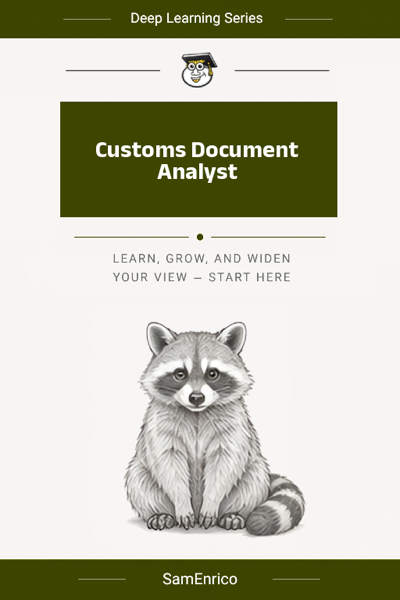
Non-FictionInformativeEducational
Customs Document Analyst eBook
A Coursebook on Customs Document Analyst
A Coursebook on Customs Document Analyst
Formats
Free sample
Chapter 1: The Gatekeeper’s Reckoning...--–- The container had been sitting at the Port of Long Beach for eleven days. Forty thousand dollars in demurrage charges. A production line idled in Ohio. And one customs document analyst named Sarah Vasquez staring at a single mismatched data point that everyone else had missed.The commercial invoice said the shipment contained “industrial conveyor belts – rubber, reinforced.” The packing list agreed. The bill of lading was clean.
The customs broker had filed the entry summary and received a green lane release. On paper, it was a routine shipment.But Sarah had learned a hard truth early in her career: the paper is never the whole story.She pulled the supplier’s original email attachment – a scanned PDF sent from a factory in Malaysia. Zooming in on the product specification sheet, buried on page seven, she found it: “Contains textile cord reinforcement – 32% by weight of aramid fibers.”That tiny detail changed everything. Rubber conveyor belts with textile reinforcement fell under a different Harmonized System heading. The duty rate was not 3.9 percent but 8.5 percent.
Worse, the aramid fibers originated in China, which triggered a Section 301 tariff of an additional 25 percent. The declared value of $187,000 suddenly carried a duty liability of nearly $63,000 instead of $7,300.The company had underpaid by over $55,000 on a single entry. And because the entry had already cleared green lane, Customs and Border Protection could come looking for that money at any time – with interest, penalties, and a potential compliance audit stretching back five years.Sarah’s job was not to fill out forms. Her job was to see what others overlooked. She was a customs document analyst, and in that moment, she was the only thing standing between her company and a financial disaster that would cost her bonus, her manager’s job, and quite possibly her own.This book is about becoming that person.Why Customs Documentation Matters More Than You Think Every year, over $25 trillion worth of goods cross international borders.
Each shipment generates an average of 15 to 30 separate documents. A single mistake on any one of them – a misclassified product, a missing signature, a transposed digit in a weight declaration – can trigger customs exams, cargo holds, liquidated damages, or even criminal investigations.Yet most companies treat customs documentation as an afterthought. They outsource it to brokers, relegate it to junior clerks, or bury it under the assumption that “the system will catch errors.” The truth is exactly the opposite. Customs systems are designed to catch anomalies, but they cannot catch what was never declared correctly in the first place.The customs document analyst is the forgotten hero of global trade. While sales teams chase revenue and logistics managers track containers, the analyst sits at the intersection of law, finance, and operations – translating complex regulations into actionable data.
The analyst decides whether a product is classified honestly, whether a value is declared accurately, and whether a country of origin claim will survive a customs audit.This chapter establishes why that role exists, what it demands, and how you can begin thinking like an analyst before you ever touch a customs form.The Three Pillars of the Customs Document Analyst Every decision an analyst makes falls into one of three categories. Together, they form the foundation of the profession.Pillar One: Compliance Compliance means meeting every legal requirement imposed by customs authorities. This sounds simple, but it is anything but. Customs laws are among the most complex and rapidly changing regulations in any country. The United States alone has over 400 separate tariff sections, 19 partner government agencies with their own rules, and thousands of binding rulings that interpret ambiguous language.Compliance is not about memorizing rules.
It is about building systems that verify each requirement before a shipment arrives. The analyst who waits until the entry is filed to check for errors has already failed. True compliance happens upstream – in the purchase order, the commercial invoice, the advance shipping notice.Practical example: A compliance-minded analyst does not simply accept a supplier’s certificate of origin. She verifies that the certificate matches the product, that the product meets the free trade agreement’s rule of origin, and that the supplier has the legal authority to issue the certificate. She documents every step of that verification.
When customs asks five years later, she has a defense file ready.Pillar Two: Risk Risk is the art of predicting what customs will scrutinize. Every entry is scored by automated targeting systems that assign probability weights to various data elements. High-risk entries go to yellow lane (document review) or red lane (physical inspection). Low-risk entries sail through green lane – but green lane does not mean customs forgot about you. It means they are saving your file for a post-clearance audit.The analyst must think like a customs officer.
That means knowing which products are targeted for valuation fraud (electronics, auto parts, pharmaceuticals), which countries are flagged for origin manipulation (transshipment hubs like Vietnam or Malaysia for Chinese goods), and which document discrepancies are considered “material” versus “clerical.”Consider the 5 percent rule. A weight mismatch of less than 5 percent might be tolerated. A mismatch of 10 percent is almost certain to trigger an exam. The analyst who reconciles gross weight, net weight, and tare weight before submission eliminates a major red flag. The analyst who ignores weight reconciliation is gambling with demurrage.Pillar Three: Facilitation Facilitation is the most misunderstood pillar.
Many people assume customs compliance is about preventing bad outcomes – penalties, delays, seizures. But great analysts do more than avoid trouble. They actively accelerate trade.How? By qualifying for trusted trader programs like AEO (Authorized Economic Operator) or C-TPAT (Customs-Trade Partnership Against Terrorism). These programs offer reduced exam rates, priority processing, and sometimes even waived bonds.
The qualification process is rigorous, requiring documented internal controls and a history of flawless entries. But once achieved, a trusted trader status can cut clearance times from days to hours.Facilitation also means correcting errors before they become problems. An analyst who discovers a past misclassification can file a prior disclosure voluntarily, paying the additional duty but avoiding penalties. An analyst who ignores the error waits for customs to find it – and pays three to ten times more.Reasonable Care: The Legal Backbone of the Analyst’s Role In the United States, the legal standard governing importers is called “reasonable care.” Under 19 USC §1484, every importer must exercise reasonable care to classify, value, and enter goods correctly. Reasonable care is not perfection.
It is the level of diligence that a reasonably prudent person would exercise under similar circumstances.What does that mean in practice? Courts and customs rulings have established several factors:Using qualified personnel to prepare entries.Maintaining systems to verify supplier data.Consulting binding rulings or expert advice for ambiguous classifications.Correcting errors when discovered.The analyst is the primary instrument of reasonable care. When a company delegates customs work to a broker, the company is not off the hook – the importer remains ultimately liable. The analyst must verify the broker’s work, question suspicious data, and document every decision.A global note: Other jurisdictions use different terminology but similar principles. The European Union’s Union Customs Code emphasizes “due diligence” and “knowledge of the customs rules” as…
This is the end of the free sample. Get the eBook to keep going. Buy now
About this book
Details
- Author
- Peltier Herta
- Publisher
- SamEnrico
- Language
- English
- Genre
- Non-Fiction, Informative, Educational
- Released
- 2026-06-02
- Pages (approx.)
- 154
- Available as
- eBook, Audiobook

Read better in the ZLOADR app
Your eBooks on your phone or tablet. Sign in with your SamEnrico account and start reading.
More by Peltier Herta
 Success Stories Work AngerPeltier Herta$11.99
 SIDS Risk Reduction GuidePeltier Herta$11.99
 After Work Shopping GuidePeltier Herta$11.99
 Citta Sankhara Breath Quieting GuidePeltier Herta$11.99
 Business Interruption Insurance ClaimsPeltier Herta$11.99
 The Vanishing Witness: Canada's First Witness Protection CasePeltier Herta$11.99
 How to Start a Hobby in Roller skatingPeltier Herta$11.99
 Legal Document AI Ethics GuidePeltier Herta$12.99
 EU VAT on Imported Low Value GoodsPeltier Herta$12.99
 Understanding Mitral AtresiaPeltier Herta$17.99
You may also like
 Hong Kong Handover 1997Dunn Johnnie$11.99
 Zumba For Postnatal Recovery CourseNeal Christian$11.99
 Zumba for BeginnersLadner Nikia$11.99
 YouTube Comment Mining GuideHumes Pandora$12.99
 Worry Box MeditationCarlin Rudy$11.99
 Workplace Stress MeditationNguyen Lynn$11.99
 Workplace Stress and Sleep RepairHawley Ivory$11.99
 Workplace Perfectionism CureDelaney Jeffry$11.99
 Workplace Injustice Anger GuideWallen Isabelle$11.99
 Work Addiction and Burnout LinkGreenwood Ester$11.99
 Women in Yoga and WellnessBeattie Galina$11.99
 Women in Stand Up ComedyChun Evangeline$11.99