
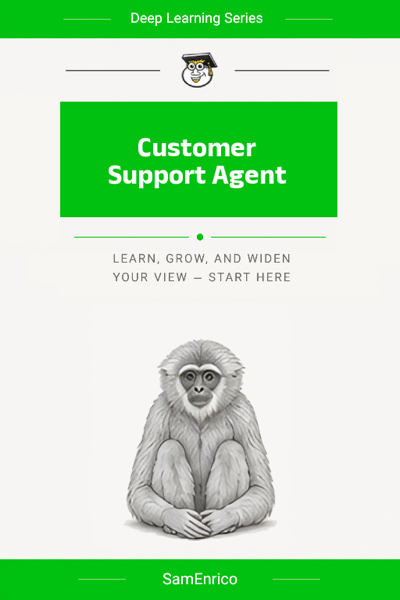
Non-FictionInformativeEducational
Customer Support Agent eBook
A Coursebook on Customer Support Agent
A Coursebook on Customer Support Agent
Formats
Free sample
Chapter 1: The Burnout Epidemic--– Every Monday morning, Sarah opens her ticketing queue and feels her stomach tighten. She has been a customer support agent for fourteen months at a mid-sized software company. She liked the job at first. Helping people felt good. But now, her queue shows forty-seven unresolved tickets.
Three are from the same customer, who has already written “ANYONE THERE?” in all caps twice. Her quality assurance score dropped last month because she missed a step in a refund process. Her manager sent a team-wide email celebrating the agent with the lowest first response time. Sarah was not that agent. She is not sure she wants to be that agent anymore.
She is not sure she wants to be any agent at all.Sarah is not lazy. She is not bad at her job. She is burning out, slowly and quietly, in a role that society treats as entry-level and disposable. And the most dangerous part is that she believes the problem is her.It is not her. It is the system.This book exists because Sarah deserves better.
And so do you.The Hidden Crisis in Customer Support Customer support is one of the largest employment categories in the modern economy. Millions of people around the world spend their working hours answering tickets, taking calls, replying to chats, and de-escalating angry customers. Yet the role is consistently undervalued, misunderstood, and poorly designed. Turnover in customer support averages between thirty and forty-five percent annually, according to industry studies. Some outsourced centers see turnover exceed one hundred percent per year.
That means the average agent lasts less than twelve months before quitting, burning out, or being fired for metrics they were never properly trained to meet.The cost of this crisis is staggering. Companies lose billions of dollars each year recruiting, hiring, and training new agents. Customers suffer through repeat explanations and inconsistent service. And agents like Sarah internalize the failure as their own.But here is the truth that the top ten customer service books of the past decade all reveal, each from a different angle: great support is not about natural-born talent. It is not about being a “people person.” It is not about smiling through abuse or working faster than humanly possible.
Great support is a set of teachable skills, supported by intelligent systems, practiced within a culture that values the agent as much as the customer.This chapter lays the foundation for everything that follows. It will redefine what customer support actually is, dismantle the myths that keep agents stuck, and give you a new framework for understanding your role. By the end of this chapter, you will see your queue differently. You will see yourself differently.Why Everything You Learned About Support Is Wrong Most people enter customer support with no formal training. They are handed a login, shown a knowledge base, and told to “make customers happy.” The implicit message is that support is simple.
Anyone can do it. If you fail, you must not care enough.That message is not just wrong. It is destructive.Customer support is one of the most cognitively demanding roles in any organization. Consider what an agent does in a single hour. They switch between five different software tools.
They read a customer’s emotional state from text alone. They diagnose technical problems they have never seen before. They translate complex product logic into plain language. They manage their own frustration while absorbing a stranger’s anger. They do all of this while a clock counts their response time in the background.A neurosurgeon focuses on one patient at a time in a quiet operating room.
A support agent handles three chats, an email, and a phone call simultaneously while someone screams about a late shipment.The comparison is not meant to diminish surgeons. It is meant to elevate the unrecognized complexity of support work. When you understand that complexity, you stop blaming yourself for struggling. You start building real skills.The Three Pillars of Modern Support Through analyzing the best-selling customer service books of the past decade, a clear pattern emerges. Despite different frameworks and terminology, they all converge on three foundational pillars that separate high-performing agents from those who burn out and leave.Pillar One: Strategic Ownership The old model of customer support treated agents as message-forwarders.
A customer reported a problem. The agent found the right department and passed the ticket along. The agent’s job was to be a polite traffic cop.That model is obsolete.Modern support requires what we call strategic ownership. This means you do not stop at the first answer. You do not close a ticket just because you found a workaround.
You own the problem from first contact to final resolution, even if that resolution requires involving other people. Strategic ownership means you are the customer’s advocate inside the company, not just the company’s voice to the customer.Consider two agents handling the same issue: a customer cannot log in because their email provider is blocking the company’s password reset messages.Agent A, operating under the old model, sends the customer the password reset link again, assumes the problem is on the customer’s end, and closes the ticket. The customer never receives the email. They reopen the ticket, angrier than before.Agent B, practicing strategic ownership, notices that the customer has requested three resets in two days. They check the delivery logs.
They see the emails are being rejected. They research the error code, discover it is a known issue with that email provider, and send the customer a workaround: adding the company’s domain to their safe senders list. They also file an internal ticket with the engineering team to improve email deliverability. They close the original ticket only after the customer confirms they can log in.Which agent would you want on your team? Which agent will be promoted?
Which agent will look back at the end of the year and feel proud of their work?Strategic ownership is not about working longer hours. It is about thinking systematically. It is the difference between treating tickets as items to check off a list and treating customers as people with problems that deserve complete solutions.Pillar Two: Adaptable Empathy Empathy is the most misused word in customer support. Many companies treat empathy as a synonym for niceness. Be polite.
Smile in your writing. Use exclamation points.That is not empathy. That is performance.Real empathy, the kind that actually helps customers and protects agents from burnout, is the ability to accurately perceive another person’s emotional state without being consumed by it. The key phrase is “without being consumed by it.”Most agents are taught to absorb customer emotion. An angry customer arrives.
The agent is supposed to feel that anger, apologize for it, and somehow transform it into satisfaction. That expectation is emotionally impossible to sustain. It leads directly to the burnout Sarah is experiencing.Adaptable empathy works differently. It has three gears.First gear is recognition. You notice what the customer is feeling.
You name it, silently or aloud. “This customer is frustrated because they have been waiting three days.” Recognition alone reduces…
This is the end of the free sample. Get the eBook to keep going. Buy now
About this book
Details
- Author
- Bartholomew Trudy
- Publisher
- SamEnrico
- Language
- English
- Genre
- Non-Fiction, Informative, Educational
- Released
- 2026-05-06
- Pages (approx.)
- 136
- Available as
- eBook, Audiobook

Read better in the ZLOADR app
Your eBooks on your phone or tablet. Sign in with your SamEnrico account and start reading.
More by Bartholomew Trudy
 Step Eleven Evening Review RoutineBartholomew Trudy$11.99
 Anticipatory Grief and Medical DecisionsBartholomew Trudy$11.99
 The Gorilla StanceBartholomew Trudy$11.99
 Only Sane One Survivor GuideBartholomew Trudy$11.99
 Food Addiction And Shame Recovery GuideBartholomew Trudy$11.99
 The Soldier's Second OverdoseBartholomew Trudy$11.99
 Remote Coaching CommunicationBartholomew Trudy$11.99
 Growth Hormone Youthful MetabolismBartholomew Trudy$11.99
 News Corp ScandalBartholomew Trudy$11.99
 The Great Barrier Bleach: How a Heatwave Turned Paradise into PerilBartholomew Trudy$11.99
 The Stoic Marketplace: How Marcus Aurelius and Seneca Built an Empire of WisdomBartholomew Trudy$11.99
 The Lost Letters of Sylvia Plath: A Poet’s Secret LifeBartholomew Trudy$11.99
You may also like
 Hong Kong Handover 1997Dunn Johnnie$11.99
 Zumba For Postnatal Recovery CourseNeal Christian$11.99
 Zumba for BeginnersLadner Nikia$11.99
 YouTube Comment Mining GuideHumes Pandora$12.99
 Worry Box MeditationCarlin Rudy$11.99
 Workplace Stress MeditationNguyen Lynn$11.99
 Workplace Stress and Sleep RepairHawley Ivory$11.99
 Workplace Perfectionism CureDelaney Jeffry$11.99
 Workplace Injustice Anger GuideWallen Isabelle$11.99
 Work Addiction and Burnout LinkGreenwood Ester$11.99
 Women in Yoga and WellnessBeattie Galina$11.99
 Women in Stand Up ComedyChun Evangeline$11.99