
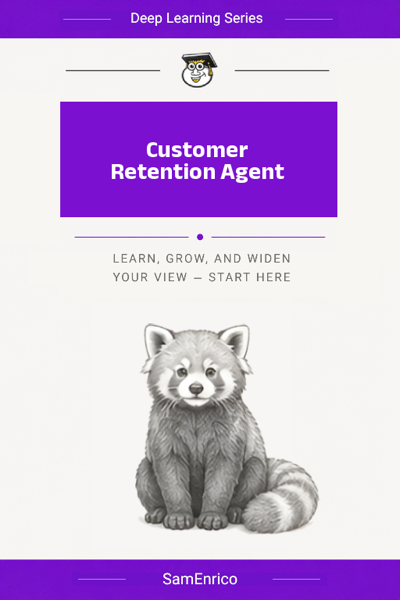
Non-FictionInformativeEducational
Customer Retention Agent eBook
A Coursebook on Customer Retention Agent
A Coursebook on Customer Retention Agent
Formats
Free sample
Chapter 1: The Five Farewells--–- The call came in at 4:47 on a Tuesday. Julia, a retention agent for a mid-sized Saa S company, had taken hundreds of similar calls before. The customer, a office manager named Carlos from a real estate firm, had been with the company for fourteen months. His voice was flat, rehearsed – the voice of someone who had already decided but felt obligated to make the call."I'd like to cancel my account," he said. "It's nothing personal.
We just don't use it enough."Julia had heard these exact words perhaps three hundred times in her career. And for the first two hundred, she had failed. She had offered discounts too early, apologized too much, or – worst of all – taken the cancellation personally and become defensive. But this time was different. This time, she recognized something she had been trained to see: Carlos wasn't actually in the active stage of churn.
He was in the behavioral stage, and his flat tone wasn't resignation – it was shame. He felt guilty for not using the product he had convinced his boss to buy."Carlos," she said, "before we process anything, can I ask you a question that might sound strange?""Sure.""What would success with our product have looked like for you? Back when you first signed up, what was the dream outcome?"There was a long pause. Then Carlos laughed – not a mocking laugh, but a surprised one. "You know," he said, "nobody has ever asked me that.
I wanted to cut the time my agents spent on lead follow-up from two hours a day to twenty minutes. And we did hit that. For about three months. Then I got busy and stopped checking the dashboard."Julia didn't offer a discount. She didn't apologize for the product.
She simply said: "Carlos, you already achieved what you set out to do. You just forgot you did. Would you be open to a fifteen-minute refresher call tomorrow to show you how to automate the parts you're doing manually now?"Carlos didn't cancel. Fourteen months later, he upgraded to the enterprise plan.This chapter is about why Carlos almost left – and why Julia saved him. It is about the hidden psychology of churn, the five distinct ways customers drift away, and the eight emotional phases that determine whether a customer becomes a promoter or a detractor.
By the end of this chapter, you will never hear a cancellation request the same way again.The $1.6 Trillion Blind Spot Every year, companies spend more than 500billiononcustomeracquisition.Theypourmoneyinto Google Ads,Facebookcampaigns,billboards,sponsorships,andexpensivesalesteams.Andeveryyear,customerschurn–cancel,defect,orsimplystopusing–atanaveragerateof19percentacrosssubscriptionbusinesses.Thecombinedvalueofthatlostrevenue?Morethan500 billion on customer acquisition. They pour money into Google Ads, Facebook campaigns, billboards, sponsorships, and expensive sales teams. And every year, customers churn – cancel, defect, or simply stop using – at an average rate of 19 percent across subscription businesses. The combined value of that lost revenue? More than 500billiononcustomeracquisition.Theypourmoneyinto Google Ads,Facebookcampaigns,billboards,sponsorships,andexpensivesalesteams.Andeveryyear,customerschurn–cancel,defect,orsimplystopusing–atanaveragerateof19percentacrosssubscriptionbusinesses.Thecombinedvalueofthatlostrevenue?Morethan1.6 trillion annually.Here is the painful irony: most of that churn is preventable.
Not because companies lack good products or smart people, but because they misunderstand why customers leave in the first place.When asked, customers give simple reasons. "Too expensive." "Didn't use it." "Poor customer service." "Found a better option." These are not causes. They are post-hoc rationalizations – stories customers tell themselves and companies to make sense of a decision that was often emotional, not logical. A customer who says "too expensive" may actually be saying "I never saw the value." A customer who says "poor customer service" may actually be saying "I felt unimportant."The job of a retention agent is not to accept these surface-level reasons at face value. The job is to become a forensic psychologist of churn – to identify which of the five stages of churn risk the customer is in, which of the eight emotional phases they are experiencing, and how to intervene before the decision hardens into action.The Five Stages of Churn Risk Not all churn looks the same.
A customer who cancels because their company went bankrupt (circumstantial churn) requires a completely different response than a customer who cancels because a competitor offered a lower price (transactional churn). The five-stage model below provides a diagnostic framework for every retention conversation.Stage 1: Latent Churn – The Silent Unhappiness Latent churn is the most dangerous because it is invisible. The customer is unhappy but has not said anything. They have not called support. They have not submitted a complaint.
They have simply begun to mentally check out. In a subscription business, latent churn shows up as declining usage – logging in less frequently, using fewer features, ignoring product update emails.The psychology here is often avoidance. The customer thinks: "I don't have time to deal with this. I'll cancel next month." But next month becomes the month after. Eventually, the frustration compounds, and the customer leaves without warning.Intervention strategy: Proactive outreach based on usage data.
A simple email: "We noticed you haven't used [feature] in three weeks. Here is a two-minute video showing how it can save you an hour each week." No apology needed. No discount offered. Just value, unblocked.Stage 2: Active Churn – The Voiced Intent Active churn is when the customer picks up the phone, clicks "cancel," or sends the email. This is what most retention agents train for.
The customer has decided – or believes they have decided – to leave. But here is the secret that separates elite retention agents from average ones: active churn is often not final. It is a negotiation the customer does not know they are having.When Carlos called Julia, he was in active churn. He had taken the action of calling. But his reason – "We don't use it enough" – was not a verdict.
It was an invitation. He was testing whether the company would fight for him.Intervention strategy: The L.E.A.P.A. method (introduced fully in Chapter 5). Listen, Empathize (cognitive empathy, not emotion matching), Apologize, Probe with diagnostic questions, Act with solutions. Never accept the first reason at face value.Stage 3: Transactional Churn – The Single Event Transactional churn is triggered by a specific, identifiable failure.
A shipment arrived late. A billing error overcharged the customer. A feature broke during a critical presentation. The customer may have been perfectly happy before this event. Now, they want to leave – not because the product is flawed overall, but because trust was broken in a single moment.The danger of transactional churn is that companies often dismiss it as "just one mistake." But for the customer, that one mistake may have cost them time, money, or reputation with their own boss or family.Intervention strategy: Rapid, no-friction service recovery.
Apologize immediately (the five-part apology engineering in Chapter 10). Fix the specific failure. Then go one step further – a small gesture that says "we know we failed, and we are sorry." Not a grand discount, but a meaningful acknowledgment.Stage 4: Behavioral Churn – The Slow Fade Behavioral churn is the most common and the most misunderstood. The customer didn't have a bad experience. They just stopped using the product.
Their subscription renews automatically for months – sometimes years – until one day they notice the charge on their credit…
This is the end of the free sample. Get the eBook to keep going. Buy now
About this book
Details
- Author
- Wilkerson Rodolfo
- Publisher
- SamEnrico
- Language
- English
- Genre
- Non-Fiction, Informative, Educational
- Released
- 2026-05-04
- Pages (approx.)
- 154
- Available as
- eBook, Audiobook

Read better in the ZLOADR app
Your eBooks on your phone or tablet. Sign in with your SamEnrico account and start reading.
More by Wilkerson Rodolfo
 Headache Advocate GuideWilkerson Rodolfo$11.99
 Credit Card Debt AddictionWilkerson Rodolfo$11.99
 Extrovert Listening ChallengeWilkerson Rodolfo$11.99
 The Teacher Classroom Stress GuideWilkerson Rodolfo$11.99
 The Silk Road to the Spice Kingdoms: Portugal's Maritime DominationWilkerson Rodolfo$11.99
 How to Start a New Multifamily Housing Construction BusinessWilkerson Rodolfo$11.99
 Learn to Play the PuWilkerson Rodolfo$11.99
 Variance Analysis with AI PromptsWilkerson Rodolfo$12.99
You may also like
 Hong Kong Handover 1997Dunn Johnnie$11.99
 Zumba For Postnatal Recovery CourseNeal Christian$11.99
 Zumba for BeginnersLadner Nikia$11.99
 YouTube Comment Mining GuideHumes Pandora$12.99
 Worry Box MeditationCarlin Rudy$11.99
 Workplace Stress MeditationNguyen Lynn$11.99
 Workplace Stress and Sleep RepairHawley Ivory$11.99
 Workplace Perfectionism CureDelaney Jeffry$11.99
 Workplace Injustice Anger GuideWallen Isabelle$11.99
 Work Addiction and Burnout LinkGreenwood Ester$11.99
 Women in Yoga and WellnessBeattie Galina$11.99
 Women in Stand Up ComedyChun Evangeline$11.99