
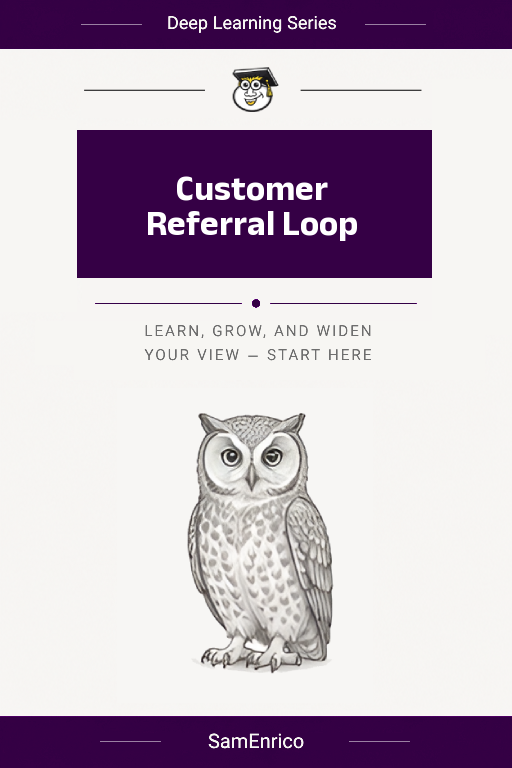
Non-FictionStartup GuideReferral ProgramsViral Growth
Customer Referral Loop eBook
Give existing customers a discount for referring n
Give existing customers a discount for referring new ones to drop CAC by 40 percent.
Formats
Free sample
Chapter 1: The $7 Billion Lie--–- Most business owners wake up today believing a lie. They believe that if they want to grow, they have to pay for growth. They believe that Facebook, Google, and Tik Tok are the only reliable highways to new customers. They believe that the budget line labeled "Acquisition" is an unavoidable tax on doing business. And they are wrong.This lie costs small and medium businesses over seven billion dollars every single year.
That is not a metaphor. That is the combined annual spend on paid social and search advertising by companies with fewer than five hundred employees. They pour this money into platforms that are actively working against them. The click costs rise. The conversion rates fall.
The algorithms change overnight. And every time a platform updates its privacy policy, the business owner pays the price.There is another way. It does not require a bigger marketing budget. It does not require a celebrity endorsement. It does not require a viral video or a stroke of luck.
It requires something you already have but have been trained to overlook: your existing customers. They are sitting on your email list, your loyalty program, and your post-purchase thank-you page, completely willing to bring you new buyers at zero marginal cost. But you are not asking. And when you do ask, you are asking the wrong way, at the wrong time, with the wrong incentive.This book is the fix.By the time you finish this chapter, you will understand why the traditional advertising model has collapsed, why your customers are worth more than your ad budget, and how a structured referral loop can cut your Customer Acquisition Cost by forty percent without increasing your spend. The remaining eleven chapters will give you the exact mechanics: the incentive structures, the timing triggers, the technology stack, the fraud prevention, and the launch plan.
But first, you need to unlearn what the ad platforms have taught you.The Treadmill of Paid Acquisition Let us start with a simple exercise. Take your total monthly marketing spend and divide it by the number of new customers you acquired last month. That is your Customer Acquisition Cost, or CAC. For most businesses reading this book, that number falls somewhere between forty and two hundred dollars. Now ask yourself a painful question: Has that number gone up or down over the past three years?If you are like the vast majority of business owners, it has gone up.
Not because your marketing has gotten worse. Not because your product is less appealing. But because the platforms have systematically raised prices while reducing your ability to target effectively.Consider the raw math. In 2019, the average cost per click on Google Ads across all industries was 1.16.By2024,thatnumberhadrisento1.16. By 2024, that number had risen to 1.16.By2024,thatnumberhadrisento4.22.
That is a 264 percent increase in five years. Facebook tells a similar story. Cost per mille, the price for one thousand impressions, tripled between 2020 and 2023. Meanwhile, conversion rates have fallen. The average click-to-purchase rate on social media is now below two percent.
You are paying three times as much to reach people who are ninety-eight percent unlikely to buy.This is not a temporary fluctuation. This is structural.The platforms have realized something that took them a decade to figure out. Their real customers are not the users scrolling through feeds. Their real customers are the advertisers. And like any business, they want to maximize revenue from their customers.
So they increase prices. They reduce organic reach. They make targeting less precise. They force you to spend more to get the same result. This is not malice.
This is capitalism.But here is the part that does not get discussed enough. Even if you are willing to pay the higher prices, you cannot buy what matters most. You cannot buy trust. You cannot buy a recommendation from a friend. You cannot buy the social guarantee that turns a stranger into a buyer.The Trust Deficit That Money Cannot Solve In 2022, Nielsen conducted its annual Trust in Advertising study.
The results were striking and consistent with a decade of prior research. Ninety-two percent of consumers said they trust recommendations from friends and family above all other forms of advertising. That includes television commercials, search ads, social media promotions, billboards, and sponsored content. The closest competitor, online reviews, came in at seventy percent. Paid social advertising landed at forty-three percent.Let those numbers sink in.
When you run a Facebook ad, nearly sixty percent of the people who see it do not trust it. They see it as a paid interruption, not as useful information. But when a friend sends them a link with a referral code, ninety-two percent trust it. The same product. The same price.
The same offer. The only difference is the messenger.This is not irrational. Human beings are wired to trust in-group recommendations. Evolutionary psychology suggests that relying on social proof was a survival mechanism long before it was a marketing tactic. If your tribe told you a berry was safe to eat, you ate it.
If a stranger told you, you hesitated. That wiring did not disappear when we started shopping online. It simply found a new expression.Your customers are your tribe. They have already proven that they trust you enough to hand over their credit card information. They have already experienced your product, your support, and your fulfillment.
They have already decided that you are worth their money. When they recommend you to a friend, they are putting their own social capital on the line. That is why the recommendation is so powerful. And that is why you should be willing to reward it.The Forty Percent Benchmark The title of this book promises a forty percent reduction in Customer Acquisition Cost. That number is not theoretical.
It comes from analyzing hundreds of referral programs across e-commerce, Saa S, and B2B services. The companies that implement structured, discount-driven referral loops consistently see CAC drop by thirty-eight to forty-two percent within six to nine months.Let me give you a concrete example. Ekar, a car-sharing company operating in the Middle East, was spending heavily on Google and Facebook ads to acquire new users. Their CAC was hovering around forty dollars in local currency equivalent. They built a double-sided referral program using automated API integrations through Braze and Voucherify.
Existing customers received a discount code to share. Both the referrer and the friend received a credit when the friend completed their first ride.Within four months, referrals accounted for thirty-seven percent of all new signups. Their blended CAC dropped to twenty-four dollars. That is a forty percent reduction. They did not increase their marketing budget.
They did not hire new staff. They simply redirected existing customer goodwill into a structured loop.Urban Store, an e-commerce home goods retailer, ran a similar test. They offered twenty percent off to both the referrer and the friend. Within six months, referred customers had a thirty-seven percent higher retention rate than paid customers and a twenty-two percent higher average order value. The program cost them margin on the first transaction but generated more than enough repeat business to compensate.These are…
This is the end of the free sample. Get the eBook to keep going. Buy now
About this book
Details
- Author
- Burdette Ozell
- Publisher
- SamEnrico
- Language
- English
- Genre
- Non-Fiction, Startup Guide, Referral Programs, Viral Growth
- Released
- 2026-05-30
- Pages (approx.)
- 140
- Available as
- eBook, Audiobook

Read better in the ZLOADR app
Your eBooks on your phone or tablet. Sign in with your SamEnrico account and start reading.
More by Burdette Ozell
 Recurring Dreams of SpidersBurdette Ozell$11.99
 Quiet Professional Confidence GuideBurdette Ozell$11.99
 Emotional Intelligence for VeteransBurdette Ozell$11.99
 Trance For ProcrastinationBurdette Ozell$11.99
 Africa Growth Capital StrategyBurdette Ozell$11.99
 Chiropractic Subluxation TheoryBurdette Ozell$11.99
 Step Two Sanity ReturnBurdette Ozell$11.99
 Photography Daily HabitBurdette Ozell$11.99
 Maimonides Philosophical TeachingsBurdette Ozell$11.99
 The Indian Ocean's Cosmic Whisper: Chandrasekhar and the Birth of Stellar PhysicsBurdette Ozell$11.99
 The Gambler Prince: The Untold Story of Mansa Musa’s Golden Baseball BetBurdette Ozell$11.99
 Shadows Over Berlin: The Spy Who Vanished in the WallBurdette Ozell$11.99
You may also like
 Hong Kong Handover 1997Dunn Johnnie$11.99
 Zumba For Postnatal Recovery CourseNeal Christian$11.99
 Zumba for BeginnersLadner Nikia$11.99
 YouTube Comment Mining GuideHumes Pandora$12.99
 Worry Box MeditationCarlin Rudy$11.99
 Workplace Stress MeditationNguyen Lynn$11.99
 Workplace Stress and Sleep RepairHawley Ivory$11.99
 Workplace Perfectionism CureDelaney Jeffry$11.99
 Workplace Injustice Anger GuideWallen Isabelle$11.99
 Work Addiction and Burnout LinkGreenwood Ester$11.99
 Women in Yoga and WellnessBeattie Galina$11.99
 Women in Stand Up ComedyChun Evangeline$11.99