
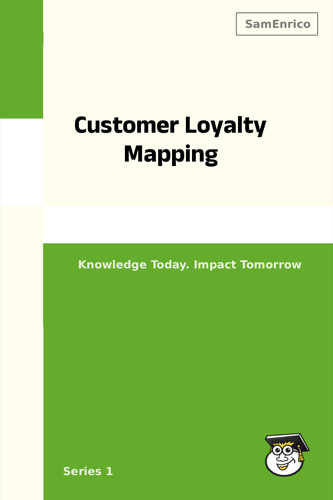
Non-FictionStrategic AtlasCustomer Loyalty
Customer Loyalty Mapping eBook
Position brands on satisfaction versus switching c
by Spence Santo
Position brands on satisfaction versus switching cost to predict retention risk.
Formats
Free sample
Chapter 1: The Satisfaction Trap--The email arrived at 9:47 AM on a Tuesday. Sarah Chen, VP of Customer Success at Tel Sphere, had just presented her quarterly report to the executive team. The numbers were beautiful. Customer satisfaction sat at 87 percent, up three points from the previous year. Net Promoter Score had climbed to 52, putting Tel Sphere in the "excellent" range for the first time in company history.
Her team had logged twenty-seven handwritten thank-you notes from happy customers. She had ended her presentation with a slide titled "Winning Hearts and Minds" and received a round of applause from the CEO.Twenty minutes later, the CEO forwarded her an email from the head of finance. The subject line read: "Q3 Churn Alert."Sarah opened the attachment. Her stomach dropped. While her team had been celebrating satisfaction scores, 38 percent of Tel Sphere's customers had quietly cancelled their subscriptions over the past twelve months.
Not the low-value customers on promotional plans. Not the ones who had signed up for free trials and never engaged. Paying customers. Satisfied customers. Customers who had rated Tel Sphere 4 or 5 out of 5 on their most recent survey, then turned around and left."How is this possible?" the CEO had scrawled at the bottom of the email.
"I thought they were happy."Sarah had no answer. She had done everything right. She had built a world-class customer support team. She had surveyed customers after every interaction. She had celebrated every positive score and investigated every negative one.
And yet, somehow, the customers who said they were happy were walking out the door.She was not alone. And she was about to learn a brutal truth that most companies never discover until it is too late.The Great Satisfaction Delusion For decades, business leaders have been told a simple, seductive story. Happy customers stay. Unhappy customers leave. Therefore, if you measure customer satisfaction and keep it high, you will maximize retention, lifetime value, and profitability.
This story has spawned an entire industry of survey vendors, certification programs, and consulting practices. It has convinced thousands of executives to tie bonuses to satisfaction scores. It has become a near-religious belief in boardrooms around the world.There is only one problem. The story is mostly wrong.Not a little wrong. Not slightly exaggerated.
Fundamentally, structurally, empirically wrong. The academic research is devastatingly clear. Satisfaction scores typically explain less than 20 percent of the variance in actual customer retention. In many industries, the number is closer to 10 percent. Let that sink in.
Ten percent. That means ninety percent of what determines whether a customer stays or leaves has nothing to do with how happy they claim to be on your survey.This chapter dismantles the satisfaction trap. You will learn why satisfied customers defect, how to spot the hidden signals of churn before they happen, and why the metric you have been worshiping may be quietly destroying your business.The Telecom That Lost Half Its "Happy" Customers Before we dive into the theory, let us return to Sarah Chen and Tel Sphere. Her story is not hypothetical. It is a composite drawn from dozens of real companies across telecommunications, software, banking, and retail.Tel Sphere sold business phone systems and unified communications software to small and medium-sized companies.
Their average customer had thirty employees and paid $12,000 per year. The sales cycle was long. The cost of acquisition was high. Keeping customers for at least four years was the only path to profitability.Sarah had inherited a customer satisfaction program that was the envy of her industry. Her team sent surveys after every support ticket, every onboarding call, and every account review.
They responded to every detractor within twenty-four hours. They had reduced negative survey responses by 60 percent in two years. Their CSAT score had climbed from 74 percent to 87 percent. By every traditional measure, they were winning.But the churn numbers told a different story. When Sarah's analytics team dug into the data, they found something disturbing.
Among customers who had rated Tel Sphere 5 out of 5 on their most recent survey, the twelve-month churn rate was still 22 percent. Among customers who had rated Tel Sphere 4 out of 5, churn jumped to 41 percent. The only customers who were truly safe? Those who had rated Tel Sphere 1, 2, or 3. Their churn rate was actually lower than the 4s.
They were unhappy, but they were trapped.Sarah had discovered the satisfaction trap firsthand. High scores did not guarantee retention. Medium scores predicted disaster. And the lowest scores were hiding a different story entirely.Attitudinal Loyalty Versus Behavioral Loyalty To understand what happened at Tel Sphere, we need to introduce a distinction that will appear throughout this book. Social scientists separate loyalty into two distinct constructs.Attitudinal loyalty is what customers say they feel.
It is their stated satisfaction, their claimed likelihood to recommend, their expressed emotional attachment. Attitudinal loyalty is measured by surveys, and it feels real because customers are telling you, to your face, that they like you.Behavioral loyalty is what customers actually do. It is repeat purchases, contract renewals, share of wallet, and retention. Behavioral loyalty is measured by transaction data, and it does not care about feelings.Here is the problem. Attitudinal loyalty and behavioral loyalty are correlated, but the correlation is much weaker than most executives believe.
In markets with low switching costs and abundant alternatives, the correlation can be as low as 0.2. That means two customers with identical satisfaction scores can have radically different retention outcomes.Consider two Tel Sphere customers. Both rate their satisfaction 5 out of 5. Customer A is a small accounting firm with three employees. They have no contract.
They have no proprietary data stored in the system. They have no integrations with other software. They are happy today, but if a competitor offers a 15 percent discount next month, they will switch without a second thought. Customer A has high attitudinal loyalty and low behavioral loyalty.Customer B is a growing marketing agency with forty employees. They have a three-year contract.
They have built custom call routing workflows. They have integrated Tel Sphere with their CRM, their helpdesk, and their analytics platform. They have trained sixteen employees on the system. They are happy today, but even if they were only moderately satisfied, they would think twice before leaving. Customer B has high attitudinal loyalty and high behavioral loyalty.Same satisfaction score.
Radically different retention outcomes. The traditional approach, which treats all high-satisfaction customers as equally valuable, is a recipe for disaster.The Unexplained Intentions to Patronize Model In the late 1990s, a group of marketing researchers began to notice the satisfaction-retention gap. They wondered: if satisfaction alone does not predict retention, what does? Their answer became known as the Unexplained Intentions to Patronize (UIP) model.The logic is elegant. Start by asking customers two simple questions:How satisfied are you with our product or service?
(Scale of 1 to 7)How likely are you to continue doing business with us in the next twelve months? (Scale of 1 to 7)In a world where satisfaction perfectly predicted retention, every satisfied customer would also express high intention to repatronize. But that is not what the data shows. Instead, there is always a gap. Some customers report high…
This is the end of the free sample. Get the eBook to keep going. Buy now
About this book
Details
- Author
- Spence Santo
- Publisher
- SamEnrico
- Language
- English
- Genre
- Non-Fiction, Strategic Atlas, Customer Loyalty
- Released
- 2026-06-09
- Pages (approx.)
- 139
- Available as
- eBook, Audiobook

Read better in the ZLOADR app
Your eBooks on your phone or tablet. Sign in with your SamEnrico account and start reading.
More by Spence Santo
 The Suicide Concern TalkSpence Santo$11.99
 Bipolar Wellness Recovery PlanSpence Santo$11.99
 The Protein Intake MetabolismSpence Santo$11.99
 Medication For Parental IrritabilitySpence Santo$11.99
 Improv for Social WorkersSpence Santo$11.99
 Gratitude for LeadersSpence Santo$11.99
 Public Speaking for Audiobook NarratorsSpence Santo$11.99
 The Timbuktu Codex: Shadows of the Golden ScholarsSpence Santo$11.99
 The Nautical Odyssey of John Cabot: Charting the New WorldSpence Santo$11.99
 How to Produce Outdoor LightingSpence Santo$11.99
 How to Produce Computer System Cooling PartsSpence Santo$11.99
 Noncompete Enforceability GambleSpence Santo$12.99
You may also like
 Hong Kong Handover 1997Dunn Johnnie$11.99
 Zumba For Postnatal Recovery CourseNeal Christian$11.99
 Zumba for BeginnersLadner Nikia$11.99
 YouTube Comment Mining GuideHumes Pandora$12.99
 Worry Box MeditationCarlin Rudy$11.99
 Workplace Stress MeditationNguyen Lynn$11.99
 Workplace Stress and Sleep RepairHawley Ivory$11.99
 Workplace Perfectionism CureDelaney Jeffry$11.99
 Workplace Injustice Anger GuideWallen Isabelle$11.99
 Work Addiction and Burnout LinkGreenwood Ester$11.99
 Women in Yoga and WellnessBeattie Galina$11.99
 Women in Stand Up ComedyChun Evangeline$11.99