
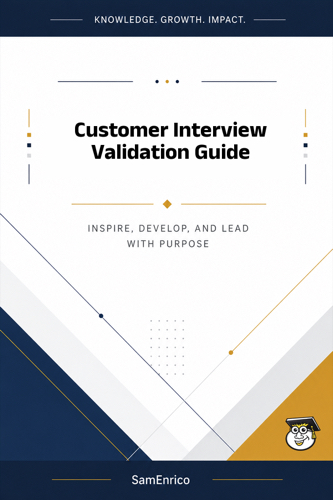
Customer Interview Validation Guide eBook
Conducts problem discovery interviews to test busi
Conducts problem discovery interviews to test business ideas before building.
Formats
Free sample
Chapter 1: The Compliment Trap--–- Three months before his startup ran out of money, a founder named Mike sat in a coffee shop with his notebook open to a page filled with thirty-seven "yes" responses. He had surveyed friends, former colleagues, and a few strangers on Linked In. Every single person told him his idea for a team communication tool was "brilliant." One person wrote, "I would download this today." Another said, "Finally, someone is solving this problem." Mike felt invincible. He raised $150,000 from an angel investor who was impressed by the survey results. He hired two developers.
He worked sixteen-hour days for nine months. When the product launched, exactly zero people paid for it. Not one. The same people who had promised to download it "today" did not even open the free trial. Mike’s investor called the experience a "$100,000 education." Mike called it a nightmare.
He had not built a bad product. He had asked the wrong questions to the wrong people and then believed their answers. This book exists because Mike’s story is not unusual. It is the default outcome for founders who mistake politeness for proof.The Most Dangerous Sentence in Business There is a sentence that has destroyed more startups than bad code, poor marketing, and running out of cash combined. That sentence is: "Great idea!" When someone says these two words to you, you feel a rush of validation.
Your brain releases dopamine. You want to hear it again. You start to believe that the world is waiting for your solution. But here is the brutal truth that separates successful founders from the ones who close their doors after eighteen months: a compliment costs nothing. A compliment requires no action, no risk, no change in behavior.
Your mother says "great idea" because she loves you and wants you to feel supported. Your best friend says it because they do not want to hurt your feelings. Your mentor says it because they want to encourage you to keep going. None of these people are lying in the way we normally think about lying. They are not trying to deceive you.
They are trying to be kind. And kindness is the most dangerous force in early-stage customer discovery because it feels exactly like validation but produces exactly the opposite result.The difference between approval and validation is the difference between a warm blanket and a cold shower. Approval feels good. It wraps around you and makes you feel safe. Validation is uncomfortable.
It asks hard questions. It demands evidence. It forces you to confront the possibility that your idea might be worthless. Most founders avoid validation because it is painful. They seek approval because it is pleasant.
Then they build products based on pleasant lies and wonder why the market does not care. This chapter is designed to make approval feel suspicious to you. By the time you finish reading, you will hear "great idea" and instinctively flinch. You will learn to distinguish between the people who love you and the people who can save your business. They are rarely the same people.The Hierarchy of Evidence: From Worthless to Gold Before we can talk about how to conduct interviews, we need a shared language for evaluating what people tell you.
Not all feedback is created equal. In fact, most feedback is worse than useless because it actively misdirects you. The Hierarchy of Evidence is the backbone of this entire book. Every interview, every question, every follow-up will be measured against this framework. Memorize it.
Write it on a sticky note and put it on your monitor. Internalize it so deeply that you cannot imagine having a customer conversation without it.At the bottom of the hierarchy, occupying the largest and most useless space, are Opinions. An opinion is any statement about what someone might do, might want, or might feel in the future. "I would use that product." "That sounds like something I need." "I think my team would love this." These statements are worthless. Not weak.
Not moderately useful. Worthless. The reason is simple: humans are terrible predictors of their own future behavior. Study after study has shown that self-reported future intentions correlate with actual behavior less than thirty percent of the time. When you ask someone "Would you buy this?" you are not conducting research.
You are conducting a fantasy exercise. The person answering is not lying to you maliciously. They are lying because their brain is wired to imagine a future version of themselves that is more organized, more motivated, and more interested than the real version will ever be.One level above opinions are Promises. A promise is a statement of future action that costs the speaker nothing to say. "I will buy this when it launches." "Send me the link and I will sign up." "I will definitely tell my colleagues about this." Promises are weak evidence.
They are better than opinions only because they require slightly more commitment from the speaker. But talk is cheap. People promise things all the time and forget within hours. The gap between "I will" and "I did" is where most startup dreams go to die. Treat every promise as a hypothesis to be tested, not a fact to be trusted.Above promises are Actions.
An action is something the person has already done. "I searched for a solution to this problem last week." "I tried three different tools and none of them worked." "I spent two hours manually solving this yesterday." Actions are strong evidence because they cannot be faked in the moment. If someone has already spent time, money, or effort trying to solve a problem, that problem is real. They have voted with their behavior, not just their words. Actions are the first level of the hierarchy that actually means something.At the very top, occupying the smallest and most valuable space, is Commitment.
A commitment is an action that the person agrees to take in the future that costs them something real. "I will put down a ten percent deposit for early access." "I will introduce you to my head of department tomorrow." "I will give you thirty minutes next week to review your wireframes." Commitments are gold because they require the person to risk something. They might waste time. They might look foolish. They might have to explain to a colleague why they are interested in an unproven solution.
When someone gives you a commitment, they are proving that their interest is not just politeness. They are putting skin in the game.Throughout this book, your goal in every single customer conversation will be to move up the hierarchy. Start by deflecting opinions. Ignore promises. Listen for actions.
And always, always ask for a commitment at the end. If you leave an interview without a commitment, you did not validate anything. You had a pleasant conversation with a stranger who was too polite to tell you that your idea does not matter to them.The Fake Yes Phenomenon There is a specific pattern of self-deception that destroys more founders than any other cognitive bias. It is called the Fake Yes phenomenon. Here is how it works.
You ask someone a question like "Would you use this product?" They pause for a moment. They nod. They say…
This is the end of the free sample. Get the eBook to keep going. Buy now
About this book
Details
- Author
- Beck Nicholas
- Publisher
- SamEnrico
- Language
- English
- Genre
- Non-Fiction, Business Brief, Market Research
- Released
- 2026-06-09
- Pages (approx.)
- 136
- Available as
- eBook, Audiobook

Read better in the ZLOADR app
Your eBooks on your phone or tablet. Sign in with your SamEnrico account and start reading.
More by Beck Nicholas
 TM for AI ResearchersBeck Nicholas$11.99
 Healthcare Worker Stress GuideBeck Nicholas$11.99
 The 30 Day Affirmation ChallengeBeck Nicholas$11.99
 Fasting During Ramadan GuideBeck Nicholas$11.99
 Veteran Presence Wisdom GuideBeck Nicholas$11.99
 HGH For Anti Aging ClinicsBeck Nicholas$11.99
 Teacher Parent Conference GuideBeck Nicholas$11.99
 Israeli Green Tax CreditsBeck Nicholas$11.99
 Velvet and Steel: The Unseen Brushstrokes of Frida KahloBeck Nicholas$11.99
 Ashoka's Redemption: The Bloodbath That Changed an EmperorBeck Nicholas$11.99
 The Forgotten Pioneers: Portuguese Explorers and the Pygmies of the CongoBeck Nicholas$11.99
 Growing SarcococcaBeck Nicholas$11.99
You may also like
 CRE Market Analysis FrameworkZamora Yanira$11.99
 Business Plan Market Analysis GuideCrane Lorna$11.99
 Market Analysis For Business Plans GuideRhoades Booker$11.99
 Rental Market Analysis GuideTejada Catrice$11.99
 One Page Market Sizing PrimerVickery Yetta$12.99
 Ghana Consumer Behavior BriefOden Kindra$12.99
 Market Sizing WorksheetGant Dorian$12.99