
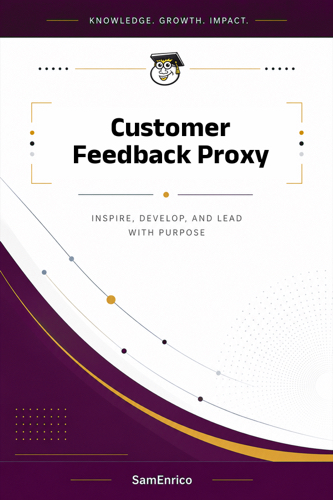
Customer Feedback Proxy eBook
Use satisfaction scores as remote productivity ind
Use satisfaction scores as remote productivity indicator.
Formats
Free sample
Chapter 1: The Visibility Trap--The email arrived at 9:14 AM on a Tuesday. Marcus had been working remotely for eleven months when his manager, Denise, sent him a screenshot from the company’s new productivity tracking software. The screenshot showed a red bar spanning fourteen minutes of “inactivity” – no mouse movements, no keystrokes, no application switching.“Can you explain what was happening during this time?” Denise wrote.Marcus stared at the email. He remembered exactly what he had been doing during those fourteen minutes. He had been reading a forty-seven-page technical manual stored on a local PDF – a manual that wasn’t indexed by the tracking software because it wasn’t a web-based application.
He was searching for a solution to an obscure error message that a long-time customer had encountered. The customer, a mid-sized manufacturing company, had been with them for six years and was responsible for nearly $200,000 in annual recurring revenue.Marcus found the answer on page thirty-two. He called the customer back, walked them through the fix in eleven minutes, and resolved the issue completely. The customer sent a follow-up email thanking Marcus for “going above and beyond” and later left a five-star satisfaction rating.But Denise wasn’t looking at the satisfaction rating. She wasn’t looking at the resolution time, the customer retention impact, or the revenue protected.
She was looking at fourteen minutes of red on a dashboard that measured only one thing: visible activity.Marcus replied to the email explaining what he had been doing. Denise responded: “In the future, please ensure you’re active in a tracked application during research time. Maybe keep a Word document open and type notes?”Marcus didn’t respond. He updated his resume that afternoon. He accepted a new job seventy-two hours later.
His exit interview cited “lack of trust and micromanagement.” The company spent $45,000 recruiting and onboarding his replacement, who took six months to reach Marcus’s proficiency level. During that six-month period, the manufacturing customer experienced three unresolved support tickets, grew frustrated, and moved to a competitor.The company lost $200,000 in annual recurring revenue to save zero dollars in productivity. They had solved for activity and lost value. They had measured presence and lost a customer.This is not an isolated story. This is the daily reality of remote work management in the twenty-first century, and it is destroying organizations from the inside.The Great Lie of Modern Management For more than a century, managers have operated under a simple assumption: if you can see your employees, you can trust your employees.
The factory floor, the office bullpen, the trading floor, the retail sales floor – all designed around a single principle of visibility. The manager walks the floor. The manager observes. The manager intervenes when something looks wrong.This model was never perfect, but it was functional. Visibility served as a cheap proxy for productivity.
If workers appeared busy, managers assumed they were being productive. If workers appeared idle, managers assumed value was being lost.Then remote work shattered that assumption entirely.When the COVID-19 pandemic forced millions of workers into their homes, managers lost the one tool they had relied on for generations: line-of-sight supervision. The response was swift and, as we will see throughout this book, catastrophically wrong. Companies rushed to install screen recorders, keystroke loggers, mouse trackers, and automated screenshot-capture software. They implemented hourly check-ins, mandatory video-on policies, and randomized “wellness checks” that were really surveillance audits by another name.The tracking software industry grew 547 percent between 2020 and 2022.
Billions of dollars were spent on tools designed to answer one question: “What are my employees doing right now?”But that was the wrong question. The right question – the only question that matters in a remote work environment – is “What value are my employees creating for customers right now?”The tragedy of modern remote management is that we have spent billions of dollars measuring the wrong thing because measuring the right thing requires a degree of trust that most managers have not yet developed. This chapter is designed to break that pattern. By the time you finish reading, you will understand why traditional supervision fails in remote environments, why surveillance tools are actively destroying your productivity, and what you should be measuring instead.The Presenteeism Delusion Let us begin with a concept that will appear only once in this book because it is so foundational that repeating it would be redundant: presenteeism is a lie.Presenteeism is the phenomenon of being physically present at work – or, in the remote context, appearing to be present – while mentally, emotionally, or functionally absent. In an office, presenteeism looks like an employee sitting at their desk for nine hours while accomplishing two hours of meaningful work.
In a remote context, presenteeism looks like an employee jiggling their mouse every few minutes to appear active while scrolling social media on a second device.The research on presenteeism is damning. A 2021 study published in the Journal of Applied Psychology tracked 1,200 knowledge workers across six months. The study found that remote workers averaged 5.2 hours of deep, focused work per day, while office workers averaged only 3.1 hours. The rest of the office worker’s day was consumed by commuting, interruptions, meetings, hallway conversations, and the performative busyness that comes from being visible to a manager.Yet when managers were asked to rate productivity, they consistently rated office workers as more productive than remote workers. Why?
Because visibility creates an illusion of value. A worker who looks busy feels productive to a manager, even if nothing meaningful is being accomplished. A worker who is deeply focused but invisible feels unproductive, even if they are delivering exceptional outcomes.This is the presenteeism delusion, and it is the root cause of virtually every failed remote management strategy.Consider the data from a 2022 analysis of 3,400 remote workers across forty-seven companies. Researchers compared two metrics: hours logged (as measured by tracking software) and customer satisfaction scores (as measured by post-interaction surveys). The correlation between hours logged and customer satisfaction was essentially zero: r = 0.03.
Workers who logged sixty-hour weeks were no more likely to have satisfied customers than workers who logged thirty-five-hour weeks. In fact, the highest-performing cohort – the top 10 percent of customer satisfaction scores – worked an average of thirty-eight hours per week, slightly below the company average of forty-two hours.The lowest-performing cohort – the bottom 10 percent of customer satisfaction scores – worked an average of forty-nine hours per week, significantly above the average. They were working harder and delivering worse outcomes. Their managers, however, rated them as “highly engaged” because they were always visible, always responding to messages, always appearing busy.Presenteeism rewards activity. Customer satisfaction rewards value.
These are not the same thing, and in a remote environment, they often move in opposite directions.The Panopticon Effect: Why Watching Workers Makes Them Worse The Panopticon was a prison design proposed by philosopher Jeremy Bentham in the late eighteenth century. The design featured a circular layout with a central watchtower from which a single guard could observe all prisoners without the prisoners knowing whether they were being watched at any given moment. The mere possibility of surveillance was sufficient to modify behavior.Modern workplace surveillance operates on the same principle, but with…
This is the end of the free sample. Get the eBook to keep going. Buy now
About this book
Details
- Author
- Whitmore Kimberli
- Publisher
- SamEnrico
- Language
- English
- Genre
- Non-Fiction, Business Brief, Customer Success
- Released
- 2026-06-10
- Pages (approx.)
- 135
- Available as
- eBook, Audiobook

Read better in the ZLOADR app
Your eBooks on your phone or tablet. Sign in with your SamEnrico account and start reading.
More by Whitmore Kimberli
 Parental Boundaries Self Care GuideWhitmore Kimberli$11.99
 Thyroid and MenopauseWhitmore Kimberli$11.99
 Mayor of a SuburbWhitmore Kimberli$11.99
 Small Business Crisis HandbookWhitmore Kimberli$11.99
 Coping With Identity Theft StressWhitmore Kimberli$11.99
 Microbiome Antibiotic RecoveryWhitmore Kimberli$11.99
 Memory Athlete Pre BedWhitmore Kimberli$11.99
 The Last Laugh of Camp Crystal LakeWhitmore Kimberli$11.99
 Galileo's Stargazing Adventure: Unlocking the Secrets of the CosmosWhitmore Kimberli$11.99
 Justinian and Theodora: The Golden Reign of ByzantiumWhitmore Kimberli$11.99
 The Mineral Guide to Varieties That Are Not Valid Species:Whitmore Kimberli$11.99
 Korea University of TechnologyWhitmore Kimberli$12.99
You may also like
 Mentorship for Customer SuccessStarkey Yuko$11.99
 Persuasive Customer Success PlanBarrows Yessenia$11.99
 Scaling SaaS Customer Success PlaybookValentin Kenneth$11.99Scaling SaaS Customer Success PlaybookValentin Kenneth$11.99
 Middle Eastern Post Sale SupportPfeiffer Jestine$12.99
 Middle East After Sales Service GuideThomas James$12.99
 Post Payment Follow Up HandbookMurry Cristopher$12.99