
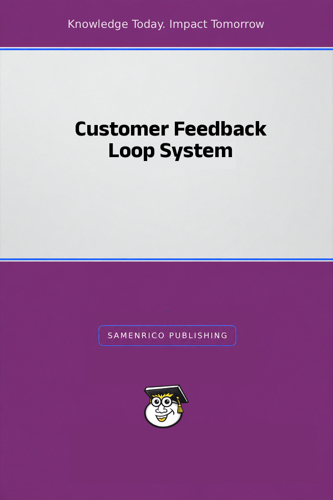
Non-FictionBusiness BriefFeedback Management
Customer Feedback Loop System eBook
Collect, analyze, and act on customer input to clo
by Crisp Deadra
Collect, analyze, and act on customer input to close the loop continuously.
Formats
Free sample
Chapter 1: The Loyalty Lie--–- A software company called Streamline Analytics had a problem that made no sense on paper. Their customer satisfaction score was 92 percent. Their product had won industry awards. Their support team responded to tickets in under two hours. And yet, every month, 8 percent of their customers churned.
Not the angry ones—those, they expected to lose. The satisfied ones. The ones who told survey-takers they were "very happy" with the product. The ones who gave four out of five stars and then, three weeks later, canceled without a word.Streamline is not an outlier. It is the rule.
Across industries, 20 to 40 percent of customers who say they are satisfied still defect to competitors within a year. They are not lying on surveys. They are simply measuring something different. Satisfaction looks backward: "How was your last interaction?" Loyalty looks forward: "Will you still be here next year?" And the gap between those two questions is where businesses lose billions.This chapter dismantles the myth that customer satisfaction guarantees loyalty. You will learn why satisfied customers churn, how the Net Promoter Score (NPS) separates growth drivers from silent defectors, and why closing the feedback loop is not a customer service expense but a revenue retention engine.
You will also be introduced to a concept missing from most customer experience books: customer segmentation by lifetime value. A $10 customer and a $10,000 customer do not deserve the same follow-up. This chapter shows you how to tier your response without tiering your respect.By the end of this chapter, you will understand why satisfaction is a trap, why loyalty is the only metric that matters, and how to calculate the ROI of closing your loop before you invest a single dollar in new software.The Satisfaction Trap: Why "Good Enough" Is Never Enough Let us start with a hard truth. Satisfaction is the lowest bar in customer experience. A customer can be satisfied and still leave.
They can be satisfied and still tell their friends to go elsewhere. They can be satisfied and still switch to a competitor the moment a cheaper option appears.Why? Because satisfaction measures the past. It asks: "How was your most recent interaction?" That is like asking a restaurant diner "How was your soup?" after they have eaten it. Even if the soup was excellent, it does not predict whether they will come back tomorrow.
They might want something different. They might find a better restaurant. They might have enjoyed the soup but decided they are on a soup-free diet.The research is unsettling. A study of 15,000 banking customers found that 80 percent of defectors had reported being "satisfied" or "very satisfied" on their most recent survey. In the telecommunications industry, the number is even higher: 85 percent of customers who switched providers had given a satisfaction score of four or five on a five-point scale.
They were not unhappy. They were just not loyal.Satisfaction surveys also suffer from what psychologists call response bias. Customers who are extremely angry respond. Customers who are extremely happy respond. The vast middle—the "satisfied but indifferent" majority—rarely bothers to fill out a survey at all.
That means your satisfaction score is built on the tails of the distribution, not the center. You are measuring the outliers, not the mainstream.Worse, satisfaction scores are easy to game. A free upgrade, a small discount, or a friendly support agent can lift a satisfaction score in minutes. But that lift is temporary. The underlying relationship has not changed.
The customer still does not trust you. They still do not see you as indispensable. They are still one small annoyance away from leaving.This is the satisfaction trap. You measure it. You celebrate it.
You assume it means loyalty. And then you are shocked when the churn report arrives.The Net Promoter Score: One Question That Changes Everything In 2003, Fred Reichheld published a Harvard Business Review article that challenged decades of satisfaction orthodoxy. His question was simple: "How likely are you to recommend this company to a friend or colleague?" He called it the Ultimate Question because it predicted customer behavior better than any satisfaction metric.The logic was elegant. A customer who recommends you is putting their own reputation on the line. They are not just saying they liked you.
They are saying they trust you enough to stake their social capital. That is a different measure entirely.Reichheld found that answers to this single question correlated more strongly with actual customer behavior—retention, share of wallet, referrals—than lengthy satisfaction surveys. Over time, the question became the basis for the Net Promoter Score (NPS) , now used by two-thirds of Fortune 1000 companies.How NPS Works:Customers answer the Ultimate Question on a 0-to-10 scale. Based on their response, they are categorized into three groups:Score Category Behavior Economic Impact9-10Promoter Loyal enthusiasts who keep buying and urge others to do the same Lifetime value 3-5x higher than Detractors7-8Passive Satisfied but indifferent. Easily poached by competitors.Unpredictable.
Will leave for a 10% discount elsewhere.0-6Detractor Unhappy customers trapped in a bad relationship. Spread negative word-of-mouth.Cost up to 5x more to serve. Churn rate 40-60% annually.The NPS score itself is calculated as: % Promoters – % Detractors. Scores range from -100 (everyone is a Detractor) to +100 (everyone is a Promoter). A score above zero is considered "good." Above 50 is "excellent." Above 70 is "world-class."But here is what most books do not tell you: the score is not the point.
The score is just a headline. The real value of NPS is the categorization. Knowing that a customer is a Detractor tells you to take action. Knowing they are a Promoter tells you to thank them and ask for a referral. Knowing they are a Passive tells you to find out what is missing.The Detractor-Complainer Distinction (A Critical Clarification)One of the most common mistakes in feedback systems is conflating Detractors (NPS score 0-6) with complainers (anyone who provides negative feedback).
These are different populations. A customer can give a Detractor score and never utter a word of complaint. They simply leave. Conversely, a customer can give a Passive score (7-8) and write a long, angry email about a specific problem. They are complainers, but they are not Detractors by the NPS definition.Why does this distinction matter?
Because the follow-up strategy is different.Detractors (0-6) who do NOT complain are at the highest risk of silent churn. They have already mentally checked out. They need proactive outreach: "We noticed you gave us a low score. Can you tell us why?" This is rescue work.Complainers who gave a 7 or 8 are engaged. They care enough to tell you about the problem.
They are not yet lost. They need a problem-solving conversation, not a rescue mission.Detractors (0-6) who also complain are a hybrid. They are angry but still talking. They need immediate, high-touch recovery.Throughout this book, when we say "Detractor," we mean the NPS definition: a score of 0-6. When we say "complainer," we mean anyone who provides negative feedback through any channel, regardless of their score.
And when we say "detractor follow-up," we mean the specific strategy for rescuing customers who gave a low score, whether…
This is the end of the free sample. Get the eBook to keep going. Buy now
About this book
Details
- Author
- Crisp Deadra
- Publisher
- SamEnrico
- Language
- English
- Genre
- Non-Fiction, Business Brief, Feedback Management
- Released
- 2026-06-10
- Pages (approx.)
- 138
- Available as
- eBook, Audiobook

Read better in the ZLOADR app
Your eBooks on your phone or tablet. Sign in with your SamEnrico account and start reading.
More by Crisp Deadra
 Wild And Crazy Guy MemoirCrisp Deadra$11.99
 Emotional Eating Calorie AwarenessCrisp Deadra$11.99
 Empathy Skills at Work GuideCrisp Deadra$11.99
 The Notorious B.I.G. Brooklyn StoryCrisp Deadra$11.99
 Silk & Sabotage: The Forgotten Heist That Reshaped FashionCrisp Deadra$11.99
 How to Become a Steeping-press TenderCrisp Deadra$11.99
 Minority Firm Contract TerminationCrisp Deadra$12.99
 Startup Invoice SoftwareCrisp Deadra$12.99
 Sales PlannerCrisp Deadra$11.99
 Learn to Play the ArobapáCrisp Deadra$11.99
You may also like
 Hong Kong Handover 1997Dunn Johnnie$11.99
 Zumba For Postnatal Recovery CourseNeal Christian$11.99
 Zumba for BeginnersLadner Nikia$11.99
 YouTube Comment Mining GuideHumes Pandora$12.99
 Worry Box MeditationCarlin Rudy$11.99
 Workplace Stress MeditationNguyen Lynn$11.99
 Workplace Stress and Sleep RepairHawley Ivory$11.99
 Workplace Perfectionism CureDelaney Jeffry$11.99
 Workplace Injustice Anger GuideWallen Isabelle$11.99
 Work Addiction and Burnout LinkGreenwood Ester$11.99
 Women in Yoga and WellnessBeattie Galina$11.99
 Women in Stand Up ComedyChun Evangeline$11.99