
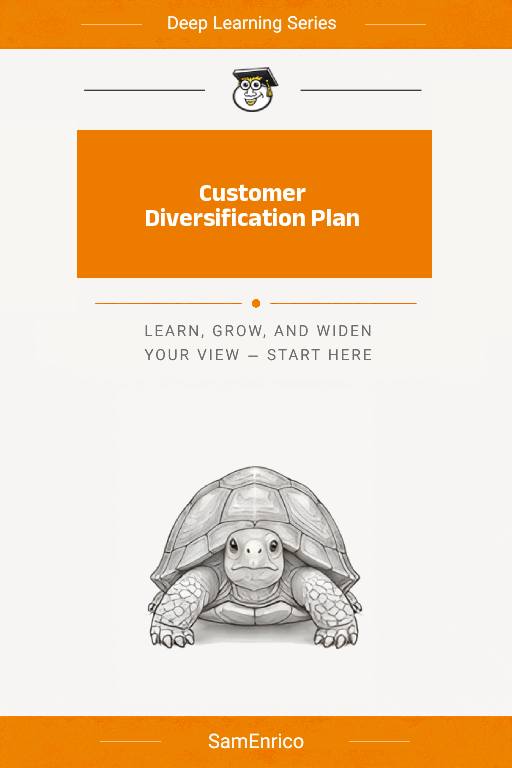
Non-FictionCrisis ManagementSales
Customer Diversification Plan eBook
Rebuild your client portfolio to reduce dependency
by Daniels Seth
Rebuild your client portfolio to reduce dependency after a major bankruptcy with tiered revenue targets.
Formats
Free sample
Chapter 1: The Dependency Illusion--Most business leaders discover they have a concentration problem at exactly the wrong moment: when their largest client files for bankruptcy, gets acquired by private equity, or simply announces they are "taking the business in a different direction." The phone call comes on a Tuesday afternoon. The voice on the other end is apologetic, professional, and utterly indifferent to your fate. And in that single moment, years of relationship building, custom feature development, and dedicated account management evaporate like smoke.The immediate aftermath is a blur of spreadsheet calculations, emergency board calls, and a creeping sense of dread that settles into your bones. You run the numbers once, then again, hoping you made a mistake. But the math is merciless.
That one client represented 34 percent of your revenue. Forty-seven percent of your engineering team's roadmap was built around their requests. Sixty-two percent of your accounts receivable was tied up in their unpaid invoices. You are not a business with a client problem. You are a business with an existential crisis.This chapter is about how you got here.
But more importantly, it is about how you can spot the warning signs years before the bankruptcy announcement appears on Bloomberg. The dependency that kills most small and medium-sized businesses does not arrive like a thief in the night. It arrives like a slow tide, rising inch by inch, disguised as partnership, disguised as loyalty, disguised as the very success you worked so hard to achieve.The Core Argument: Dependency Is Not Partnership Let me state the thesis of this chapter—and, in many ways, of this entire book—as directly as possible: A client that represents more than 15 percent of your annual revenue is not a partner. It is a structural liability that you have mistakenly labeled as an asset.This claim sounds provocative because it contradicts everything you have been taught about business development. You have been told to land whales, to build deep relationships, to become indispensable to your largest accounts.
And these strategies work—until they don't. The problem is not the strategy itself. The problem is that most business owners confuse the feeling of importance with the reality of risk.When a client pays you $10 million annually, they feel like a partner. Their executives know your executives by first name. You have shared Slack channels, joint business reviews, and an annual off-site where you talk about "co-innovation." But here is the uncomfortable truth that no one tells you: none of that goodwill will survive a bankruptcy filing, an acquisition, or a change in procurement leadership.
The moment your client's survival is at stake, you become a line item. And line items get cut.The distinction I want you to internalize is between what I call a Strategic Partner and a Structural Crutch. These terms will appear throughout the book, so let me define them with precision.A Strategic Partner is a client with whom you have reciprocal investment, multi-threaded relationships across departments and executive levels, shared data, and aligned long-term incentives. Critically, no single Strategic Partner represents more than 15 percent of your revenue. You have multiple Strategic Partners, and the loss of any one of them would be painful but survivable—a bad quarter, not a going-concern warning.A Structural Crutch is a client that props up your business while slowly breaking your back.
The relationship is asymmetrical: you have invested far more in them than they have invested in you. You have a single champion or a single department as your only point of contact. You have no visibility into their financial health beyond what they choose to share. And most dangerously, you have started to build your product roadmap, your hiring plan, and your cash flow projections around their continued patronage.The tragedy of the Structural Crutch is that it feels like success. Your largest client loves you.
They pay you on time (mostly). They ask for custom features that make your product better for everyone (maybe). But the moment they stumble, you fall twice as hard because you have built your house on their foundation.The Client Dependency Ratio: Your Most Important Number If you take nothing else from this chapter, take this: you need to calculate and monitor your Client Dependency Ratio (CDR) every single quarter. The formula is almost embarrassingly simple:CDR = Revenue from Largest Client / Total Revenue That is it. A single number that tells you, in seconds, how vulnerable you are to a single point of failure.The CDR thresholds I want you to internalize are as follows:CDR below 0.10 (10 percent): Healthy diversification.
You have no single client whose loss would cause a crisis. Continue monitoring quarterly.CDR between 0.10 and 0.15 (10-15 percent): Elevated risk. You are not in immediate danger, but you have entered what I call the warning zone. Any new deal that would push a client above 10 percent should trigger a formal review (a process we will cover in Chapter 10). You have time to diversify, but you must act deliberately.CDR between 0.15 and 0.25 (15-25 percent): Dangerous concentration.
You are one bad quarter away from an existential crisis. Every decision you make should prioritize reducing this ratio. Do not accept new custom work from this client. Do not build features exclusively for them. Begin an aggressive diversification campaign immediately.CDR above 0.25 (25 percent): Critical vulnerability.
Your business is not sustainable in its current form. The loss of this client would trigger layoffs, missed payroll, or worse. You should treat this as a board-level emergency, even if you are a sole proprietor.I can already hear the objections. "But my largest client is a Fortune 500 company. They are not going anywhere." "We have been doing business together for fifteen years." "They just signed a three-year contract extension."These objections are exactly why the CDR matters.
Every company that collapsed due to client concentration had the same rationalizations. Blockbuster had a concentration problem with its physical retail model. Hundreds of suppliers to Bed Bath & Beyond had concentration problems with that single retailer. Thousands of startups that built their entire product around Twitter's API had a concentration problem with a platform that changed its terms overnight.The CDR does not care about your relationship. The CDR does not care about your contract.
The CDR cares only about the cold, mathematical reality of your revenue structure. And that reality is that any revenue stream controlled by a single buyer is one decision away from disappearing.The Strategic Partner vs. Structural Crutch Diagnostic Let me give you a practical tool to determine whether your largest client is a genuine Strategic Partner or a dangerous Structural Crutch. I call this the Relationship Depth Audit. Score your largest client on each of the following five dimensions.
If you score three or more "Structured Crutch" answers, you are in danger regardless of your CDR.Dimension 1: Points of Contact Strategic Partner: We have relationships with at least three people across at least two departments (e.g., finance, operations, product). We know their CEO or equivalent leader.Structural Crutch: We have one primary champion. If that person leaves, we are not confident the relationship survives.Dimension 2: Financial Transparency Strategic Partner: They share relevant financial information with us (e.g., annual…
This is the end of the free sample. Get the eBook to keep going. Buy now
About this book
Details
- Author
- Daniels Seth
- Publisher
- SamEnrico
- Language
- English
- Genre
- Non-Fiction, Crisis Management, Sales
- Released
- 2026-06-01
- Pages (approx.)
- 146
- Available as
- eBook, Audiobook

Read better in the ZLOADR app
Your eBooks on your phone or tablet. Sign in with your SamEnrico account and start reading.
More by Daniels Seth
 Senior Technology EsteemDaniels Seth$11.99
 Anger And Grief ConnectionDaniels Seth$11.99
 Russian Wildlife Poaching MafiaDaniels Seth$11.99
 The Risk Pooling Safety StockDaniels Seth$11.99
 Transcendental Meditation Quick StartDaniels Seth$11.99
 Angry Subordinate ManagementDaniels Seth$11.99
 Animal Archetypes in DreamsDaniels Seth$11.99
 Procrastination for ChefsDaniels Seth$11.99
 Sabor a Mi: How a 19th-Century Mexican Telenovela Launched a Cultural RevolutionDaniels Seth$11.99
 Behind the Walls: The Psychological Battle for Reform in Middle Eastern PrisonsDaniels Seth$11.99
 How to Produce a Power Tower (Power Take-off)Daniels Seth$11.99
 The Photographer's Guide to PhotobiographyDaniels Seth$11.99
You may also like
 Hong Kong Handover 1997Dunn Johnnie$11.99
 Zumba For Postnatal Recovery CourseNeal Christian$11.99
 Zumba for BeginnersLadner Nikia$11.99
 YouTube Comment Mining GuideHumes Pandora$12.99
 Worry Box MeditationCarlin Rudy$11.99
 Workplace Stress MeditationNguyen Lynn$11.99
 Workplace Stress and Sleep RepairHawley Ivory$11.99
 Workplace Perfectionism CureDelaney Jeffry$11.99
 Workplace Injustice Anger GuideWallen Isabelle$11.99
 Work Addiction and Burnout LinkGreenwood Ester$11.99
 Women in Yoga and WellnessBeattie Galina$11.99
 Women in Stand Up ComedyChun Evangeline$11.99