
Non-FictionAnnual CheckupRegulatory Compliance
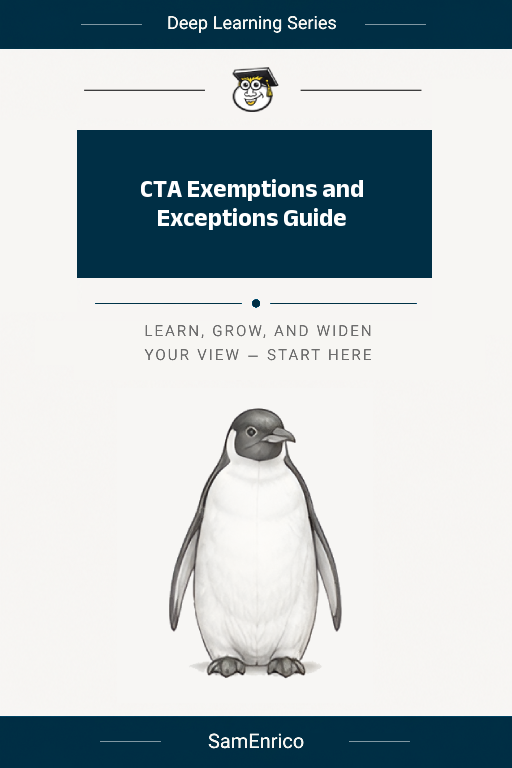
CTA Exemptions and Exceptions Guide eBook
Identifies 23 exemptions from Corporate Transparen
Identifies 23 exemptions from Corporate Transparency Act filing including large operating companies, banks, and public entities.
Formats
Free sample
Chapter 1: The Great Assumption--Every business owner in America wakes up today with a secret legal problem they do not know they have. The problem is not a lawsuit, a tax audit, or a regulatory investigation. It is something far more insidious: a federal law that assumes guilt first and grants innocence only to those who can prove they deserve it. This is the Corporate Transparency Act, and its most dangerous feature is not the penalties, the filing requirements, or the definition of beneficial ownership. The most dangerous feature is what this book calls the Great Assumption – the presumption that every entity is a Reporting Company unless it successfully claims one of twenty-three narrow exemptions.The Great Assumption reverses centuries of American legal tradition.
In ordinary law, the government must prove you are subject to a regulation before it can penalize you. Under the CTA, you must prove you are not subject to the regulation, or you are automatically in violation. This inversion of burden is not an accident or a drafting error. It is a deliberate design choice by Congress to close the anonymous shell company loophole that has allowed money laundering, tax evasion, and terrorist financing to flow through unregulated American entities for decades. The problem the CTA solves is real.
But the solution creates a compliance nightmare for millions of legitimate businesses that have never laundered a dollar or evaded a penny of tax.This chapter establishes the foundation for everything that follows. It explains why the CTA exists, what the Great Assumption means in practice, how the twenty-three exemptions function as affirmative defenses rather than automatic exclusions, and what happens when you get it wrong. By the end of this chapter, you will understand why the question "Do I need to file?" is the wrong question entirely, and why the correct question – "Which exemption applies to me, and how do I prove it?" – will save you from penalties that can reach nearly six hundred thousand dollars per day.The Corporate Transparency Act was signed into law on January 1, 2021, as part of the National Defense Authorization Act for Fiscal Year 2021. It was not a standalone bill that received extensive public debate. It was buried inside a must-pass defense spending bill, attached as the William M.
(Mac) Thornberry National Defense Authorization Act. This legislative maneuver meant that most business owners never heard about the CTA when it passed, and most lawyers did not begin studying it until years later, when Fin CEN finally released the implementing regulations. The quiet birth of the CTA is the first reason so many businesses remain unaware of their obligations. The second reason is the Great Assumption itself.Under traditional regulatory frameworks, a new law that imposes reporting requirements typically includes a grandfather clause, a safe harbor for existing entities, or a clear affirmative statement of who must comply. The CTA does none of these things.
Instead, it declares that every corporation, limited liability company, and similar entity created by filing a document with a secretary of state or similar office is a Reporting Company – unless it fits within one of twenty-three specific exemptions listed in 31 CFR § 1010.380(e)(2). The burden of proving the exemption falls entirely on the entity claiming it. There is no presumption of exemption. There is no grace period for entities that were formed before the law passed. There is no safe harbor for small businesses that genuinely do not know the law exists.The Great Assumption operates like a reverse audit.
In a normal tax audit, the IRS must identify a specific issue and then ask the taxpayer to substantiate a deduction or credit. The taxpayer remains presumptively compliant until proven otherwise. Under the CTA, every entity is presumptively non-compliant until it proves otherwise. Fin CEN does not need to identify any red flags or suspicious activity. The mere existence of the entity is enough to trigger the reporting obligation unless the entity proactively claims an exemption.
This shift is subtle but profound. It means that a business owner who has never heard of the CTA is already in violation of federal law on the day the regulations take effect, simply by virtue of having formed an entity that does not fall within an exemption.The twenty-three exemptions are the only way out of the Great Assumption. They are not optional exclusions that you can elect at your convenience. They are affirmative defenses that you must establish based on objective facts about your entity's size, ownership, regulatory status, or activities. If you claim an exemption that you do not actually qualify for, you are not simply wrong – you are in violation of federal law, subject to the same civil and criminal penalties as someone who never filed a Beneficial Ownership Information report at all.
This is a critical point that many compliance guides obscure. Claiming an exemption incorrectly is not a lesser violation. It is identical in the eyes of Fin CEN to failing to file.Understanding the exemptions as affirmative defenses changes the entire compliance calculus. Instead of asking "Do I need to file?" – a passive question that invites wishful thinking – you must ask "Which exemption applies to me, and what documentation do I need to prove it?" This is the methodology of reverse-engineered compliance, and it is the central framework of this book. You will start with the assumption that you are a Reporting Company, and then you will work backwards through the exemptions to see if any of them fit your entity.
If you find a fit, you will document it thoroughly and monitor it continuously for changes. If you do not find a fit, you will file your BOI report with Fin CEN within the required timeframe. What you will not do is guess, assume, or hope that no one notices.The penalties for getting this wrong are severe enough to destroy a small business and ruin a career. The CTA provides for civil penalties of up to 591perdayforeachdayofviolation,adjustedforinflation.Butthatstatutoryminimumisnottheceiling.Forwillfulviolations–whichincludeknowinglyfilingfalseinformation,knowinglyfailingtofile,orrecklesslydisregardingtherequirement–thecivilpenaltyincreasestotheinflation−adjustedmaximumof591 per day for each day of violation, adjusted for inflation. But that statutory minimum is not the ceiling.
For willful violations – which include knowingly filing false information, knowingly failing to file, or recklessly disregarding the requirement – the civil penalty increases to the inflation-adjusted maximum of 591perdayforeachdayofviolation,adjustedforinflation.Butthatstatutoryminimumisnottheceiling.Forwillfulviolations–whichincludeknowinglyfilingfalseinformation,knowinglyfailingtofile,orrecklesslydisregardingtherequirement–thecivilpenaltyincreasestotheinflation−adjustedmaximumof591,000 per day as of 2025. To put that number in perspective, a willful violation that continues for sixty days could result in civil penalties exceeding thirty-five million dollars. That is not a typo. Thirty-five million dollars is the potential civil exposure for a sixty-day willful violation.The criminal penalties are equally alarming. A person who willfully violates the CTA can be imprisoned for up to two years and fined up to $10,000.
These criminal penalties attach to individuals, not just entities. If you are a chief executive officer, chief financial officer, general counsel, compliance officer, or anyone else who is responsible for filing or determining exemption status, you personally can go to prison for a CTA violation. The entity cannot serve time. You can. This personal liability is a feature of the law, not a bug.
Congress intentionally imposed criminal penalties on individuals to ensure that corporate officers could not hide behind the entity's corporate veil.Consider…
This is the end of the free sample. Get the eBook to keep going. Buy now
About this book
Details
- Author
- Alba Julianne
- Publisher
- SamEnrico
- Language
- English
- Genre
- Non-Fiction, Annual Checkup, Regulatory Compliance
- Released
- 2026-06-01
- Pages (approx.)
- 151
- Available as
- eBook, Audiobook

Read better in the ZLOADR app
Your eBooks on your phone or tablet. Sign in with your SamEnrico account and start reading.
More by Alba Julianne
 Franchise Corporate Social Responsibility AbroadAlba Julianne$11.99
 The Emotional Regulation for BPDAlba Julianne$11.99
 Stress and Skin DisordersAlba Julianne$11.99
 Mammogram Callback Anxiety GuideAlba Julianne$11.99
 Customer Service Anger ControlAlba Julianne$11.99
 The Silk Road Tycoon: How a College Dropout Built a $1 Billion Empire in the ShadowsAlba Julianne$11.99
 Understanding Romberg Hemi-facial AtrophyAlba Julianne$17.99
 Multi-Channel E-Commerce BusinessAlba Julianne$11.99
 Invoice Factoring Nigeria GuideAlba Julianne$12.99
 How to Become a Stained Glass ArtistAlba Julianne$11.99
You may also like
 Hong Kong Handover 1997Dunn Johnnie$11.99
 Zumba For Postnatal Recovery CourseNeal Christian$11.99
 Zumba for BeginnersLadner Nikia$11.99
 YouTube Comment Mining GuideHumes Pandora$12.99
 Worry Box MeditationCarlin Rudy$11.99
 Workplace Stress MeditationNguyen Lynn$11.99
 Workplace Stress and Sleep RepairHawley Ivory$11.99
 Workplace Perfectionism CureDelaney Jeffry$11.99
 Workplace Injustice Anger GuideWallen Isabelle$11.99
 Work Addiction and Burnout LinkGreenwood Ester$11.99
 Women in Yoga and WellnessBeattie Galina$11.99
 Women in Stand Up ComedyChun Evangeline$11.99