
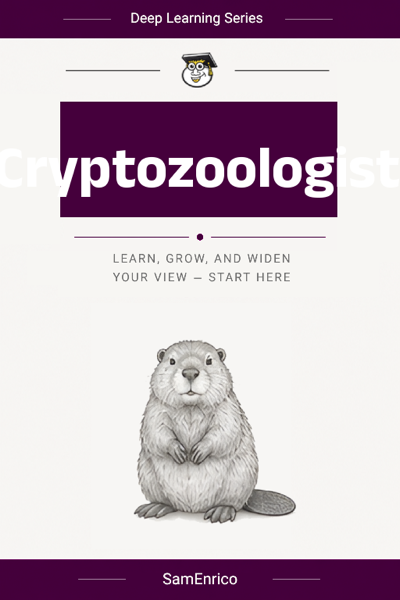
Non-FictionInformativeEducational
Cryptozoologist eBook
A Coursebook on Cryptozoologist
by Roth Alisa
A Coursebook on Cryptozoologist
Formats
Free sample
Chapter 1: The Map of Shadows--– In the winter of 1938, a fishing trawler named Nerine dragged its nets through the cold waters of the Indian Ocean, off the eastern coast of South Africa. The crew expected the usual haul: sharks, rattails, perhaps a few lanternfish. What they got instead was a creature that should have been dead for sixty-five million years. The fish that flopped onto the deck was five feet long, armored with gleaming scales, and possessed of lobed fins that looked unsettlingly like limbs. No one on board recognized it.
A local museum curator named Marjorie Courtenay-Latimer, summoned to the docks by a phone call from the trawler’s captain, later described her first glimpse: “I picked away the slime and saw the most beautiful fish I had ever seen. It was five feet long, a pale mauvy blue with faint flecks of whitish spots. It had an iridescent silver-blue-green sheen all over. It was covered in hard scales, and it had four limb-like fins and a strange puppy-dog tail.” She did not know it yet, but she was holding the coelacanth—a fish that paleontologists had declared extinct for 65 million years, a creature that had last appeared in the fossil record alongside the dinosaurs.That single fish changed everything. Not just for biology, which had to rewrite its understanding of evolutionary timelines.
But for cryptozoology, a field that did not even have a name yet. If a living fossil could hide for millions of years in waters that fishermen crossed every day, what else might be out there?This chapter traces the long, strange, and often dismissed history of hidden animals—from medieval bestiaries filled with creatures that turned out to be real, to the golden age of cryptozoology in the early twentieth century, to the modern milestones that still haunt the field. The key takeaway is simple but profound: forgotten, extinct, or dismissed zoology repeatedly becomes cryptozoology—and sometimes, as with the coelacanth, becomes biology. But we must begin with a caveat. Some of the earliest “evidence” for hidden animals comes from indigenous oral traditions around the world.
In this chapter, those traditions appear as cultural history, not as scientific evidence. They tell us what people believed and saw, not necessarily what existed. The ethical use of indigenous knowledge will receive its full treatment in Chapter 10. For now, we walk the map of shadows, where every blank space once read “Here Be Dragons”—and sometimes, the dragons were real.The Pre-Scientific World: Monsters on the Margin Long before Bernard Heuvelmans coined the term “cryptozoology” in the 1950s, humans were filling the edges of their maps with fantastic beasts. Medieval bestiaries—illustrated volumes describing animals both real and imagined—were the encyclopedias of their day.
They included the unicorn (a creature that almost certainly began as garbled accounts of the Indian rhinoceros, seen from a distance or described by secondhand travelers), the dragon (likely derived from crocodile and large snake sightings in regions where such animals were unknown to European audiences), and the bonnacon, a creature that supposedly defended itself by projecting flaming dung at pursuers (a plausible exaggeration of the defensive spraying behavior of certain ruminants).These were not mere fantasies. They were attempts to make sense of a world larger than any single culture could comprehend. When a medieval monk described a “sea serpent” with multiple humps, he was not lying. He was likely seeing a pod of surfacing whales or a line of porpoises and interpreting the sight through the only zoological framework available to him. The same cognitive machinery that produces modern cryptid sightings—patternicity, expectation bias, the brain’s desperate need to turn ambiguous stimuli into recognizable shapes—was already at work in the scriptorium.Travelers’ tales of exotic beasts often aged into scientific fact.
The giant squid, Architeuthis dux, appeared in Norse sagas as the kraken, a tentacled monster capable of dragging whole ships beneath the waves. For centuries, naturalists dismissed the kraken as sailor’s gossip. Then, in 1853, a giant squid corpse washed ashore in Denmark. In 1874, a Newfoundland clergyman photographed another. Today, we know that giant squids grow to over forty feet and possess eyes the size of dinner plates.
They are not monsters. They are just very large, very elusive animals. But for every kraken that became a species, a hundred other “monsters” remained unconfirmed.The lesson here is not that every legend contains a kernel of truth. It is that some do. And the cryptozoologist’s job is to distinguish which from which—not by faith, but by evidence.Sea Serpents: The First Global Cryptid No cryptid has a longer or more consistent history than the sea serpent.
From the Greek historian Plutarch’s account of a giant serpent that appeared along the coast of what is now Albania to the Norse sagas of the Midgard Serpent circling the entire world, the image of a long, undulating creature in the water is almost universal. In 1734, a Danish missionary named Hans Egede reported a “most dreadful monster” off the coast of Greenland: “Its body was very long, and as thick as a ship. It spouted water like a whale. It had very large flippers and its tail seemed to be like that of a serpent.” Egede was a sober observer, not given to sensationalism. But what did he actually see?
A whale with a deformed spine? A giant oarfish, which can reach thirty feet and swims with a sinuous, serpentine motion? A school of sea lions surfacing in sequence?The sea serpent became the first global cryptid precisely because it could be seen anywhere. By the nineteenth century, so many respectable witnesses—ship captains, naval officers, harbor masters—had reported serpentine creatures that the British Association for the Advancement of Science convened a special committee in 1845 to investigate. The committee collected hundreds of reports and concluded that the sightings were “not satisfactorily explained by any known animal.” That was not an endorsement of the sea serpent’s existence.
It was an admission of scientific humility.The most famous sea serpent case is also the most frustrating. In 1848, the crew of HMS Daedalus reported a “immense serpent” with a head like a snake and a body sixty feet long, moving at twelve knots off the coast of Africa. The report was signed by multiple officers, including the captain. No one doubted their honesty. But the drawing they produced showed a creature that looked remarkably like a large seal or a whale’s erect penis—a known misidentification that fooled even seasoned observers.
The Daedalus case became a cautionary tale: even credible witnesses can be wrong. And that is not a weakness of cryptozoology. It is a feature of human perception, which this book will dissect in Chapter 4.The Golden Age: Heuvelmans, Sanderson, and the Birth of a Discipline If cryptozoology has a founding father, it is Bernard Heuvelmans. A Belgian-born zoologist and protégé of the eccentric French naturalist Théodore Monod, Heuvelmans published On the Track of Unknown Animals in 1955. The book was a revelation.
It synthesized centuries of sightings, folkloric accounts, and physical evidence into a coherent argument: unknown animals are not supernatural. They are simply species that…
This is the end of the free sample. Get the eBook to keep going. Buy now
About this book
Details
- Author
- Roth Alisa
- Publisher
- SamEnrico
- Language
- English
- Genre
- Non-Fiction, Informative, Educational
- Released
- 2026-05-06
- Pages (approx.)
- 157
- Available as
- eBook, Audiobook

Read better in the ZLOADR app
Your eBooks on your phone or tablet. Sign in with your SamEnrico account and start reading.
More by Roth Alisa
 Dual Recovery Anonymous GuideRoth Alisa$11.99
 Values And Mission Alignment Performance ReviewsRoth Alisa$11.99
 Franchise Builder's Customer LoyaltyRoth Alisa$11.99
 Calming Breath ObservationRoth Alisa$11.99
 The Great Unraveling: How a Single Bank Brought the World to Its KneesRoth Alisa$11.99
 The Fires of Kilimanjaro: How the Chagga Kings Tamed the MountainRoth Alisa$11.99
 Blockchain Fundamentals PrimerRoth Alisa$12.99
 Financial Knowledge Management AIRoth Alisa$12.99
 Understanding Hypersensitivity Type IvRoth Alisa$17.99
 How to Start a Multi-layer Paper Obtained By Compression Business (Beginners Guide)Roth Alisa$11.99
You may also like
 Hong Kong Handover 1997Dunn Johnnie$11.99
 Zumba For Postnatal Recovery CourseNeal Christian$11.99
 Zumba for BeginnersLadner Nikia$11.99
 YouTube Comment Mining GuideHumes Pandora$12.99
 Worry Box MeditationCarlin Rudy$11.99
 Workplace Stress MeditationNguyen Lynn$11.99
 Workplace Stress and Sleep RepairHawley Ivory$11.99
 Workplace Perfectionism CureDelaney Jeffry$11.99
 Workplace Injustice Anger GuideWallen Isabelle$11.99
 Work Addiction and Burnout LinkGreenwood Ester$11.99
 Women in Yoga and WellnessBeattie Galina$11.99
 Women in Stand Up ComedyChun Evangeline$11.99