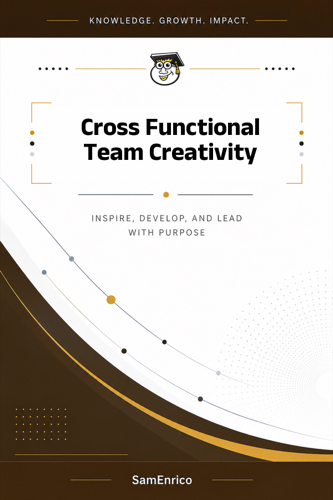
Cross Functional Team Creativity eBook
Brings diverse departments together for innovation
Brings diverse departments together for innovation.
Formats
Free sample
Chapter 1: The Diversity Paradox...--–- It was 3:47 PM on a Tuesday when the project died. Not with a dramatic explosion or a shouted resignation, but with a quiet, exhausted sigh from a senior engineer named Elena. She had just spent ninety minutes in a room with five other brilliant people from marketing, finance, product management, and sales. The goal was simple: brainstorm features for a new software tool that could capture a growing market. The outcome was anything but.
Marketing wanted "delightful user experiences" supported by vague customer anecdotes. Engineering wanted "technical specifications" backed by data sheets. Finance wanted "unit economics" before anyone had even sketched a prototype. Sales wanted "whatever the biggest potential client asked for yesterday." By the end, Elena had stopped talking. She opened her laptop, answered emails, and mentally checked out.
The team had convened with enthusiasm and dispersed with resentment. No one had been wrong. Everyone had been right—about their own piece of the puzzle. And that was precisely the problem.This scene plays out every day in thousands of organizations around the world. Smart, well-intentioned, highly compensated professionals from different departments gather in conference rooms—physical or virtual—and instead of generating breakthrough ideas, they generate friction, confusion, and paralysis.
The diversity that leadership sought as a competitive advantage becomes a liability. The cross-functional team, celebrated in business literature as the engine of innovation, becomes instead a machine for producing frustration.This book exists because that outcome is not inevitable. The problem is not diversity itself. The problem is diversity without a framework. You cannot simply throw engineers, marketers, accountants, and salespeople into a room and expect magic.
What you get, more often than not, is what Dorothy Leonard and Walter Swap called "creative abrasion"—but abrasion without guidance is just damage. The challenge, and the entire premise of this book, is to transform that natural friction into productive dissonance. To make the sparks from colliding perspectives light a fire instead of burning down the house.The Counterintuitive Truth at the Heart of This Book Let us state plainly what most management books dance around: putting smart people from different functions together does not automatically yield better ideas. It often yields worse ideas, slower decisions, and lower morale than if each function had worked alone. This is not speculation.
Decades of research on group dynamics, organizational behavior, and team effectiveness point to a consistent conclusion: diverse teams have higher creative potential but also higher failure rates. They are capable of breakthroughs that homogeneous teams cannot achieve, but they are also more likely to collapse into dysfunction.Think of it like nuclear fusion. The sun generates enormous energy by fusing hydrogen atoms under immense pressure and heat. But if you simply throw hydrogen atoms into a room, nothing happens. You need containment, temperature control, and a sustained reaction.
Cross-functional teams are the same. The potential energy from different perspectives is real—enormously real—but without the right conditions, that energy dissipates as heat, noise, and conflict.The fundamental mistake that most organizations make is treating cross-functional teams as an assembly problem rather than an ignition problem. They assume that if you gather the right people with the right skills, creativity will spontaneously emerge. It will not. In fact, the more expertise each member brings, the harder the collaboration becomes, because experts are deeply embedded in their functional assumptions.This book is built on a single, unifying concept that will appear in every chapter: cognitive conflict.
Cognitive conflict is disagreement over ideas, assumptions, evidence, or approaches. It is the productive friction that occurs when one person says "I see the problem this way" and another says "I see it completely differently," and instead of attacking each other, they attack the problem from two angles. Cognitive conflict is the engine of innovation. It is what happens when an engineer says "that's technically impossible" and a marketer says "customers don't care about technical impossibility, they care about value," and the two of them work together to find a third path that neither saw alone.The enemy of innovation is not conflict. The enemy is affective conflict—disagreement that becomes personal.
Affective conflict is when "your idea is wrong" becomes "you are wrong." It is when the engineer and the marketer stop arguing about the product and start arguing about each other's competence, intelligence, or motives. Affective conflict destroys trust, silences dissent, and drives creative work underground. It is the difference between a heated debate that ends with a better solution and a heated argument that ends with HR.Throughout this book, you will learn to generate more cognitive conflict while preventing its escalation into affective conflict. You will learn to recognize the difference in yourself and in your team. You will learn that harmony is overrated—silence is not agreement, it is usually fear—and that the most innovative teams are not the ones that get along best, but the ones that have learned to fight productively.Why Cross-Functional Teams Are Necessary Despite the Difficulty If cross-functional collaboration is so hard, why bother?
Why not let engineering invent, marketing sell, and finance count, each in their own silos, coordinated only by senior leadership? The answer is simple: the problems worth solving no longer fit inside a single function.Consider the Boeing 787 Dreamliner, a case study we will revisit throughout this book. Boeing set out to build an airplane that was radically more fuel-efficient, comfortable, and technologically advanced than anything before it. To do so, they assembled a cross-functional team of engineers, supply chain experts, designers, financiers, and safety regulators. On paper, this was a dream team.
In reality, the diversity of perspectives led to catastrophic delays. The engineers wanted to push the boundaries of composite materials. The supply chain team wanted to outsource major components to global partners to reduce cost. The designers wanted passenger cabins with larger windows and higher humidity. Each function pursued its own version of excellence.
And because no framework existed to harness the friction between them, the project ran years behind schedule and billions over budget.The tragedy is that the Dreamliner eventually became a successful aircraft. The potential was always there. But the cost of unmanaged friction was staggering. The same pattern repeats across industries: medical devices delayed because regulatory and R&D teams cannot agree on testing protocols; software products that miss market windows because engineering and product management speak different languages; marketing campaigns that flop because creative and legal teams cannot find common ground.The alternative is not to abandon cross-functional teams but to equip them better. The organizations that succeed—from Pixar to IDEO to Amazon—have not solved the problem of friction.
They have learned to channel it. They have built processes, structures, and cultures that turn the natural abrasion between functions into a source of creative energy rather than a drain on it.The Occupational Foreigners Metaphor Throughout this book, we will refer to colleagues from other functions as Occupational Foreigners. This metaphor is deliberate. When you travel to another country, you encounter people who speak a different language, follow different customs, value different things, and operate according to different rules. You do not expect them…
This is the end of the free sample. Get the eBook to keep going. Buy now
About this book
Details
- Author
- Gaskin Josphine
- Publisher
- SamEnrico
- Language
- English
- Genre
- Non-Fiction, Self-Help, Cross Functional
- Released
- 2026-06-06
- Pages (approx.)
- 156
- Available as
- eBook, Audiobook

Read better in the ZLOADR app
Your eBooks on your phone or tablet. Sign in with your SamEnrico account and start reading.
More by Gaskin Josphine
 Road Rage Virtual Reality TrainingGaskin Josphine$11.99
 Anticipatory Grief And Young ChildrenGaskin Josphine$11.99
 Sentinel Lymph Node BiopsyGaskin Josphine$11.99
 Divorce Therapy ModalitiesGaskin Josphine$11.99
 Benefits Summary LineGaskin Josphine$11.99
 Excess Inventory AIGaskin Josphine$11.99
 Persuasion for ManagersGaskin Josphine$11.99
 The Scholars of Timbuktu: Guardians of the Golden Age of LearningGaskin Josphine$11.99
 The Last Dance of the Icebergs: How a Melting Glacier Changed the WorldGaskin Josphine$11.99
 How to Produce CookiesGaskin Josphine$11.99
 Reducing Transfer Fees on Export PaymentsGaskin Josphine$12.99
 Argentine CBC Completion GuideGaskin Josphine$12.99