
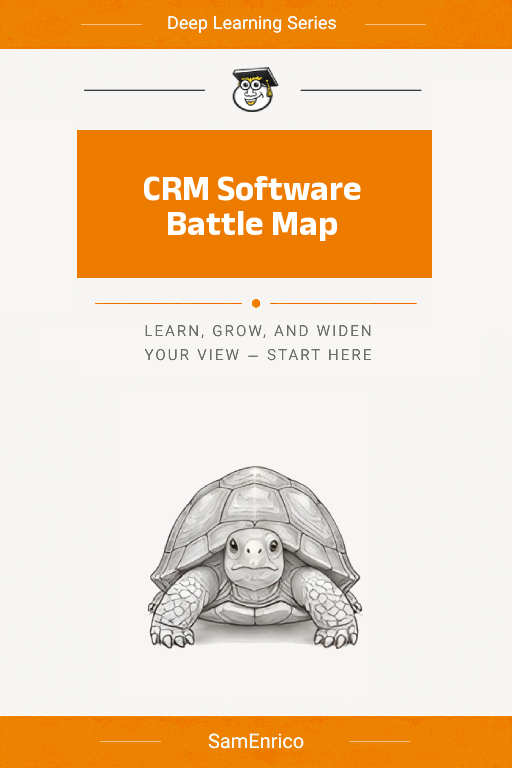
Non-FictionStrategic AtlasEnterprise Software
CRM Software Battle Map eBook
Compare Salesforce, Microsoft Dynamics, HubSpot, a
by Good Collene
Compare Salesforce, Microsoft Dynamics, HubSpot, and Oracle on enterprise fit versus ease of use.
Formats
Free sample
Chapter 1: The $100 Billion Blindspot--–- In 2019, a mid-sized medical device company we will call Med Tech Solutions signed a $1.2 million contract with a major CRM vendor. The software had everything: predictive forecasting, territory management, complex quoting, full audit trails, and seamless integration with their ERP system. The CIO celebrated. The CFO approved the budget. The board applauded the digital transformation initiative.Eighteen months later, Med Tech Solutions had less pipeline visibility than when they started using spreadsheets.
Their VP of Sales was fired. Their CTO resigned. And the CRM system that was supposed to be their competitive advantage had become a $4.2 million paperweight—including implementation, customization, and three failed attempts to get sales reps to log their activities.The software worked perfectly. The problem was that no one used it.This story is not an outlier. It is the rule.The Failure Nobody Talks About Let me state the central argument of this book as plainly as possible: organizations almost never fail at CRM because the software lacked a feature.
They fail because users refuse to use the software they already paid for.I have analyzed dozens of CRM implementations across industries ranging from Saa S startups to global manufacturing firms. I have interviewed CIOs who lost their jobs over failed deployments, sales VPs who watched their teams actively sabotage new systems, and reps who would rather manually update three different spreadsheets than click three buttons in an "enterprise-grade" CRM.The data confirms what these stories suggest. Industry research consistently shows that approximately 50 percent of CRM implementations fail to meet expectations, and the primary cause is not technical. It is human. Users reject the system.
They find workarounds. They maintain shadow spreadsheets. They comply minimally when watched and revert to old habits the moment pressure subsides.Here is what makes this statistic truly devastating: every single one of those failed implementations began with a thorough feature comparison. Someone made a spreadsheet. Someone checked boxes next to capabilities like "custom reporting," "workflow automation," and "API access." Someone concluded that Vendor A had more checkmarks than Vendor B, and the deal was signed.That spreadsheet was worthless.
It measured the wrong thing entirely.The Feature Trap The feature trap is the single most expensive cognitive bias in enterprise software purchasing. It works like this: when faced with a complex decision involving multiple products, the human brain naturally gravitates toward what is easily comparable. Features are easily comparable. Vendors publish feature lists. Analysts create feature grids.
Consultants build feature-weighted scorecards.Ease of use is not easily comparable. It cannot be captured in a checkbox. It cannot be quantified in a vendor's marketing materials. It cannot be evaluated without putting real users in front of a real system and watching what happens.So buyers default to features. And vendors know this.Every CRM vendor has mastered the art of feature marketing.
Salesforce will show you Einstein AI predicting deal closes with eerie accuracy. Microsoft will demonstrate Copilot generating follow-up emails from inside Outlook. Hub Spot will dazzle you with a beautifully animated lead scoring interface. Oracle will walk you through compliance reports that would satisfy a federal auditor.These are all real capabilities. They are not lies.
But they are also not the reason your CRM implementation will succeed or fail.Your CRM implementation will succeed if and only if your sales team actually uses it to manage their daily work. Not because they are forced to. Not because management checks their activity logs. But because the system makes their job easier, faster, or more profitable.No feature list in any vendor's sales deck can guarantee that outcome.The Battle Map Framework This book introduces a new framework for evaluating CRM platforms, one that prioritizes the question that actually matters over the questions that are merely easy to answer. I call it the Battle Map.The Battle Map plots every CRM platform along two critical axes.
The first axis is Enterprise Fit: security, scalability, compliance, customization depth, integration capabilities, and the ability to handle complex business processes. This is the dimension that IT and finance care about. It is the dimension that feature checklists measure reasonably well.The second axis is Ease of Use: intuition, onboarding speed, daily user happiness, mobile experience, and whether the tool provides immediate value to the person doing the work. This is the dimension that sales reps care about. It is the dimension that feature checklists miss entirely.Here is the brutal truth that vendors will never tell you: no platform excels at both.
The design choices that create enterprise fit—customization options, security layers, complex data models, audit trails—directly conflict with the design choices that create ease of use—simplicity, speed, fewer clicks, less configuration.Every CRM vendor has made a bet. Salesforce bet on enterprise fit. Hub Spot bet on ease of use. Microsoft bet on ecosystem integration as a bridge between the two. Oracle bet on data management and compliance, sacrificing user experience almost entirely.Your job is not to find the "best" CRM.
Your job is to understand where your organization sits on this map and choose the vendor whose bet aligns with your needs.But here is where the Battle Map becomes truly useful: it reveals that the vast majority of organizations are not well-served by the extremes. Most companies do not need Salesforce's infinite customizability. Most companies cannot tolerate Oracle's six-month deployment timelines. Most companies will outgrow Hub Spot's per-contact pricing model before they reach their fifth year.The sweet spot is somewhere in the middle. But the middle is not a single point.
It is a dynamic position that shifts as your company grows, as your sales process becomes more complex, and as your compliance requirements expand.The Four Gladiators Before we go any further, let me introduce the four protagonists who will battle across this map throughout the book. Each represents a distinct philosophy about the trade-off between enterprise fit and ease of use.Salesforce is the customizable giant. It offers unmatched power, an infinite App Exchange marketplace, and AI capabilities that are genuinely impressive. But that power comes at a cost: Salesforce requires dedicated administrators, expensive consultants, and ongoing maintenance. It is the CRM you buy when you have a Rev Ops team and complex, non-standard sales processes.
It is also the CRM that your sales reps will complain about on day one and continue complaining about until they leave the company.Microsoft Dynamics 365 is the ecosystem integrator. Its greatest strength is invisibility—it lives inside Teams, Outlook, and the tools your team already uses all day. For organizations deep in the Microsoft ecosystem, this integration creates friction reduction that no competitor can match. But the familiar interface creates a false sense of confidence; configuration still requires real technical expertise, and the modular pricing model makes total cost unpredictable.Hub Spot is the growth hacker. Its interface is so intuitive that new users can be productive in hours.
Its free tier lets teams start without budget approval. Its onboarding feels like breathing compared to the suffocating complexity of enterprise alternatives. But the scaling ceiling is real and brutal. The per-contact pricing model becomes a success tax that punishes growth.…
This is the end of the free sample. Get the eBook to keep going. Buy now
About this book
Details
- Author
- Good Collene
- Publisher
- SamEnrico
- Language
- English
- Genre
- Non-Fiction, Strategic Atlas, Enterprise Software
- Released
- 2026-06-01
- Pages (approx.)
- 143
- Available as
- eBook, Audiobook

Read better in the ZLOADR app
Your eBooks on your phone or tablet. Sign in with your SamEnrico account and start reading.
More by Good Collene
 TM and EEG Coherence GuideGood Collene$11.99
 Creative Deprivation MethodGood Collene$11.99
 The Postpartum Bleeding GuideGood Collene$11.99
 The Assertiveness for Nurses GuideGood Collene$11.99
 Manager Anger Control GuideGood Collene$11.99
 The Iron Navigators: How Portugal Unlocked the WorldGood Collene$11.99
 Understanding Phacomatosis PigmentovascularisGood Collene$17.99
 How to Become a Commutator AssemblerGood Collene$11.99
 One Page Plan for ConsultantsGood Collene$12.99
 Taylor Swift: The Eras Tour Record BreakerGood Collene$11.99
You may also like
 Hong Kong Handover 1997Dunn Johnnie$11.99
 Zumba For Postnatal Recovery CourseNeal Christian$11.99
 Zumba for BeginnersLadner Nikia$11.99
 YouTube Comment Mining GuideHumes Pandora$12.99
 Worry Box MeditationCarlin Rudy$11.99
 Workplace Stress MeditationNguyen Lynn$11.99
 Workplace Stress and Sleep RepairHawley Ivory$11.99
 Workplace Perfectionism CureDelaney Jeffry$11.99
 Workplace Injustice Anger GuideWallen Isabelle$11.99
 Work Addiction and Burnout LinkGreenwood Ester$11.99
 Women in Yoga and WellnessBeattie Galina$11.99
 Women in Stand Up ComedyChun Evangeline$11.99