
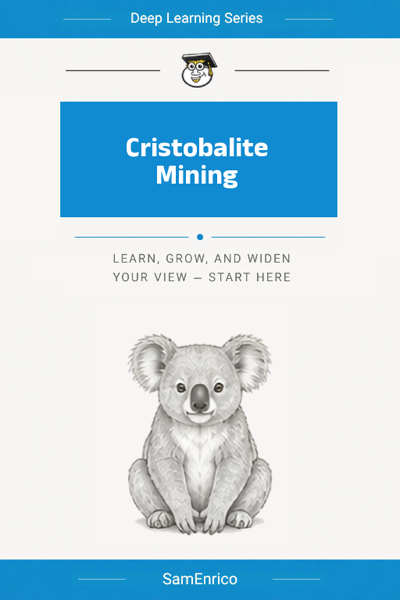
Non-FictionInformativeEducational
Cristobalite Mining Audiobook
A Coursebook on Cristobalite Mining
by Worth Kendal
A Coursebook on Cristobalite Mining
Formats
Free sample
Chapter 1: The Silica Lie--–- The first problem you will encounter in studying cristobalite is that nearly everything you think you know is wrong. If you came to this book expecting to learn about mining operations—shovels, haul trucks, conveyor belts, and processing plants pulling a mineral called cristobalite directly from the earth—you have been misled by a convenient industry fiction. The truth is far more interesting, far more technical, and far more valuable to understand.This chapter exists to shatter the foundational misconception that has confused engineers, investors, and students for decades. We will uncover why the term "cristobalite mining" persists despite being almost entirely inaccurate, what cristobalite actually is, and why the synthetic production of this remarkable material has become a quiet but essential pillar of modern manufacturing. By the time you finish this chapter, you will understand the silica polymorph system, the dramatic phase transition that makes cristobalite both useful and dangerous, and the physical properties that drive a global market measured in hundreds of millions of dollars.Let us begin with a confession from the industry itself.The Convenient Fiction Walk onto the production floor of any major cristobalite supplier—Sibelco in Belgium, Covia in Ohio, Quarzwerke in Germany—and you will hear workers refer to "mining" cristobalite.
Their websites speak of "natural cristobalite" and "high-purity crystalline silica." Their marketing materials emphasize the "natural origin" of their products. None of this is technically false, but all of it is strategically incomplete.The reality is this: commercially viable deposits of naturally occurring cristobalite do not exist. Yes, cristobalite forms in nature. It appears in volcanic rocks such as obsidian, pumice, and rhyolite. It crystallizes from silica-rich lavas that cooled under specific conditions.
It can be found in some meteorites and in lunar rocks brought back by Apollo astronauts. But these natural occurrences are mineralogical curiosities, not industrial resources.Why? Three reasons.First, natural cristobalite is never pure. Volcanic environments introduce a chaotic array of impurities—iron, titanium, aluminum, sodium, calcium—that become locked into the crystal structure. These impurities alter the material's color (turning it gray, brown, or green), reduce its brightness, and change its thermal behavior.
For most industrial applications, especially engineered stone and high-end coatings, even trace amounts of iron (above 0.02%) ruin the product.Second, natural cristobalite deposits are small and inconsistent. A vein of volcanic cristobalite might run for a few meters before…
This is the end of the free sample. Get the Audiobook to keep going. Buy now
About this book
Details
- Author
- Worth Kendal
- Publisher
- SamEnrico
- Language
- English
- Genre
- Non-Fiction, Informative, Educational
- Released
- 2026-06-02
- Pages (approx.)
- 146
- Available as
- eBook, Audiobook

Listen in the VoxFlicks app
Audiobooks and audio dramas wherever you go. Sign in with your SamEnrico account and press play.
More by Worth Kendal
 Ivan Lendl Ice ManWorth Kendal$11.99
 Equifax Class Action LawyersWorth Kendal$11.99
 SAS Motorbike Escape StoryWorth Kendal$11.99
 Emotional Intelligence For DiplomatsWorth Kendal$11.99
 Mistake Recovery EsteemWorth Kendal$11.99
 The Last Analog Call: How the World Said Goodbye to Rotary PhonesWorth Kendal$11.99
 The Architect of the Wind: The Djinn Who Built BabylonWorth Kendal$11.99
 Pop Up Retail Window DisplayWorth Kendal$12.99
 USD Billing Navigation GuideWorth Kendal$12.99
 Understanding Gastric Dumping SyndromeWorth Kendal$17.99
 How to Become a Job AnalystWorth Kendal$11.99
You may also like
 Hong Kong Handover 1997Dunn Johnnie$11.99
 Zumba For Postnatal Recovery CourseNeal Christian$11.99
 Zumba for BeginnersLadner Nikia$11.99
 YouTube Comment Mining GuideHumes Pandora$12.99
 Worry Box MeditationCarlin Rudy$11.99
 Workplace Stress MeditationNguyen Lynn$11.99
 Workplace Stress and Sleep RepairHawley Ivory$11.99
 Workplace Perfectionism CureDelaney Jeffry$11.99
 Workplace Injustice Anger GuideWallen Isabelle$11.99
 Work Addiction and Burnout LinkGreenwood Ester$11.99
 Women in Yoga and WellnessBeattie Galina$11.99
 Women in Stand Up ComedyChun Evangeline$11.99