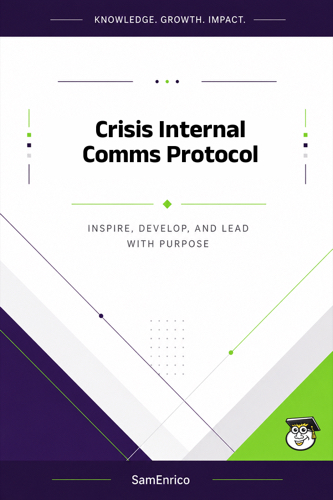
Crisis Response Block Guide
Build flexibility into blocks with emergency respo
by Yoon Treasa
Build flexibility into blocks with emergency response protocol and rescheduling authority.
Formats
About this book
Free sample
Chapter 1: The Day the Plan Died--The first thing you need to understand about crisis management is that your plan is already obsolete. Not because you wrote it badly, not because your team is untrained, and not because you chose the wrong fonts for the emergency binders sitting on the shelf behind your desk. Your plan is obsolete because plans, by their very nature, assume a world that behaves predictably. And crises, by their very nature, do not.Let me tell you about the morning of March 24, 1989. At twelve minutes past midnight, the Exxon Valdez, a supertanker the length of three football fields, ran aground on Bligh Reef in Prince William Sound, Alaska.
The ship was carrying 53 million gallons of crude oil. Within hours, 11 million gallons would spill into one of the most biologically rich marine environments on Earth. It remains one of the worst environmental disasters in American history.But here is what most people do not know. The initial breach was survivable. The ship was damaged but not sinking.
The captain was not on the bridge, having retired to his cabin while the third mate attempted to maneuver through ice-filled waters. That was a failure of judgment, certainly. But the catastrophic spill that followed, the one that killed hundreds of thousands of seabirds, otters, and seals, the one that contaminated over 1,300 miles of coastline, the one that cost two billion dollars to clean up and still left oil on the beaches decades later—that catastrophe was not caused by the grounding. It was caused by the response.Or more precisely, it was caused by the absence of a response.For the first fourteen hours after the grounding, the ship's crew, the Coast Guard, and Alyeska Pipeline Service Company (the consortium responsible for oil spill response in the region) engaged in what can only be described as bureaucratic paralysis. They followed checklists.
They waited for approvals. They consulted procedures written for a different kind of emergency. They called supervisors who called supervisors. At 3:30 AM, the Exxon Valdez's crew requested permission to begin lightering the ship—transferring oil to another vessel…
This is the end of the free sample. Get the eBook to keep going. Buy now
Contents
- Chapter 1
- Chapter 2
- Chapter 3
- Chapter 4
- Chapter 5
- Chapter 6
- Chapter 7
- Chapter 8
- Chapter 9
- Chapter 10
- Chapter 11
- Chapter 12
Details
- Author
- Yoon Treasa
- Publisher
- SamEnrico
- Language
- English
- Genre
- Non-Fiction, Professional's Cheat Sheet, Crisis Management
- Released
- 2026-05-29
- Pages (approx.)
- 151
- Available as
- eBook, Audiobook

Read better in the ZLOADR app
Your eBooks on your phone or tablet. Sign in with your SamEnrico account and start reading.
More by Yoon Treasa
 The Meeting Warm Up GuideYoon Treasa$11.99
 The Amputation Pain GuideYoon Treasa$11.99
 Pinterest VA Discovery Call ScriptsYoon Treasa$11.99
 Exercise During Breast CancerYoon Treasa$11.99
 Conversation Starters for Cultural EventsYoon Treasa$11.99
 Echoes of the Cosmic Symphony: The Voyager Golden Record's Interstellar MessageYoon Treasa$11.99
 The Polio Wars: Salk vs. Sabin and the Race to Eradicate a KillerYoon Treasa$11.99
 Understanding Cold UrticariaYoon Treasa$17.99
 Singapore Early Stage Fund GuideYoon Treasa$12.99
 Collection AssistantYoon Treasa$11.99
 How to Start a Show Case Business (Beginners Guide)Yoon Treasa$11.99