
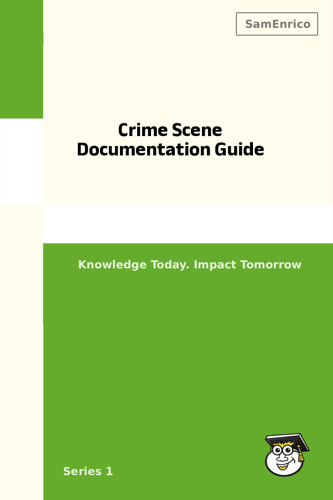
Crime Scene Documentation Guide eBook
Master photography, sketching, note-taking, and vi
by Sosa Lorrie
Master photography, sketching, note-taking, and videography for legally defensible records.
Formats
Free sample
Chapter 1: The Invisible Record...--–- Every crime scene tells a story, but without proper documentation, that story becomes a whisper in a hurricane—heard by no one, believed by none, and forgotten before the first witness takes the stand. The difference between a conviction and an acquittal often has nothing to do with the quality of the forensic analysis or the brilliance of the detective work. It has everything to do with the record. The written notes, the photographs, the sketches, and the video footage that leave the scene in the hands of an investigator become the only version of the truth that a jury will ever see. The scene itself will be cleaned, altered, demolished, or simply weathered away.
The blood will dry. The fingerprints will be lifted and removed. The body will be taken to the morgue. What remains—the only thing that remains—is the documentation.This is the invisible record. It is invisible because when it is done correctly, no one notices it.
The judge does not remark on the clarity of the photolog. The jury does not applaud the thoroughness of the sketch. The defense attorney does not compliment the chronological precision of the notes. But when the record is flawed, it becomes blindingly visible. Missing photo numbers.
Sketches without measurements. Notes written hours after the scene was released. Videography that jumps and shakes and zooms erratically. These failures are not technicalities. They are the open doors through which guilty defendants walk free.This chapter introduces the foundational philosophy that drives every page of this book: the four pillars of crime scene documentation—notes, photography, sketching, and videography—are not separate tasks to be checked off a list.
They are a single, integrated system. Each pillar supports the others. Each pillar exposes the weaknesses of the others. And when all four are erected properly, they form a structure that no cross-examination can collapse.The Four Pillars Defined Before we can understand how the pillars work together, we must understand what each pillar is and, equally important, what it is not.Notes are the chronological, written account of everything that happens at the scene from the moment of notification to the moment of release. They include observations, actions, measurements, personnel arrivals, evidence discoveries, and the chain of custody.
Notes are not a report. They are not a narrative written for a prosecutor. They are the raw, unfiltered, contemporaneous record. They are written in ink, on consecutively numbered pages, in real time. Notes answer the question: What happened, when, and who did it?Photography is the visual capture of the scene as it exists at the moment of the investigator's arrival.
It is not artistic. It is not compositional in the aesthetic sense. It is forensic. Every photograph must be true, accurate, and reproducible. Photography answers the question: What did it look like?Sketching is the spatial blueprint of the scene.
Unlike photography, which flattens three-dimensional space into a two-dimensional image with inherent lens distortion, sketching preserves exact measurements and distances. A sketch is not a work of art. It is a data visualization. It answers the question: Where was everything in relation to everything else?Videography is the narrative walk-through of the scene. It provides context that still photographs cannot—the flow from room to room, the approach to a body, the play of light across a bloodstain pattern.
But videography is not a replacement for photography. Video lacks the resolution to capture fine detail, and single frames extracted from video are rarely admissible as evidence. Videography answers the question: What would it feel like to walk through this scene?Each pillar is essential. None is sufficient alone.The Fallacy of the Single Method New investigators often believe that mastery of one pillar compensates for weakness in another. This is a dangerous fallacy.
Consider the investigator who takes exceptional photographs but writes sloppy notes. At trial, the defense attorney asks: "Officer, your photograph number 47 shows a knife on the bedroom floor. But your notes do not mention discovering that knife. Can you tell the jury exactly when you found it, who was present, and whether anyone touched it before your photograph was taken?" The investigator has no answer. The photograph is truthful, but without the notes, it is orphaned—disconnected from the chain of events that gave it meaning.Consider the investigator who keeps meticulous notes but sketches poorly.
The notes say the body was found "approximately three feet from the foot of the bed." The defense produces a witness who testifies that the bed was moved before the police arrived. Without an accurate sketch with fixed reference points, the investigator cannot prove the original distance. The notes become a guess, not a measurement.Consider the investigator who produces beautiful scaled diagrams but takes mediocre photographs. The sketch places the weapon exactly 47 inches from the south wall. But the photographs are blurry, poorly lit, and fail to show the weapon in context.
The defense argues that the sketch is a reconstruction, not a record, and without clear photographs to validate it, the jury cannot trust what they cannot see.The pillars work together. A failure in one is a failure in all.The Cross-Referencing Standard The single most important concept in this chapter—and arguably in this entire book—is the Cross-Referencing Standard. It is simple to state but difficult to execute perfectly. Here it is:Every piece of information in one pillar must be findable in at least one other pillar.In practice, this means:Every photograph number must appear in the notes, logged at the exact time it was taken, with a brief description of what the photograph depicts.Every piece of evidence identified in the notes must be locatable on the sketch, either by measurement coordinates or by a labeled evidence marker that appears in the photographs.Every video segment must have a corresponding entry in the notes, noting the start time, end time, and the path covered.Every measurement on the sketch must be verifiable by photographs showing the tape measure in place, or by notes describing the measurement method.This standard creates redundancy. Redundancy is not inefficiency.
Redundancy is the foundation of legal defensibility. When the defense attacks one pillar, the other pillars stand ready to corroborate. When a note is illegible, the photograph provides context. When a photograph is ambiguous, the sketch provides clarity. When a sketch is questioned, the video provides the visual flow.Consider a typical cross-examination exchange without the Cross-Referencing Standard:Defense Attorney: "Officer, you testified that the knife was found on the blue rug.
But looking at your photograph number 22, I don't see any rug. I see a floor. Where is the rug?"Investigator: "The rug is there. The photograph just doesn't show it well."Defense Attorney: "So the jury should just take your word for it?"Now consider the same exchange with the Cross-Referencing Standard in place:Defense Attorney: "Officer, you testified that the knife was found on the blue rug. But looking at your photograph number 22, I don't see any rug."Investigator: "That's correct.
Photograph 22 is a close-up of the knife with a scale. The rug is visible in photograph 21, which is…
This is the end of the free sample. Get the eBook to keep going. Buy now
About this book
Details
- Author
- Sosa Lorrie
- Publisher
- SamEnrico
- Language
- English
- Genre
- Non-Fiction, True Crime
- Released
- 2026-06-11
- Pages (approx.)
- 151
- Available as
- eBook, Audiobook

Read better in the ZLOADR app
Your eBooks on your phone or tablet. Sign in with your SamEnrico account and start reading.
More by Sosa Lorrie
 The Startup Bookkeeping DIY GuideSosa Lorrie$11.99
 Focus For Operations ManagersSosa Lorrie$11.99
 Failure Reframing ImposterSosa Lorrie$11.99
 ADA Section 504 Occupation StorySosa Lorrie$11.99
 Mobile Apps for Hypnosis RecordingSosa Lorrie$11.99
 Journey Method For Daily TasksSosa Lorrie$11.99
 Entrepreneur Time BlockingSosa Lorrie$11.99
 The Radiant Court of Queen Amina: Warrior Queen of ZazzauSosa Lorrie$11.99
 How to Produce a DrainSosa Lorrie$11.99
 How to Produce Popcorn and French Fry ScoopsSosa Lorrie$11.99
 Exploring Still Life Painting: Objects, Arrangement & SymbolismSosa Lorrie$11.99
 Research Proposal Ethics Clearance HandbookSosa Lorrie$12.99
You may also like
 Hong Kong Handover 1997Dunn Johnnie$11.99
 Zumba For Postnatal Recovery CourseNeal Christian$11.99
 Zumba for BeginnersLadner Nikia$11.99
 YouTube Comment Mining GuideHumes Pandora$12.99
 Worry Box MeditationCarlin Rudy$11.99
 Workplace Stress MeditationNguyen Lynn$11.99
 Workplace Stress and Sleep RepairHawley Ivory$11.99
 Workplace Perfectionism CureDelaney Jeffry$11.99
 Workplace Injustice Anger GuideWallen Isabelle$11.99
 Work Addiction and Burnout LinkGreenwood Ester$11.99
 Women in Yoga and WellnessBeattie Galina$11.99
 Women in Stand Up ComedyChun Evangeline$11.99