
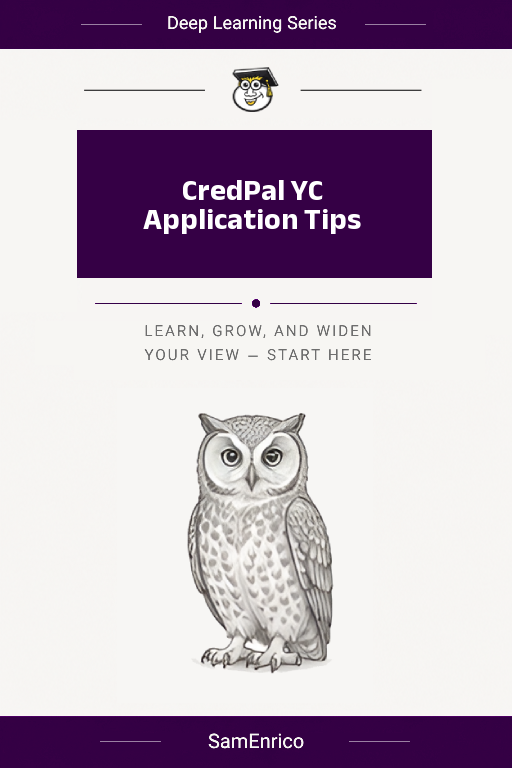
Non-FictionStartup GuideAccelerator PrepConsumer Credit
CredPal YC Application Tips eBook
Study CredPal Y Combinator consumer credit applica
Study CredPal Y Combinator consumer credit application and apply their buy now pay later story to fintech.
Formats
Free sample
Chapter 1: The Mother's Fridge--–- The refrigerator broke on a Tuesday. That was the detail that haunted Fehintolu Olaogun years later, even after he had raised millions of dollars and been profiled in tech publications. Not the crash of the compressor or the slow leak of coolant—just the mundane Tuesdayness of it. His mother had come home from the market, opened the freezer to store the fish she had just bought, and found the contents warm. She called a repairman.
The repairman came, poked at the compressor with a screwdriver, and delivered the verdict: beyond fixing. A new refrigerator would cost ₦150,000—approximately $360 at the time.His mother had the money. That was the second detail that stuck. She was not destitute. She had a steady income, a small business selling provisions, and a network of family and friends who would have lent her the ₦150,000 if she had asked.
But she did not ask, because asking felt like failure. Instead, she rearranged. She bought a secondhand fridge from a neighbor for ₦45,000. It lasted eight months. Then it broke too.
The cycle repeated: repair, postpone, replace with something cheaper, repeat.Fehintolu watched this pattern for years, not just in his mother's kitchen but across Lagos. His neighbors, his cousins, his friends from university—all of them competent, employed, financially functional adults—could not make large purchases work. They could afford ₦5,000 per day for food, but not ₦150,000 for a refrigerator. They could afford ₦20,000 per week for school fees, but not ₦300,000 for the term upfront. They could afford ₦10,000 per month for phone credit, but not ₦120,000 for a new smartphone.The problem was not poverty.
The problem was lump sums.The Lump Sum Barrier This chapter opens where every successful fintech application must open: not with a product, not with a market size calculation, not with a founder's resume—but with a specific, visceral, almost humiliating moment of customer failure. The refrigerator that broke on a Tuesday is not a story about refrigerators. It is a story about the gap between how money flows and how life demands it be spent.Most fintech founders make a catastrophic mistake when they sit down to write their Y Combinator application. They start with what they are building. "We are a BNPL platform." "We provide installment credit." "We offer working capital loans to SMEs." These statements are factually correct and utterly useless.
YC partners read thousands of applications. They have seen every product category, every business model, every clever twist on lending. What they have not seen is your specific observation of a specific pain point that everyone else has stopped noticing because it has become invisible—normalized by decades of quiet suffering.Cred Pal's winning observation was not that Nigerians lacked credit. That was obvious. Banks had known that for decades.
The World Bank had written reports about it. Every fintech founder in Lagos could recite the statistic: credit card penetration below 2%, millions of adults excluded from formal lending.The winning observation was something smaller, sharper, and more actionable: Middle-income Nigerians could afford daily expenses but could not aggregate those small payments into large purchases. This is not a banking problem. Banks are not designed to solve aggregation problems; they are designed to assess creditworthiness, extend lines of credit, and collect repayment with interest. The aggregation problem is a product design problem—a mismatch between the timing of income (daily, weekly, irregular) and the timing of expenses (lump sum, unpredictable, urgent).Why Banks Didn't Solve It To understand why Cred Pal succeeded where banks failed, we must first understand why banks never even tried.
The answer is not incompetence or lack of capital. Nigerian banks are sophisticated institutions with billions of dollars in assets, thousands of employees, and decades of experience in consumer lending. They are not failing because they are stupid. They are failing because they are optimized—optimized for a different customer, a different risk profile, and a different cost structure.Consider the economics of a traditional bank loan. To underwrite a ₦150,000 loan to a new customer, a bank must collect documentation (proof of income, proof of address, identification), run a credit bureau check (if the customer has a credit history—most do not), conduct a manual review by an underwriter, and set up repayment collection infrastructure (direct debit, reminders, collections agency for defaults).
The total cost of this process, even for a digital-first bank, is typically ₦15,000–₦25,000 per approved loan. That is 10–15% of the loan principal. On a loan with a 15% annual interest rate, the bank needs the customer to repay for at least 12 months just to break even on the underwriting cost, assuming zero defaults.Now consider the customer. The middle-income Nigerian who needs a ₦150,000 refrigerator is not going to keep that loan outstanding for 12 months. They want to repay in 2–3 months.
The bank's interest income on a 3-month loan of ₦150,000 at 15% annualized is roughly ₦5,600. That is less than the underwriting cost. The bank loses money on every small, short-term loan it makes.This is the structural misalignment that Cred Pal identified. Banks make money on large loans (millions of naira) with long durations (12–36 months). The fixed costs of underwriting are amortized over a larger principal and longer repayment period.
Small, short-term loans are economically irrational for banks to make—not because they are risky, but because they are unprofitable given the bank's cost structure.Cred Pal's insight was not to lower the cost of underwriting (though they did). It was to eliminate underwriting as traditionally conceived. By requiring a 30% down payment, Cred Pal created a self-screening mechanism. A customer who could produce ₦45,000 for the down payment had demonstrated three things: first, they had access to some liquidity; second, they were committed to the purchase (the down payment was non-refundable); third, they had a repayment capacity (they could afford the remaining ₦105,000 over 60 days). No credit bureau check.
No manual underwriter. No documentation beyond basic identity verification.The Frustration Monologue One of the most powerful exercises in this book—the exercise that separates applications that get read twice from applications that get skimmed and rejected—is what Cred Pal called the "Frustration Monologue." Here is how it works.Take a blank sheet of paper. Write for 200 words from your customer's internal voice, describing a specific moment when the problem you are solving caused them tangible harm, embarrassment, or frustration. Do not use jargon. Do not use your company's name.
Do not describe your solution. Just describe the pain. Be specific about the object (a refrigerator, a school fee bill, a smartphone), the amount (₦150,000, $360), the timing (Tuesday, end of month, before a holiday), and the emotion (shame, frustration, resignation, desperation).Here is Cred Pal's Frustration Monologue, reconstructed from their internal documents and early pitch decks:*"The refrigerator broke on Tuesday. I knew it was coming—it had been making that noise for weeks—but I kept putting off the repair because I didn't have the lump sum. Now the fish I bought this morning is thawing.
The kids will be home from school in three hours expecting dinner. My salary comes in ten days. I have ₦45,000 in my savings account. The fridge costs ₦150,000. I could ask my sister for money, but I already…
This is the end of the free sample. Get the eBook to keep going. Buy now
About this book
Details
- Author
- Kendall Julienne
- Publisher
- SamEnrico
- Language
- English
- Genre
- Non-Fiction, Startup Guide, Accelerator Prep, Consumer Credit
- Released
- 2026-05-26
- Pages (approx.)
- 131
- Available as
- eBook, Audiobook

Read better in the ZLOADR app
Your eBooks on your phone or tablet. Sign in with your SamEnrico account and start reading.
More by Kendall Julienne
 Email Batching Productivity GuideKendall Julienne$11.99
 The Governor's AffairKendall Julienne$11.99
 Digital Body Language SignsKendall Julienne$11.99
 Data Leak International Customer ScriptsKendall Julienne$11.99
 IBS Enzyme Supplement GuideKendall Julienne$11.99
 The Balloon Astronauts: Europe's First High-Altitude PioneersKendall Julienne$11.99
 Blood and the Iron Crown: The Vampire Conspiracy of Vlad the ImpalerKendall Julienne$11.99
 Understanding Cmv Antenatal InfectionKendall Julienne$17.99
 Production Schedule VisualizationKendall Julienne$12.99
 Airbrush Tattoo ArtistKendall Julienne$11.99
 How to Become a Irrigation EngineerKendall Julienne$11.99
You may also like
 Hong Kong Handover 1997Dunn Johnnie$11.99
 Zumba For Postnatal Recovery CourseNeal Christian$11.99
 Zumba for BeginnersLadner Nikia$11.99
 YouTube Comment Mining GuideHumes Pandora$12.99
 Worry Box MeditationCarlin Rudy$11.99
 Workplace Stress MeditationNguyen Lynn$11.99
 Workplace Stress and Sleep RepairHawley Ivory$11.99
 Workplace Perfectionism CureDelaney Jeffry$11.99
 Workplace Injustice Anger GuideWallen Isabelle$11.99
 Work Addiction and Burnout LinkGreenwood Ester$11.99
 Women in Yoga and WellnessBeattie Galina$11.99
 Women in Stand Up ComedyChun Evangeline$11.99