
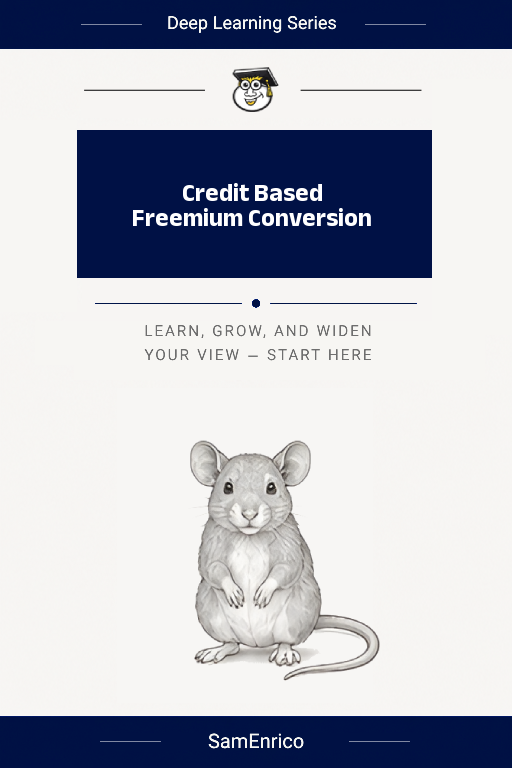
Non-FictionCredit SystemsScarcity Design
Credit Based Freemium Conversion eBook
Give free users monthly credits that replenish, co
Give free users monthly credits that replenish, converting when they exhaust credits early and need more to continue workflows uninterrupted.
Formats
Free sample
Chapter 1: The $10 Billion Mistake--Every failed freemium model tells the same story—just with different characters.The founder stands in a conference room, clutching a laptop, showing investors a beautiful product. The demo is flawless. The design is award-winning. The free tier has millions of signups. And yet, the revenue line is flat.
Users come, they poke around, they leave. A tiny fraction upgrade. The rest become digital ghosts—active enough to cost server bills, not active enough to pay them.The founder says: "We need to optimize the paywall."The founder is wrong.Not slightly wrong. Not missing a detail. Fundamentally, catastrophically wrong—in the same way that a captain who blames the waves for sinking his ship is wrong.
The waves are not the problem. The hull is the problem. And the hull of most freemium products is cracked at the waterline.This book is about fixing the hull. It is about replacing the hard paywall—that blunt, resentment-inducing barrier that says "Upgrade to unlock"—with something far more sophisticated, far more profitable, and far more aligned with human psychology: the credit-based freemium model.But before we build the new machine, we need to understand exactly why the old machine failed. And to do that, we need to talk about a mistake so common, so expensive, and so invisible to the people making it, that I have given it a name.The $10 Billion Mistake.The Graveyard of Hard Paywalls Let me tell you about a company you have never heard of.In 2016, a well-funded AI startup called X.ai raised $10 million to build a smart scheduling assistant.
The product worked beautifully. You cc'd "Amy" on an email, and she—an algorithm—found time on your calendar. Users loved the demo. Early adopters raved.Then X.ai made The Mistake.They put their product behind a hard paywall. After 14 days, the free trial ended.
Users who wanted to keep using Amy had to enter a credit card. The conversion rate was anemic. Investors pushed for growth. The company pivoted, then pivoted again, then quietly shut down in 2020. The technology was solid.
The team was talented. The market was real. They died because they interrupted the user at the wrong moment—before the value was fully realized, before the workflow was embedded, before the loss would feel painful.Now let me tell you about a company you have definitely heard of.Slack launched in 2013 with a radically different approach. They did not put their product behind a hard paywall. Instead, they gave teams free access to the full Pro version of Slack—all features, all integrations, all search history—with one simple limit: message storage.
Teams could use Slack for free until they hit 10,000 messages. At that point, the oldest messages would start to disappear unless the team upgraded.Notice what Slack did not do. They did not block the "send message" button. They did not pop up a modal that said "Upgrade to continue chatting." They did not interrupt the user at the start of a task. They let teams build habits, integrate workflows, invite colleagues, and embed Slack into the daily rhythm of work.
Only after the team was fully dependent—only after the "Aha!" moment had been experienced hundreds of times—did Slack introduce the question: "Would you like to keep your history?"That question is not a paywall. It is a lifeline. And it turned Slack into a $27 billion company.The difference between X.ai and Slack is the difference between a locked door and a slow leak. A locked door creates resentment. A slow leak creates urgency.
One says "You cannot enter." The other says "You cannot finish."This is the $10 Billion Mistake: building a freemium model that gates access instead of continuity.Why "Upgrade to Unlock" Is a Psychological Disaster To understand why hard paywalls fail, we need to understand something counterintuitive about the human brain.Imagine you are baking a cake. You have mixed the flour, cracked the eggs, stirred the batter, and poured it into a pan. You open the oven door. Just as you are about to slide the pan inside, someone snatches it from your hands and says: "Pay $10 to continue."How do you feel?Now imagine a different scenario. You have baked the cake.
It has cooled on the counter. You have invited friends over. Everyone is holding forks. You cut the first slice, lift it onto a plate, and then someone says: "Pay $10 for the rest of the cake."Which scenario makes you more likely to pay?The answer is obvious—and it is the same answer that explains why credit-based freemium converts at 3x to 5x the rate of hard paywalls. Humans are driven by loss aversion, a cognitive bias identified by psychologists Daniel Kahneman and Amos Tversky.
Loss aversion means that the pain of losing something is psychologically about twice as powerful as the pleasure of gaining the same thing.Losing 10feelsworsethanfinding10 feels worse than finding 10feelsworsethanfinding10 feels good. Losing access to a workflow feels worse than gaining access to a feature. Losing progress hurts more than gaining potential.A hard paywall asks the user to gain access to something they have never had. "Upgrade to unlock reports." The user has no reports today. They might want reports tomorrow.
But they are not losing anything by clicking away. The pleasure of gaining reports is hypothetical. The effort of entering a credit card is real. The math does not work.A credit-based model asks the user to avoid losing something they already have. "You have used your 50 free AI calls.
Add credits to analyze this final dataset." The user is mid-task. The output is almost ready. The work is invested. The loss of that progress is immediate, tangible, and painful. The pleasure of spending $10 to avoid that loss is not hypothetical—it is survival.This is not a minor distinction.
It is the difference between a conversion rate of 2% and a conversion rate of 15%. It is the difference between a 10millionexitanda10 million exit and a 10millionexitanda27 billion one.The Continuity Principle Let me formalize this into a framework you can use for the rest of this book.The Continuity Principle: Users will pay to preserve progress far more readily than they will pay to unlock potential.Every freemium model asks a question. The question is either:"Would you like to access something new?" (potential)"Would you like to finish what you started?" (continuity)The first question is a luxury. The second question is a necessity. Necessity converts.
Luxury does not.Think about the most successful freemium products of the last decade. Dropbox did not ask you to pay for cloud storage. Dropbox let you upload files for free, then asked you to pay when you ran out of space. Canva did not ask you to pay for design tools. Canva let you design for free, then asked you to pay when you needed to export a transparent background.
Zoom did not ask you to pay for video calls. Zoom let you have 40-minute calls for free, then asked you to pay when you needed to finish a board meeting.Notice the pattern. Every one of these products uses the…
This is the end of the free sample. Get the eBook to keep going. Buy now
About this book
Details
- Author
- Mcgovern Charmain
- Publisher
- SamEnrico
- Language
- English
- Genre
- Non-Fiction, Credit Systems, Scarcity Design
- Released
- 2026-05-29
- Pages (approx.)
- 134
- Available as
- eBook, Audiobook

Read better in the ZLOADR app
Your eBooks on your phone or tablet. Sign in with your SamEnrico account and start reading.
More by Mcgovern Charmain
 The Slow Mover Exception GuideMcgovern Charmain$11.99
 Money Laundering via Real EstateMcgovern Charmain$11.99
 Anger And Noise SensitivityMcgovern Charmain$11.99
 Senior Adult Child EsteemMcgovern Charmain$11.99
 Goal Setting for ProcrastinatorsMcgovern Charmain$11.99
 Software Engineer Anger GuideMcgovern Charmain$11.99
 TM and Mindfulness DifferencesMcgovern Charmain$11.99
 The Destroyer Archetype in DreamsMcgovern Charmain$11.99
 Bankruptcy Tax ImplicationsMcgovern Charmain$12.99
 The Lost Vineyards of Prohibition: A Toast to Forbidden GrapesMcgovern Charmain$11.99
 The Great Violin Heist: Paganini’s Lost Stradivarius and the Birth of a LegendMcgovern Charmain$11.99
 How to Produce Preemergent Weed KillerMcgovern Charmain$11.99
You may also like
 Hong Kong Handover 1997Dunn Johnnie$11.99
 Zumba For Postnatal Recovery CourseNeal Christian$11.99
 Zumba for BeginnersLadner Nikia$11.99
 YouTube Comment Mining GuideHumes Pandora$12.99
 Worry Box MeditationCarlin Rudy$11.99
 Workplace Stress MeditationNguyen Lynn$11.99
 Workplace Stress and Sleep RepairHawley Ivory$11.99
 Workplace Perfectionism CureDelaney Jeffry$11.99
 Workplace Injustice Anger GuideWallen Isabelle$11.99
 Work Addiction and Burnout LinkGreenwood Ester$11.99
 Women in Yoga and WellnessBeattie Galina$11.99
 Women in Stand Up ComedyChun Evangeline$11.99