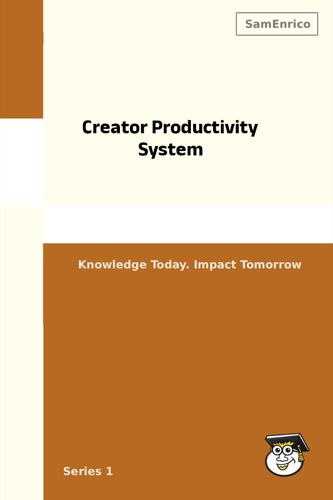
Creator Productivity System eBook
Time management and workflow optimization for full
Time management and workflow optimization for full time content production.
Formats
Free sample
Chapter 1: The Energy Map--–- At 10:47 on a Tuesday morning, Sarah sat in front of her editing timeline with an empty coffee mug, a blinking cursor, and absolutely nothing to show for the last three hours. She had opened the project file at 8 AM, full of determination. By 8:45, she had checked Instagram seventeen times. By 9:30, she had reorganized her plugin folder. By 10:15, she had watched three videos about color grading techniques she knew she wouldn't use.
At 10:47, she was scrolling through job postings for "anything that doesn't require creative thinking."Sarah is a full-time You Tuber with 180,000 subscribers. She posts twice weekly, answers every comment, and has not taken a vacation in fourteen months. By every external metric, she is successful. But she is also exhausted, resentful of the work she once loved, and secretly convinced that she is simply lazy.She is not lazy. She is managing time instead of energy.This chapter dismantles the single most destructive myth in creator productivity: that time is the resource you need to optimize.
Time is fixed. You have exactly twenty-four hours each day, just like every other creator on the planet. You cannot manufacture more time, nor can you stretch it. What you can control, measure, and leverage is your creative energy—and until you map it, protect it, and align your work to its natural rhythms, you will continue to feel like Sarah: busy, burnt out, and bewildered by your own lack of output.The Energy Fallacy Most productivity systems treat all hours as equal. They assume that if you block three hours for writing, you will write for three hours.
They assume that a task scheduled at 8 AM requires the same cognitive resources as a task scheduled at 2 PM. They assume that you are a machine that can be programmed, and that your only failure is a failure of discipline.These assumptions are wrong. And they are especially wrong for creators.Creative work is not data entry. It is not responding to emails. It is not organizing files or scheduling posts.
Creative work—writing scripts, filming on camera, designing thumbnails, editing narrative arcs—draws from a finite well of cognitive, emotional, and physiological energy that fluctuates dramatically throughout the day. When you schedule your most demanding creative work during your natural energy trough, you are setting yourself up for failure before you begin. You will sit there, blinking at the screen, and conclude that you lack talent, discipline, or both.The research on this is unequivocal. Psychologist Anders Ericsson’s studies of elite performers revealed that the most accomplished violinists, athletes, and writers practice in focused sessions of no more than ninety minutes, and they schedule those sessions during their personal peak energy windows. They do not grind for ten hours.
They do not believe that more time equals more output. They understand that the quality of an hour matters infinitely more than the quantity of hours.For creators, the stakes are even higher. Unlike a violinist who can practice scales on autopilot, creators generate original intellectual and emotional material. You are not performing a memorized piece; you are inventing something that did not exist before. This act of creation requires what psychologist Mihaly Csikszentmihalyi called flow—a state of deep immersion where time distorts, self-consciousness vanishes, and output feels almost effortless.
Flow cannot be forced. It cannot be scheduled arbitrarily. It can only be invited by aligning your work with your energy.The good news is that energy is not mysterious. It follows patterns. And those patterns can be mapped.The Creator Diurnal Chart Before you can optimize your energy, you must measure it.
This chapter introduces the Creator Diurnal Chart—a seven-day log of your natural focus, fatigue, and inspiration peaks. The word "diurnal" refers to daily rhythms, and your goal over the next week is to discover your unique daily rhythm.Here is how the chart works. For seven consecutive days, you will rate your creative energy every two hours from the moment you wake until two hours before you sleep. Use a simple 1-to-5 scale:1: Completely depleted. Cannot focus.
Staring at the screen produces nothing.2: Low energy. Can handle routine tasks (replying to comments, organizing files) but not creative work.3: Moderate energy. Can do shallow creative work (outlining, research, rough drafting) but not deep creation.4: High energy. Can enter flow. Writing, filming, or editing feels engaging, not exhausting.5: Peak creative energy.
Flow comes easily. Ideas connect. Work feels almost effortless.Record your rating alongside a brief note about what you were doing. Be honest. Do not rate yourself based on what you wish were true.
The chart is for data collection, not self-judgment.At the end of seven days, look for patterns. Most creators discover one of three diurnal profiles:The Morning Lark: Peak creative energy occurs between 90 minutes and four hours after waking. Energy declines steadily after lunch, with a possible secondary peak in the late afternoon. Approximately forty percent of creators fit this profile.The Night Owl: Mornings are foggy and unproductive. Creative energy does not peak until late evening, sometimes as late as 10 PM or midnight.
Approximately thirty-five percent of creators fit this profile.The Two-Peak: Energy spikes in the late morning, dips after lunch, rises again in the late afternoon, and then falls sharply in the evening. Approximately twenty percent of creators fit this profile. (The remaining five percent have irregular patterns often linked to sleep disorders or inconsistent schedules.)There is no superior profile. Morning Larks are not more disciplined than Night Owls. Night Owls are not more creative than Morning Larks.
The only mistake is fighting your natural rhythm. A Morning Lark who forces herself to write at midnight will produce garbage and conclude she has no talent. A Night Owl who forces himself to film at 6 AM will feel like a failure and abandon his channel. You cannot win a battle against your own biology. You can only surrender to it and design your workflow accordingly.Sarah, the burned-out You Tuber from the opening of this chapter, completed her Creator Diurnal Chart and discovered she was a Two-Peak creator.
Her highest energy window was 9 AM to 11 AM. Her second peak was 3 PM to 5 PM. She had been trying to edit from 8 PM to midnight because she believed "successful creators work at night." She was editing during her lowest energy window of the day. No wonder she felt like a failure.Once she moved her editing to her morning peak, her output doubled in one week. She did not work more hours.
She worked the same number of hours but at the right time. That is the power of energy management.The Peak Creation Zone Once you have identified your daily energy peaks, you will establish your Peak Creation Zone, or PCZ. This term will appear throughout the rest of this book, so commit it to memory now. Your PCZ is a non-negotiable, two-to-three-hour block reserved exclusively for high-cognition creative work. During your PCZ, you do not answer emails.
You do not check analytics. You do not scroll social media. You do not reorganize your desk. You create.Your PCZ must be scheduled during your highest energy window as identified…
This is the end of the free sample. Get the eBook to keep going. Buy now
About this book
Details
- Author
- Homan Lashonda
- Publisher
- SamEnrico
- Language
- English
- Genre
- Non-Fiction, Non-Obvious Career, Productivity
- Released
- 2026-06-09
- Pages (approx.)
- 148
- Available as
- eBook, Audiobook

Read better in the ZLOADR app
Your eBooks on your phone or tablet. Sign in with your SamEnrico account and start reading.
More by Homan Lashonda
 Methadone Take Home GuideHoman Lashonda$11.99
 Nation State Attack TrendsHoman Lashonda$11.99
 Imposter Syndrome at Work GuideHoman Lashonda$11.99
 Mbuti Bark Cloth NarrativesHoman Lashonda$11.99
 Waves of the Ancients: The Forgotten Surfers of the African CoastHoman Lashonda$11.99
 Clinical Business AnalystHoman Lashonda$11.99
 Private School TuitionHoman Lashonda$12.99
 HARO Competitor MonitoringHoman Lashonda$12.99
 How to Become a Cement LoaderHoman Lashonda$11.99
 Understanding Posterior Tibial Tendon RuptureHoman Lashonda$17.99