
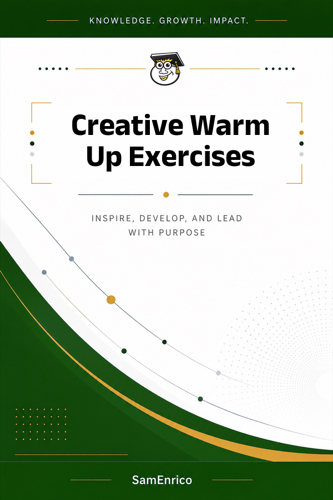
Creative Warm Up Exercises eBook
Prepares brain for imaginative work.
Prepares brain for imaginative work.
Formats
Free sample
Chapter 1: The Silent Saboteur--Every time you have stared at a blank page, a blinking cursor, or an empty canvas and felt absolutely nothing—that was not a failure of talent. That was not a lack of discipline. That was not evidence that you are "not a real creative." That was your brain doing exactly what evolution designed it to do, and no one ever showed you the emergency exit.The most destructive myth about creativity is that it requires a special mood, a lightning strike of inspiration, or a rare alignment of cosmic forces. This myth has ruined more artists than lack of skill ever could. It has convinced millions of intelligent, talented people that they are somehow broken because they cannot summon brilliance on command.The truth is simpler and stranger.
Your brain is actively working against your creativity for approximately ninety percent of your waking hours. Not because your brain is defective. Not because you are lazy. Because your brain is a survival machine, not a joy machine. It does not care if you write a beautiful poem.
It cares if you avoid being eaten by a tiger. The problem is that, neurologically speaking, your brain cannot reliably tell the difference between a tiger and a blank page.This chapter introduces you to the Silent Saboteur—the internal voice that shuts down your imagination before it has a chance to speak. You will learn why this voice exists, how it operates, and most importantly, how to disarm it in sixty seconds or less. By the end of this chapter, you will have a practical, science-backed tool that works whether you are a novelist, a designer, a coder, a parent helping with homework, or anyone else who needs to think originally under pressure.The Negativity Bias: Your Brain's Broken Alarm System Let us begin with a simple experiment. Think back to the last time someone criticized your work.
Really feel that memory. Notice the knot in your stomach, the heat in your face, the loop of thoughts replaying the moment. Now think back to the last time someone praised your work. Notice the difference in intensity. The criticism probably feels sharper, more detailed, more real.
The praise feels fuzzier, more distant, almost like it happened to someone else.This is not a quirk of your personality. This is the negativity bias, and it is one of the most well-documented phenomena in cognitive neuroscience.The human brain processes negative stimuli more thoroughly, remembers them longer, and gives them more emotional weight than positive stimuli of equal intensity. The estimated ratio is approximately three to one. One harsh critique cancels out three compliments. A single angry email can ruin an entire morning of productive work.
Ten words of mockery from a middle school classmate can echo for thirty years.Why would evolution create such a seemingly unfair system? Because your ancestors who noticed a rustle in the grass and assumed it was a predator—even when it was just the wind—lived to pass on their genes. Your ancestors who assumed the rustle was nothing and turned out to be wrong were eaten. The cost of a false positive (thinking there is a threat when there is none) is low. You feel anxious for a few minutes.
The cost of a false negative (thinking there is no threat when there is one) is death. So your brain is wired to assume the worst.Now apply this bias to creativity. Your brain, left to its own devices, will scan your creative output for threats with the same intensity it would scan a dark alley. That sentence is awkward. That sketch is ugly.
That melody has been done before. That idea is stupid. These are not objective aesthetic judgments. These are threat-detection signals, and your brain generates them automatically because it believes it is keeping you safe from the social dangers of embarrassment, rejection, mockery, and failure.The tragedy is that your brain does not distinguish between physical threats and social threats. The same amygdala activation occurs.
The same cortisol spikes. The same urge to flee or freeze takes over. From your brain's perspective, showing someone your painting is neurologically similar to walking through a lion enclosure.This is the Silent Saboteur. It is not evil. It is not trying to ruin your life.
It is trying to protect you from dangers that no longer exist in the form your brain imagines them. But intentions do not matter. Only results matter. And the result of the negativity bias is that most people never start, and most of those who start never finish.The Default Mode Network: Where Creativity Goes to Die The negativity bias is not the only neurological obstacle you face. There is also the default mode network, or DMN—a collection of brain regions that become active when you are not focused on an external task.The DMN is responsible for mind-wandering, autobiographical memory, and social cognition.
It is the network that activates when you are in the shower, driving a familiar route, or lying in bed unable to sleep. It is also the network responsible for rumination, self-criticism, and the endless loop of negative thoughts that plays in the background of your mind.Here is the cruel irony. The DMN is essential for certain types of creative insight. Many of your best ideas arrive in the shower precisely because the DMN is active. But the DMN is also the primary source of your inner critic.
The same network that generates "what if I tried this?" also generates "who do you think you are?"The key to creative warm-ups is not to shut down the DMN. That is impossible and undesirable. The key is to briefly interrupt its negative bias so you can access its generative capacity without being destroyed by its judgment.Think of the DMN as a river. You cannot stop the river from flowing. But you can build a small dam that redirects some of the water.
A creative warm-up is that dam. It does not eliminate the inner critic. It simply gives you sixty seconds of quiet water before the current returns.Beta, Alpha, Theta: The Three Brains Inside Your Head To understand how warm-ups work, you need a basic map of your brain's electrical activity. This is not neuroscience for its own sake. This is practical knowledge that will save you hours of frustration.Your brain produces five types of electrical waves, measured in hertz (cycles per second).
For creative work, only three matter.Beta waves (12 to 30 hertz) are your default waking state. You are in Beta right now, reading these words. Beta is analytical, critical, linear, and survival-oriented. It is excellent for doing your taxes, following a recipe, or writing a work email. It is terrible for brainstorming, improvising, or generating original ideas.
When you feel stuck, you are almost certainly stuck in Beta.Alpha waves (8 to 12 hertz) are the bridge state. Alpha is relaxed alertness—the feeling of a lazy Sunday morning, a long shower, a walk without a destination. In Alpha, your internal critic quiets down. Connections between distant ideas become more likely. Time feels softer.
This is the state where solutions arrive in the shower, not at the desk.Theta waves (4 to 8 hertz) are…
This is the end of the free sample. Get the eBook to keep going. Buy now
About this book
Details
- Author
- Maurer Allyson
- Publisher
- SamEnrico
- Language
- English
- Genre
- Non-Fiction, Self-Help, Warm Up
- Released
- 2026-06-06
- Pages (approx.)
- 145
- Available as
- eBook, Audiobook

Read better in the ZLOADR app
Your eBooks on your phone or tablet. Sign in with your SamEnrico account and start reading.
More by Maurer Allyson
 The Growth Mindset for SeniorsMaurer Allyson$11.99
 Pelvic Floor ED TherapyMaurer Allyson$11.99
 Pixar Recording Booth StoriesMaurer Allyson$11.99
 Stress and Oxidative StressMaurer Allyson$11.99
 Pelvic Floor Yoga FlowMaurer Allyson$11.99
 Student Exam Stress SleepMaurer Allyson$11.99Student Exam Stress SleepMaurer Allyson$11.99
 Resume After LayoffMaurer Allyson$11.99
 The Wolf of Wall Street’s Shadow: The Untold Story of Jordan Belfort’s First ScamMaurer Allyson$11.99
 Ghosts of the Green Zone: The Secret War Inside BaghdadMaurer Allyson$11.99
 How to Start a Agricultural Machinery and Accessories and Implements, Including Tractors Importer (wMaurer Allyson$11.99
 Noncompete Agreement Traps GuideMaurer Allyson$12.99
You may also like
 Hong Kong Handover 1997Dunn Johnnie$11.99
 Zumba For Postnatal Recovery CourseNeal Christian$11.99
 Zumba for BeginnersLadner Nikia$11.99
 YouTube Comment Mining GuideHumes Pandora$12.99
 Worry Box MeditationCarlin Rudy$11.99
 Workplace Stress MeditationNguyen Lynn$11.99
 Workplace Stress and Sleep RepairHawley Ivory$11.99
 Workplace Perfectionism CureDelaney Jeffry$11.99
 Workplace Injustice Anger GuideWallen Isabelle$11.99
 Work Addiction and Burnout LinkGreenwood Ester$11.99
 Women in Yoga and WellnessBeattie Galina$11.99
 Women in Stand Up ComedyChun Evangeline$11.99