
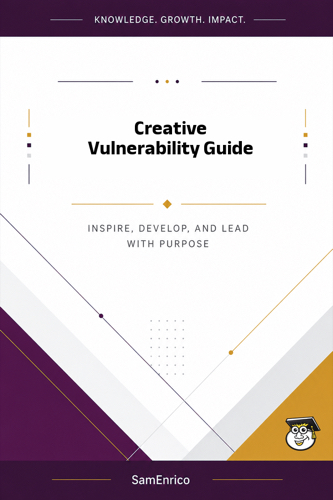
Creative Vulnerability Guide eBook
Share raw creative work and build intimacy with au
Share raw creative work and build intimacy with audiences.
Formats
Free sample
Chapter 1: The Two Faces of Vulnerability...--–- The first time I shared something truly unfinished, I thought I would die. Not metaphorically. Not in the way writers say "I wanted to die" when they mean "I was embarrassed." I mean my heart rate spiked to 130 beats per minute. My palms soaked through the paper I was holding. My vision narrowed to a tunnel, and the thirty people in the room became a blur of flesh-colored smudges.
I was thirty-four years old, I had already published two books that no one read, and I was standing in a cramped community center in Portland, Oregon, about to read a poem that had no ending.The poem was about my father, who had left when I was seven. I had never written about him before. I had never told more than three people the details of his departure. And here I was, in a room full of strangers, about to read seven stanzas that trailed off into white space because I couldn't figure out how to finish the thought. The poem wasn't good.
It wasn't even finished. But something had cracked open in me that week, and I had made a decision: I would stop waiting until I was ready. I would stop polishing. I would stop pretending that the next draft would finally make me safe.I read the poem. My voice shook.
I stumbled over two lines. I looked up at the end—such as it was, hanging there incomplete—and waited for the judgment. What I got instead was silence. Then one person started crying. Then another.
Then a woman in the back raised her hand and said, "My father left too. I've never heard anyone say it like that." She wasn't complimenting my craft. She wasn't praising my metaphors. She was responding to the exposure—the raw, unfinished, dangerous act of letting someone see the wound before you've bandaged it.That night changed everything I believed about creativity. For years, I had operated under what I now call the Polisher's Fallacy: the belief that my work needed to be perfect before anyone could see it, that vulnerability was a liability, and that safety was the same thing as professionalism.
I was wrong. Safe work is forgettable work. Perfect work is invisible work. The only work that lands—the only work that creates intimacy, loyalty, and transformation—is the work that arrives with the fingerprints still visible, the edges still raw, the ending still uncertain.This book is not for people who want to be safe. This book is for people who want to be seen.The Great Confusion: What We Talk About When We Talk About Vulnerability Before we go any further, we need to address a problem.
The word "vulnerability" has been everywhere for the past decade. Brené Brown made it a household term. TED Talks have been given. Instagram quotes have been memed. But in that process of popularization, the word has become so stretched and vague that it now means almost nothing—or worse, it means everything, which is the same thing.Ask ten creators what vulnerability means, and you'll get ten different answers:"Vulnerability is sharing my deepest trauma.""Vulnerability is showing up without a mask.""Vulnerability is admitting I don't know what I'm doing.""Vulnerability is posting a no-makeup selfie.""Vulnerability is writing honestly about my failures.""Vulnerability is sitting in silence with a stranger."These are not the same thing.
And yet, in the creative advice industry, they are treated as interchangeable. The result is a kind of vertigo: you are told to be vulnerable, but you are not told what kind of vulnerability is appropriate for your medium, your audience, or your nervous system. So you either overshare (trauma-dumping without structure) or you freeze (sharing nothing at all).This chapter introduces a distinction that will run throughout the entire book. It is the single most important framework you will learn, and it will save you from the confusion that derails most creators.Narrative Vulnerability: The Courage to Tell Your Story Narrative vulnerability is what most people mean when they say "vulnerable art." It is the act of sharing your personal story—your failures, your fears, your painful past, your unfinished drafts, your secret hopes. Narrative vulnerability uses language (spoken or written) to transmit experience from your interior to someone else's.
It says, "Let me tell you what happened to me."Examples of narrative vulnerability across creative fields:Writers: Publishing an essay about a miscarriage, performing a spoken word piece about addiction, sharing a blog post about financial ruin Musicians: Writing a song about a breakup, recording a demo that includes the breath and the mistakes, performing a new, unrehearsed piece Visual artists: Creating a series about childhood trauma, exhibiting sketches with visible erasures, writing artist statements that admit to uncertainty Performers: Doing a solo show about mental illness, improvising without a net, telling a true story on stage that you've never told anyone Narrative vulnerability is powerful. It is also dangerous, because it can tip into oversharing—a concept we will explore in depth in Chapter 3. The difference between narrative vulnerability that connects and narrative vulnerability that repels is not the truth of the story but the container you build around it. Does your story serve the audience, or does it use them as a trash can for your unprocessed pain?But narrative vulnerability is not the only game in town. And if you have been trying to be vulnerable by confessing your deepest secrets and it isn't working—or it's leaving you feeling hollow—there is another path.Presentational Vulnerability: The Courage to Be Seen Without a Story Presentational vulnerability is quieter, stranger, and often more powerful than its narrative cousin.
It is the act of being seen without armor, without explanation, without performance. Presentational vulnerability shares no story at all. It simply exists in front of another person, allowing them to witness you without the buffer of language or narrative.Presentational vulnerability says, "I am not going to tell you what happened to me. I am just going to be here, with you, and we are going to feel whatever arises."Examples of presentational vulnerability across creative fields:Writers: Reading a poem with long pauses, allowing silence to exist between stanzas, looking up at the audience between lines Musicians: Holding a rest longer than is comfortable, playing a single note and letting it decay fully, making eye contact with individual audience members Visual artists: Creating work that is incomplete by design, leaving raw edges uncorrected, refusing to explain the work's meaning Performers: Sitting in stillness (as Marina Abramović did for 736 hours), making sustained eye contact, allowing your face to be readable without controlling it Presentational vulnerability is the domain of Marina Abramović, whose 2010 performance The Artist Is Present we will study in Chapter 7. For 736 hours, she sat motionless at a wooden table in the Museum of Modern Art, making eye contact with strangers who sat across from her.
She spoke no words. She told no stories. She shared no personal history. And yet, thousands of people wept, laughed, and experienced profound intimacy. Some returned every day for months.
One woman later said, "She saw me. Not my story. Me."That is presentational vulnerability. And it is available to every…
This is the end of the free sample. Get the eBook to keep going. Buy now
About this book
Details
- Author
- Wood Alejandro
- Publisher
- SamEnrico
- Language
- English
- Genre
- Non-Fiction, Self-Help, Vulnerability
- Released
- 2026-06-10
- Pages (approx.)
- 132
- Available as
- eBook, Audiobook

Read better in the ZLOADR app
Your eBooks on your phone or tablet. Sign in with your SamEnrico account and start reading.
More by Wood Alejandro
 Fear Based Anger GuideWood Alejandro$11.99
 Body Image For Large Bust Concerns GuideWood Alejandro$11.99
 Ski Patrol Avalanche GuideWood Alejandro$11.99
 Sleep Hygiene for Students WorkbookWood Alejandro$11.99
 Body Scan For Phantom LimbWood Alejandro$11.99
 Nepal Karnali River SourceWood Alejandro$11.99
 Emergency Cost ReductionWood Alejandro$11.99
 The First Meme: How a 19th-Century Caricature Went Viral Before the InternetWood Alejandro$11.99
 Lyssa’s Howl: The Curse of the Maddened GoddessWood Alejandro$11.99
 Growing CurcumaWood Alejandro$11.99
 Middle East Competitive TenderingWood Alejandro$12.99
 Chinese Mental Health ServicesWood Alejandro$12.99
You may also like
 The Disclosure Discussion GuideOakley Sammie$11.99
 Stress Confessions for CouplesAlderman Hobert$11.99
 Vulnerability Connection GuideWeathers Taryn$11.99
 Loneliness Vulnerability GuideLangford Diego$11.99
 Step Four Inventory Sharing With Sponsor GuideMoffett Jackson$11.99
 Step Five Confession Made SimpleCasillas Jettie$11.99
 Shame and Vulnerability WorkCarlson Mildred$11.99
 Self Esteem And VulnerabilityAult Maisie$11.99
 Personal Brand VulnerabilityWren Lavon$11.99
 Asking For Help EffectivelyMarx Gus$11.99
 Affirmations For Vulnerability HandbookMartins Casie$11.99
 Teen Vulnerability StrengthCooley Katia$11.99