
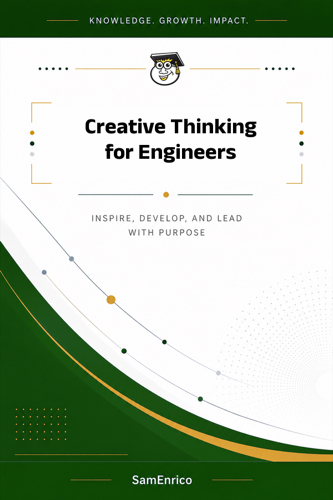
Creative Thinking for Engineers eBook
Break free from linear thinking to solve complex t
by Hackett King
Break free from linear thinking to solve complex technical problems.
Formats
Free sample
Chapter 1: The Efficiency Trap--–- The first time Mira Patel nearly destroyed a $40 million satellite, she was following every rule in the engineering handbook.She had done everything right. The thermal analysis was flawless—seventy-three pages of differential equations, validated by three senior engineers, signed off by two separate review boards. The materials had been tested to twice their expected load. The margins were conservative. The documentation was immaculate.And still, the satellite would have failed.Not because of a math error.
Not because of a material defect. Not because of a corner cut or a deadline rushed. The failure would have occurred because Mira, like nearly every engineer trained in the past half-century, had been taught to think in straight lines. And the problem she was trying to solve was not a straight line.The problem—a thermal management issue in a tightly packed payload bay—was what engineers call a "coupled system." Change one variable and three others shift in unpredictable ways. Linear thinking assumes you can isolate variables, solve them one by one, and sum the results.
Linear thinking assumes cause A produces effect B, reliably and repeatedly. Linear thinking assumes the world is a spreadsheet.Mira's spreadsheet was beautiful. It was also wrong.The only reason she discovered the error was a last-minute conversation with a biologist who happened to share her lunch table—a biologist who knew nothing about satellites but asked a single question that shattered every assumption Mira had built her analysis on: "Why are you assuming those three temperature zones are independent when everything in nature is connected?"That question saved forty million dollars. It also launched Mira on a seven-year journey to understand a terrifying paradox: the very thinking patterns that make engineers valuable on routine problems make them dangerous on novel ones. And the more expertise you accumulate, the more vulnerable you become.This book is about that paradox, how to escape it, and how to build a systematic practice of creative thinking that works alongside—not against—your engineering training.The Paradox That Ruins Careers Let me state the problem as bluntly as possible: Engineers are trained to solve problems that have already been solved.Think about your engineering education.
Every textbook problem had a known answer. Every homework set had a solution path someone had walked before. Every exam tested your ability to apply established formulas to predictable scenarios. Even your capstone design project—the one that felt so open-ended—was likely a variation on something someone in your department had built before.This is not a criticism of engineering education. It is a description of how expertise is built.
You learn the fundamentals. You practice on well-structured problems. You internalize patterns. You become faster, more accurate, more confident. Your brain literally rewires itself to recognize and execute standard solutions with less conscious effort.This process is called neural efficiency, and it is wonderful—until it isn't.The problem emerges when you face a situation that does not match any pattern in your mental library.
When the variables are unknown. When the cause-effect relationships are ambiguous. When the problem itself is not clearly defined. In these moments, the same neural efficiency that makes you fast on routine problems makes you blind on novel ones.This is not a metaphor. It is a measurable neurological phenomenon, and it has a name: the Einstellung Effect.The Chess Grandmaster Who Couldn't See the Obvious In 1942, the psychologist Abraham Luchins designed a deceptively simple experiment that has been replicated hundreds of times across dozens of domains.
He gave subjects a set of water jugs and asked them to measure specific volumes. The first several problems could all be solved using the same multi-step formula. Then came a problem that had a much simpler solution—one that required only two steps instead of the familiar seven.Nearly all the subjects who had practiced the complicated formula missed the simple solution. They had been "set" by their prior experience. Their brains had locked onto a pattern that worked, and that pattern actively blocked them from seeing a better approach.
Subjects with no prior practice—complete novices—solved the simple problem almost instantly.The Einstellung Effect (from the German word for "attitude" or "set") is the tendency for existing knowledge to blind you to better solutions. It has been demonstrated in chess, where grandmasters miss two-move checkmates because they are fixated on complex attacking patterns. It has been demonstrated in medicine, where experienced doctors miss obvious diagnoses because they are locked into their initial hypotheses. And it has been demonstrated in engineering, again and again, in contexts ranging from circuit design to bridge construction to software architecture.Here is the cruel irony: The Einstellung Effect gets stronger as you get better at your job.The more patterns you have stored in your mental library, the more likely you are to retrieve the wrong one when the problem looks familiar but isn't. The faster your pattern-matching system becomes, the harder it is to slow down and check your assumptions.
The more successful you have been using a particular approach, the more confident you become that it will work again—even when the problem has changed in ways you haven't noticed.This is why the most catastrophic engineering failures are rarely caused by incompetence. They are caused by experts who were certain they were right.The Three Symptoms of Linear Lock How do you know when you have fallen into the Efficiency Trap? The symptoms are subtle because they feel like competence. Here are three diagnostic questions to ask yourself the next time you are stuck on a technical problem:Symptom One: You are optimizing instead of exploring.You have a solution in mind—maybe even a good one—and you are spending all your energy making it slightly better. You are running sensitivity analyses.
You are tweaking parameters. You are shaving milliseconds off runtime or grams off weight. This feels productive because you are generating numbers and making progress. But you have stopped asking whether you are solving the right problem. You have stopped generating alternative approaches.
You are running in place on a treadmill that is moving in the wrong direction.Symptom Two: Your first three ideas are all variations on a theme.You generate a solution. Then you generate a second solution that is essentially the first solution with one parameter changed. Then you generate a third solution that is the second solution with a different material. You feel creative because you have multiple options, but all of your options share the same underlying assumptions. You have not broken out of your mental model.
You have just added trim packages to the same car.Symptom Three: You feel impatient with questions about the problem itself.Someone asks, "Why are we solving this?" and you feel irritated. Someone suggests a completely different approach and you dismiss it as impractical before they finish the sentence. Someone asks you to explain an assumption and you hear it as an attack on your competence. These are not signs of confidence. They are signs of cognitive fixation.
Your brain has locked onto a path and is actively defending it against alternatives—not because the alternatives are worse, but…
This is the end of the free sample. Get the eBook to keep going. Buy now
About this book
Details
- Author
- Hackett King
- Publisher
- SamEnrico
- Language
- English
- Genre
- Non-Fiction, Self-Help, Engineering
- Released
- 2026-06-07
- Pages (approx.)
- 147
- Available as
- eBook, Audiobook

Read better in the ZLOADR app
Your eBooks on your phone or tablet. Sign in with your SamEnrico account and start reading.
More by Hackett King
 Parenting Multiple ChildrenHackett King$11.99
 Body Language For Emotional Intelligence WorkbookHackett King$11.99
 OCD And Sleep DisturbanceHackett King$11.99
 Survey Data Quality Scoring with AIHackett King$11.99
 The Unseen Hand: How a Studio Secretary Shaped the Golden AgeHackett King$11.99
 Tracking the Moon: How the Indian Ocean Helped Apollo Land on the MoonHackett King$11.99
 Understanding Camptodactyly Syndrome Galajara Type 1Hackett King$17.99
 Clinical PhD Without PublicationsHackett King$12.99
 How to Start a Construction of Parking Garages Business (Beginners Guide)Hackett King$11.99
 Candle MakingHackett King$11.99
You may also like
 Relationship Building for EngineersGetz Cordie$11.99
 Dreaming for Engineering DesignKline Sharee$11.99
 Constraints for EngineersSlaughter Birgit$11.99
 Emotional Intelligence For EngineersWorth Zina$11.99
 Personal Branding for EngineersKimmel Cletus$11.99
 Failure Fear in EngineeringSpalding Richard$11.99
 TRIZ Problem SolvingMcdade Refugio$11.99
 NVC for EngineersCrump Krysta$11.99
 Workaholism in EngineeringHughes Derrick$11.99
 Fear of Failure for EngineersSchott Charline$11.99
 Engineering Student StressBurris Trinh$11.99
 Engineer Imposter SyndromeMoreau Melodee$11.99