
Non-FictionForecast & OutlookCreative SkillsSelf-Help
Creative Problem Solving Guide Audiobook
Apply structured ideation methods to business chal
Apply structured ideation methods to business challenges without artistic skills.
Formats
Free sample
Chapter 1: The Cult of Genius...--–- The conference room smelled of stale coffee and desperation. Fourteen executives sat in a semicircle, staring at a blank whiteboard. The CEO had just finished her opening statement: “We need creative solutions to the customer retention problem, and we need them by Friday.” She then pointed to the marketing director. “You’re our creative one. Lead the brainstorm.”The marketing director, visibly uncomfortable, picked up a marker.
“Okay, everyone… just shout out ideas. No judgment. Go.” What followed was thirty minutes of chaos: three people dominated the conversation, two scrolled through their phones, one suggested renaming the product (which had nothing to do with retention), and the CFO shot down every idea that cost more than five thousand dollars. At the end, they had exactly zero actionable concepts, one marker with a dried-out tip, and a collective belief that “creativity doesn’t work in our industry.”This scene plays out in thousands of organizations every single day. The underlying assumptions are almost never questioned: that creativity is a rare, innate gift; that some people have it and others don’t; that the best way to generate ideas is to put the “creative people” in a room and tell them to brainstorm.
These assumptions are not just wrong—they are actively harmful to business problem-solving.This book exists because those assumptions are nonsense. And more importantly, because the cost of that nonsense is staggering.The Myth You Didn’t Know You Believed Let us name the enemy explicitly. The Cult of Genius is the pervasive belief that creative problem-solving requires a special, inborn talent—that some people are “creative types” (artists, designers, visionaries) and the rest of us are left to execute their ideas. This myth is reinforced by popular culture: the lone inventor in a garage, the advertising creative with the eccentric wardrobe, the tech founder who “sees around corners.”The data tells a very different story.In a landmark study of over two thousand professionals across industries, researchers found that structured creativity training improved problem-solving outcomes by an average of 48 percent—regardless of the participants’ self-reported “natural creativity.” More strikingly, the gap between those who considered themselves highly creative and those who did not shrank to near-zero after as little as eight hours of systematic training. The conclusion was unavoidable: creativity is not a personality trait.
It is a skill.Skills can be learned. Skills have methods. Skills improve with practice.This book treats creative problem-solving exactly like…
This is the end of the free sample. Get the Audiobook to keep going. Buy now
About this book
Details
- Author
- Michael Romaine
- Publisher
- SamEnrico
- Language
- English
- Genre
- Non-Fiction, Forecast & Outlook, Creative Skills, Self-Help, Business Innovation
- Released
- 2026-06-07
- Pages (approx.)
- 140
- Available as
- eBook, Audiobook

Listen in the VoxFlicks app
Audiobooks and audio dramas wherever you go. Sign in with your SamEnrico account and press play.
More by Michael Romaine
 Welles Rising Citizen KaneMichael Romaine$11.99
 Internal Networking SkillsMichael Romaine$11.99
 Workplace Mindfulness MBSR CourseMichael Romaine$11.99
 Candy Crush Life ReplacementMichael Romaine$11.99
 Fiverr Order Revision ManagementMichael Romaine$11.99
 The Last Voyage of the SS America: A Titanic of the 20th CenturyMichael Romaine$11.99
 Retail Arbitrage and Reselling BusinessMichael Romaine$11.99
 Understanding MeningoceleMichael Romaine$17.99
 Project Management For NonprofitsMichael Romaine$12.99
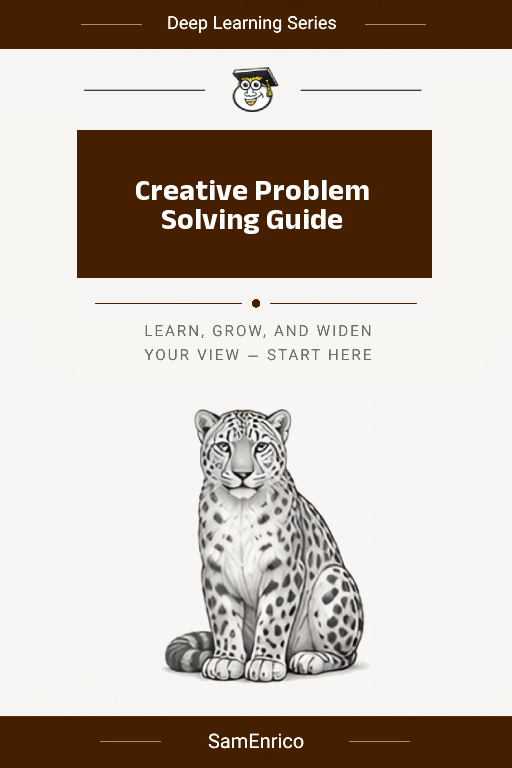 Creative Problem Solving GuideMichael Romaine$12.99
 How to Become a Splitter TenderMichael Romaine$11.99
You may also like
 Hong Kong Handover 1997Dunn Johnnie$11.99
 Zumba For Postnatal Recovery CourseNeal Christian$11.99
 Zumba for BeginnersLadner Nikia$11.99
 YouTube Comment Mining GuideHumes Pandora$12.99
 Worry Box MeditationCarlin Rudy$11.99
 Workplace Stress MeditationNguyen Lynn$11.99
 Workplace Stress and Sleep RepairHawley Ivory$11.99
 Workplace Perfectionism CureDelaney Jeffry$11.99
 Workplace Injustice Anger GuideWallen Isabelle$11.99
 Work Addiction and Burnout LinkGreenwood Ester$11.99
 Women in Yoga and WellnessBeattie Galina$11.99
 Women in Stand Up ComedyChun Evangeline$11.99