
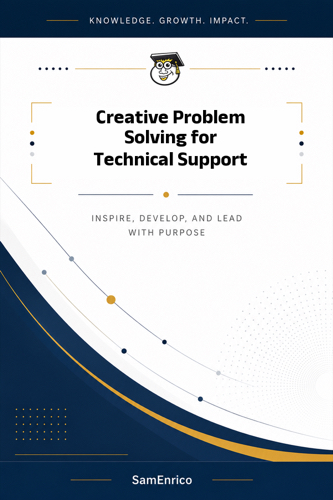
Creative Problem Solving for Technical Support eBook
Invent workarounds and fixes for issues without do
Invent workarounds and fixes for issues without documented solutions.
Formats
Free sample
Chapter 1: The Documentation Lie...--–- The first lie you learn in technical support is also the most dangerous: “Check the manual.” Not because manuals are useless—they are often beautifully written, meticulously indexed, and completely wrong the moment the first patch is deployed. The second lie is more subtle: “If it’s not documented, it can’t be fixed.” That lie has cost organizations millions of dollars in unnecessary downtime, forced upgrades, and vendor hostage fees. This book exists to dismantle the second lie. But before we can build workarounds, we must understand why the documentation failed in the first place.Every technician has felt the cold dread of opening a knowledge base article only to find it was written for a version of the software that no longer exists. Or searching through a vendor’s official documentation and discovering that the error code on your screen isn’t listed anywhere.
Or inheriting a system from a predecessor who left no notes, no comments, and no contact information. These are not edge cases. They are the norm.This chapter dismantles the myth that “the manual has the answer” and replaces it with a practical framework for assessing undocumented systems. You will learn the three categories of undocumented issues—legacy ghosts, vendor black boxes, and configuration drift—and how to identify which one you are facing. You will follow the first part of a longitudinal case study that will run through every chapter of this book: a 20-year-old Access 97 database with no documentation, no source code, and a crash that nobody can explain.
Finally, you will learn a Return on Investment (ROI) formula that will help you decide whether to invent a workaround or wait for a vendor. And you will learn the single most important rule of creative problem solving: the timebox decision rule that separates productive experimentation from endless rabbit holes.By the end of this chapter, you will never again say “I can’t fix it because it’s not documented.” Instead, you will say “I don’t have a documented solution yet—let me see what I can learn.”The Three Faces of Undocumented Hell Before you can solve an undocumented problem, you must classify it. Classification drives strategy. A legacy ghost requires different tools than a vendor black box, and configuration drift requires different tactics than either. Misclassify the problem, and you will waste hours pursuing workarounds that cannot possibly succeed.Legacy Ghosts: Systems That Outlived Their Creators A legacy ghost is any system that was built by people who are no longer available to explain it.
The original developers may have retired, been laid off, died, or simply disappeared. The documentation—if it ever existed—was lost to a crashed hard drive, a closed wiki, or a filing cabinet that was thrown away during an office move. These systems are often mission-critical because organizations fear replacing them more than they fear maintaining them.Consider the banking industry, where COBOL systems from the 1970s still process billions of dollars daily. The original developers are retired or deceased. The documentation, if it exists, describes the system as it was in 1985—not as it is today after forty years of patches, regulatory changes, and desperate band-aids.
When a COBOL system crashes with an error that isn’t in the manual, there is no vendor to call. There is only a technician and a terminal.Legacy ghosts share common characteristics. They run on obsolete hardware or operating systems. They use file formats that modern software cannot read. They depend on libraries or components that were abandoned decades ago.
And critically, they have no clear owner. No one in the organization will admit to understanding how they work. Everyone is afraid to touch them.The Access 97 database we will follow throughout this book is a perfect legacy ghost. It was built in 1999 by a freelance developer who died in 2012. The company that commissioned it has changed ownership three times.
The original specifications were on a zip disk that was thrown away in 2005. Yet every month, the manufacturing firm’s entire inventory reconciliation depends on a single report that this database generates. When that report crashes—as it has started doing—no one knows why.Vendor Black Boxes: When the Seller Won’t Tell A vendor black box is commercial software where the vendor deliberately withholds internal information. This is not malice—usually. Vendors protect their intellectual property.
They do not want competitors copying their algorithms. They do not want customers modifying their code and then demanding support for broken modifications. But the result is the same: you have a system that you cannot see inside, and the vendor is the only source of documentation.The problem arises when the documentation is incomplete, incorrect, or intentionally vague. Vendor documentation often describes ideal behavior, not actual behavior. It tells you what should happen, not what does happen.
It assumes perfect network conditions, perfect hardware, and perfect user behavior. The real world is none of those things.Consider enterprise resource planning (ERP) systems from vendors like SAP or Oracle. Their documentation runs to thousands of pages, yet technicians routinely encounter error messages that are not listed anywhere. The vendor’s support portal requires a expensive contract. The support engineers read from the same incomplete scripts you have.
And the true fix—the undocumented registry key, the hidden configuration flag, the specific order of service restarts—is known only to a few senior engineers who guard it like a trade secret.Vendor black boxes require a different approach than legacy ghosts. With a legacy ghost, you have no one to ask. With a vendor black box, you have someone to ask—but they may not answer. The workaround strategies in this book will teach you how to extract information from vendors without waiting for their permission. You will learn how to create Minimal Reproducible Examples that force vendors to acknowledge bugs.
You will learn how to find undocumented switches by observing system behavior. And you will learn when to stop asking and start working around.Configuration Drift: The Slow Decay of Documented States Configuration drift is the most insidious category because it is self-inflicted. A system begins in a documented, supported state. Then someone applies a security patch. Then someone else changes a firewall rule to fix a different problem.
Then a third person modifies a configuration file to work around a temporary issue—and forgets to change it back. Over months or years, the system drifts further and further from its documented configuration until it no longer resembles anything the vendor or the manual describes.Configuration drift is everywhere. Every production system that has been running for more than a year has drifted. The question is not whether drift exists, but whether the drift is causing your current problem.Consider a web server that was documented to run on port 80 with default timeouts. Over three years, a system administrator changed the timeout to 300 seconds to accommodate a slow reporting tool.
A security consultant moved the server to port 8080 to avoid automated attacks. A developer added a custom module that modifies HTTP headers. Now the server crashes every Tuesday at 3 AM.…
This is the end of the free sample. Get the eBook to keep going. Buy now
About this book
Details
- Author
- Kowalski Daphne
- Publisher
- SamEnrico
- Language
- English
- Genre
- Non-Fiction, Self-Help
- Released
- 2026-06-09
- Pages (approx.)
- 153
- Available as
- eBook, Audiobook

Read better in the ZLOADR app
Your eBooks on your phone or tablet. Sign in with your SamEnrico account and start reading.
More by Kowalski Daphne
 ARB Medications GuideKowalski Daphne$11.99
 Hubert Green Under RadarKowalski Daphne$11.99
 RV Park Precedent GuideKowalski Daphne$11.99
 Law School Anki GuideKowalski Daphne$11.99
 Intensive Outpatient GuideKowalski Daphne$11.99
 Acrophobia GuideKowalski Daphne$11.99
 Department of Justice Best PracticesKowalski Daphne$11.99
 The Battle of Adwa: Ethiopia's Triumph Over ImperialismKowalski Daphne$11.99
 Raven’s Flight: The Viking Explorers and Their Feathered GuidesKowalski Daphne$11.99
 Discount for Early PaymentKowalski Daphne$12.99
 Cost Pass Through Pricing WorkbookKowalski Daphne$12.99
 How to Produce Household Cleaning Tools and AccessoriesKowalski Daphne$11.99
You may also like
 Workplace Stress MeditationNguyen Lynn$11.99
 Volcano Monitoring ScientistCox Alexis$11.99
 The Tech Professional NetAguiar Nevada$11.99
 The Morning Metta RitualCanales Anya$11.99
 The Chunking Memory TechniqueClanton Hyacinth$11.99
 The Beginner Mistake FixAmmons Cassondra$11.99
 Surrendering to What IsGrimm Reatha$11.99
 Self Hypnosis for Fear of FireBillups Eli$11.99
 Road Rage for Professional DriversBrackett Janise$11.99
 Psychiatric Ward Nurse StressDunning Wyatt$11.99
 Observation vs Evaluation NVCTimmons Alda$11.99
 Networking for Nonprofit ProfessionalsPoole Jesse$11.99