
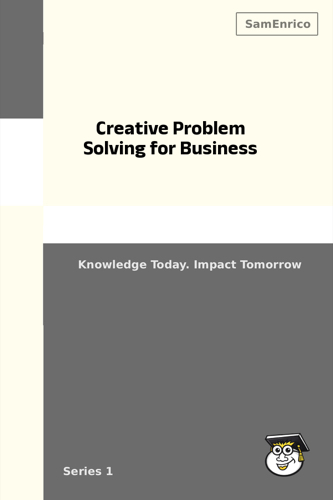
Creative Problem Solving for Business eBook
Tackle market stagnation, operational inefficiency
Tackle market stagnation, operational inefficiency, and product fatigue with structured creativity tools.
Formats
Free sample
Chapter 1: The Action Fallacy--–- The conference room smelled of stale coffee and recycled air. Fourteen executives sat around a walnut table that cost more than most people's cars. On the whiteboard, someone had written the same problem that had been on the whiteboard for eleven consecutive quarterly meetings: "Declining market share in the 25-34 demographic."The Chief Marketing Officer presented the same three solutions she had presented last quarter. The Head of Product showed slides with the same five features they had been building for eight months. The CFO asked the same question about ROI.
And the CEO—a brilliant, exhausted woman who had grown the company from nothing to eighty million in revenue—did what she always did when the conversation circled without landing. She said, "Let's not overthink this. We need to take action. What's our first step?"The team produced a list of thirty-seven action items. They assigned owners.
They set deadlines. They left the room feeling productive, accomplished, even virtuous.Eighteen months later, the company was acquired for less than half its peak valuation. The 25-34 demographic had moved to a competitor that didn't exist when those quarterly meetings began.The problem was not that the team failed to act. The problem was that they acted brilliantly on the wrong question. They had fallen into what this book calls The Action Fallacy: the deeply seductive belief that doing something—anything—is superior to stopping, thinking, and asking whether you are solving the right problem in the first place.This chapter is about why The Action Fallacy is the single greatest barrier to creative problem solving in business today.
And it is about the first step toward escaping it: learning the difference between being busy and being productive, between activity and progress, between the urgent and the important.The Seduction of Motion There is a reason The Action Fallacy is so pervasive. It feels good to act. When you check an item off a to-do list, your brain releases a small amount of dopamine—the same neurotransmitter involved in pleasure and reward. When you sit in a meeting and generate a list of next steps, you experience a sense of closure and forward momentum. When you respond to an email within thirty seconds, you feel responsive and in control.These feelings are not trivial.
They are biochemical rewards for perceived progress. And they are dangerously misleading.Consider a study conducted by researchers at the University of Virginia. Participants were placed in a room with no distractions and asked to sit quietly and think for fifteen minutes. That was the only instruction: sit and think. No phone.
No book. No music.Sixty-seven percent of male participants and twenty-five percent of female participants chose to give themselves mild electric shocks rather than sit alone with their thoughts. They preferred physical pain to the discomfort of doing nothing.This is the core psychological driver of The Action Fallacy. We are so uncomfortable with ambiguity, with uncertainty, with the absence of visible progress, that we will literally hurt ourselves to avoid it. And in business, that discomfort manifests as a relentless bias toward activity—any activity—over the slower, harder work of figuring out what actually needs to be done.The executive who calls a meeting is rewarded with the feeling of leadership.
The team that produces a thirty-page plan feels the satisfaction of completion. The engineer who rewrites a working system to use a newer programming language experiences the thrill of technical progress. But none of these activities may address the underlying problem. In fact, they may actively prevent its solution by consuming time, attention, and resources that could have been directed elsewhere.The Cost of Inaction Is Not What You Think When business leaders talk about the cost of inaction, they usually mean something like this: "If we don't act quickly, we will lose market share to competitors." Or "If we don't launch this feature by Q3, our customers will churn." Or "If we don't cut costs now, we will miss our quarterly numbers."These are real risks. They are not trivial.
But they obscure a much larger and more dangerous cost of inaction: the cost of solving the wrong problem well.Let us define two terms clearly.Reactive creativity is what happens when a problem becomes so painful, so visible, so impossible to ignore that an organization finally mobilizes resources to address it. A product recall. A mass customer exodus. A regulatory fine. A public relations disaster.
Reactive creativity feels heroic—the team that works through the weekend to save the company, the executive who makes the tough decision, the engineers who pull the all-nighter. But reactive creativity is almost always expensive, exhausting, and suboptimal. It produces band-aid fixes that address symptoms rather than causes. It burns out the very people you need for genuine innovation. And it creates a cycle of crisis and recovery that becomes culturally embedded.Proactive creativity is different.
Proactive creativity applies the same structured thinking tools—the ones you will learn throughout this book—to problems before they become crises. It asks "what might go wrong in eighteen months?" not "what just broke?" It asks "what customer need are we currently missing?" not "why are customers leaving?" It asks "what inefficiencies are we tolerating as normal?" not "how do we cut 20% by next month?"The cost of inaction that most leaders track is the cost of delaying reactive creativity. But the much larger cost—the one that separates market leaders from market laggards—is the cost of never developing proactive creativity at all.Let us put numbers on this. A study of three hundred companies over a ten-year period found that organizations with structured, proactive creative problem-solving processes outperformed their industry peers by 2.3 to 1 on revenue growth and 3.1 to 1 on profit margins. More striking: when these companies faced industry downturns, they were 40% less likely to lay off employees and recovered to pre-downturn performance an average of seven months faster than reactive competitors.The difference was not intelligence.
It was not resources. It was not luck. It was the disciplined habit of applying creative thinking before the crisis demanded it.Analytical Thinking vs. Creative Thinking: A Crucial Distinction To understand why The Action Fallacy is so damaging, we must first understand two fundamentally different modes of thinking. Most business environments heavily favor one while systematically suppressing the other.Analytical thinking is the process of taking something that exists and making it better, faster, cheaper, or more efficient.
It operates within known constraints. It uses established rules and frameworks. It seeks the single correct answer. It values data, logic, and precedent. Analytical thinking is essential.
It is how you optimize a supply chain, reduce manufacturing defects, or improve customer support response times. It is how you move from good to great within an existing paradigm.Creative thinking is the process of discovering something that does not yet exist. It questions the constraints themselves. It invents new rules and frameworks. It generates multiple possible answers.
It values novelty, connection, and divergence. Creative thinking is how you invent a category that did not previously exist, discover a customer need that customers themselves could not articulate, or…
This is the end of the free sample. Get the eBook to keep going. Buy now
About this book
Details
- Author
- Hutton Rochel
- Publisher
- SamEnrico
- Language
- English
- Genre
- Non-Fiction, Self-Help, Business
- Released
- 2026-06-11
- Pages (approx.)
- 145
- Available as
- eBook, Audiobook

Read better in the ZLOADR app
Your eBooks on your phone or tablet. Sign in with your SamEnrico account and start reading.
More by Hutton Rochel
 The Gwalior Campaign 1858Hutton Rochel$11.99
 Recalled Food Disposal GuideHutton Rochel$11.99
 Burmese Monk EscapeHutton Rochel$11.99
 Muscle Dysmorphia GuideHutton Rochel$11.99
 Dream Journal For StudentsHutton Rochel$11.99
 Slovak E Mobility InfrastructureHutton Rochel$11.99
 Al Sharpton NYCHutton Rochel$11.99
 PCOS Insulin Resistance GuideHutton Rochel$11.99
 Glass Ceiling Shattered: The Untold Story of the First Female CEO of a Fortune 500 CompanyHutton Rochel$11.99
 Hops & Revolutions: How a Beer War Shaped a NationHutton Rochel$11.99
 The Vanishing Doctor: The Enigma of Dr. Michael GarronHutton Rochel$11.99
 How to Become a Alarm InvestigatorHutton Rochel$11.99
You may also like
 Hong Kong Handover 1997Dunn Johnnie$11.99
 Zumba For Postnatal Recovery CourseNeal Christian$11.99
 Zumba for BeginnersLadner Nikia$11.99
 YouTube Comment Mining GuideHumes Pandora$12.99
 Worry Box MeditationCarlin Rudy$11.99
 Workplace Stress MeditationNguyen Lynn$11.99
 Workplace Stress and Sleep RepairHawley Ivory$11.99
 Workplace Perfectionism CureDelaney Jeffry$11.99
 Workplace Injustice Anger GuideWallen Isabelle$11.99
 Work Addiction and Burnout LinkGreenwood Ester$11.99
 Women in Yoga and WellnessBeattie Galina$11.99
 Women in Stand Up ComedyChun Evangeline$11.99