
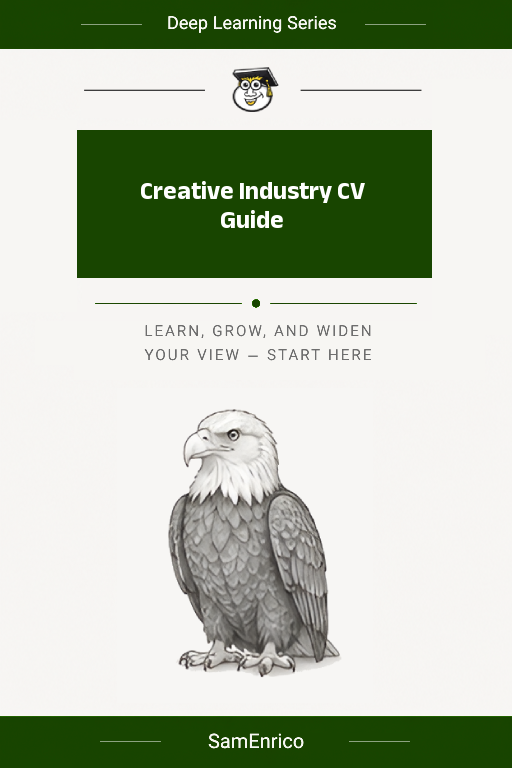
Non-FictionSide Hustle ArchitectCreative Niche
Creative Industry CV Guide eBook
Specialize in CVs for graphic designers, writers,
by Jansen Diann
Specialize in CVs for graphic designers, writers, and artists, emphasizing portfolio links and creative formatting.
Formats
Free sample
Chapter 1: The First Date...--Your CV is not a document. It is a room, and a recruiter has just walked inside. They will decide whether to stay or leave in less time than it takes to boil an egg. Most creative professionals never realize this. They spend ten hours polishing their portfolio—adjusting kerning on a logo, rewriting a caption, re-rendering a 3D model—and then ten minutes throwing together a CV that reads like a tax form.
Then they wonder why no one calls back.Here is the truth they have not been told: in creative fields, your resume functions as the first design test a recruiter encounters. You are being judged before a single word is read. Your layout, your typography, your use of white space, your ability to prioritize information—these are not separate from your creative skills. They are your creative skills, demonstrated in real time. A graphic designer who submits an ugly CV has failed the test before the interview.
A writer with grammatical errors has proven they cannot do the job they claim to want. An artist who formats their exhibition history like a shopping list has signaled that they do not understand hierarchy, curation, or professionalism.This chapter dismantles the single most damaging misconception in creative job searching: that your CV is merely administrative paperwork. It is not. It is the first date. And like any first date, you have approximately ten seconds to make a second date happen.The Ten-Second Rule Let us start with a brutal fact.
Creative recruiters do not read CVs the way you read novels. They scan. They skim. They hunt for visual and verbal cues that tell them whether to invest another thirty seconds.The average time a recruiter spends on a creative CV before deciding "yes" or "no" is ten seconds. Ten seconds.
That is not enough time to read every word you wrote. It is barely enough time to register your name, your job titles, and one or two stand-out accomplishments. Everything else is noise.But here is where creative recruiting differs from corporate recruiting. In a corporate setting, a recruiter scans for keywords: "MBA," "sales quota," "project management." In a creative setting, a recruiter scans for evidence of taste. They are not just looking for what you did.
They are looking for how you chose to show it.For agency recruiters hiring graphic designers: they scan for visual hierarchy first, content second. Their eyes go to the top of the page, then follow the dominant visual line. If your layout confuses them, they do not try harder—they close the PDF.For publishing editors hiring writers: they scan for voice and error-free prose first, experience second. One typo in the first three lines is often enough for rejection. Editors know that if you cannot proofread your own CV, you will not proofread a manuscript.For gallery directors hiring artists: they scan for institutional names and exhibition prestige first, everything else second.
A solo show at a respected gallery outweighs five years of unrelated freelance work.The Ten-Second Rule is not a constraint to resent. It is a design problem to solve. If you only have ten seconds to communicate your creative value, what is the one thing you want the recruiter to see? That is not a rhetorical question. Write it down before you read the next paragraph.The Application Ecosystem: A Unified Theory Most job seekers treat their CV, portfolio, and Linked In profile as three separate things.
They update one without updating the others. They use different language, different formatting, different project selections. This is a catastrophic error.These three artifacts form a single Application Ecosystem. The CV is the front door. The portfolio is the living room.
Linked In is the backstory. A recruiter will typically encounter all three, often in the same sitting, and any inconsistency between them signals sloppiness, disorganization, or—worst of all—a lack of attention to detail.Here is how the ecosystem should function:The CV does not need to contain every project you have ever made. It needs to contain enough to make a recruiter want to see your portfolio. Its only job is to earn the click.The Portfolio does not need to repeat everything on your CV. It needs to show the work that the CV promised.
Every project mentioned on the CV should be visible in the portfolio within three clicks or fewer.Linked In does not need to mirror your CV exactly. But its headline, summary, and featured work should tell the same story. A recruiter who sees "Graphic Designer" on your Linked In and "Visual Artist" on your CV will wonder which one you actually are.The chapter will return to this ecosystem repeatedly. For now, internalize this principle: your CV is not an island. It is the shoreline between a recruiter's curiosity and your best work.Why Corporate CV Advice Kills Creative Careers Walk into any bookstore or scroll through any career advice website.
Ninety percent of the guidance on resume writing comes from the corporate world. It tells you to use bullet points. It tells you to list your responsibilities. It tells you to use reverse-chronological order. It tells you to avoid color, avoid graphics, avoid anything that might distract an Applicant Tracking System.For an accountant or a lawyer, this advice is fine.
For a creative professional, it is career poison.Corporate CV advice assumes that the document's purpose is to transmit information efficiently. But a creative CV has a different purpose: to demonstrate aesthetic judgment under constraint. Efficiency is not the goal. Distinction is the goal. A creative CV that looks like every other CV has failed before it was opened.This does not mean you should design a CV that is illegible, chaotic, or self-indulgent.
It means you should apply the same design thinking to your CV that you apply to your best client work. If you are a graphic designer, your CV is a typographic specimen. If you are a writer, your CV is a piece of micro-copy. If you are an artist, your CV is a curated exhibition in PDF form.The corporate world optimizes for safety. The creative world rewards risk—but only intelligent risk.
The difference between "creative" and "unprofessional" is intentionality. A CV that breaks the rules because you did not know the rules is a failure. A CV that breaks the rules because you understood them and chose to transcend them is a statement.Later chapters will teach you exactly how to navigate this line. For now, accept that the advice your non-creative friends gave you about resumes is probably wrong for you.The Three Creative Species One of the central arguments of this book is that there is no such thing as a "creative professional" in the abstract. There are graphic designers, writers, and artists.
Each group faces different expectations, different scanning patterns, and different CV conventions. Generic advice applied to all three produces mediocre results for all three.Graphic designers are judged first on layout, then on content. A perfectly written CV with ugly typography will be rejected immediately. A beautifully designed CV with thin content will be…
This is the end of the free sample. Get the eBook to keep going. Buy now
About this book
Details
- Author
- Jansen Diann
- Publisher
- SamEnrico
- Language
- English
- Genre
- Non-Fiction, Side Hustle Architect, Creative Niche
- Released
- 2026-05-29
- Pages (approx.)
- 121
- Available as
- eBook, Audiobook

Read better in the ZLOADR app
Your eBooks on your phone or tablet. Sign in with your SamEnrico account and start reading.
More by Jansen Diann
 Riboflavin For MigrainesJansen Diann$11.99
 Body Image for Amputees GuideJansen Diann$11.99
 Shift Work for Casino WorkersJansen Diann$11.99
 The Relationship AuditJansen Diann$11.99
 The Ripper’s Shadow: How a 19th-Century Murder Inspired a Modern KillerJansen Diann$11.99
 The Frozen Code: The Untold Story of the Arctic's Last Data VaultJansen Diann$11.99
 Member Reception AgentJansen Diann$11.99
 CCPA Terms of ServiceJansen Diann$12.99
 Understanding EsotropiaJansen Diann$17.99
 How to Become a Diamond-powder TechnicianJansen Diann$11.99
You may also like
 Hong Kong Handover 1997Dunn Johnnie$11.99
 Zumba For Postnatal Recovery CourseNeal Christian$11.99
 Zumba for BeginnersLadner Nikia$11.99
 YouTube Comment Mining GuideHumes Pandora$12.99
 Worry Box MeditationCarlin Rudy$11.99
 Workplace Stress MeditationNguyen Lynn$11.99
 Workplace Stress and Sleep RepairHawley Ivory$11.99
 Workplace Perfectionism CureDelaney Jeffry$11.99
 Workplace Injustice Anger GuideWallen Isabelle$11.99
 Work Addiction and Burnout LinkGreenwood Ester$11.99
 Women in Yoga and WellnessBeattie Galina$11.99
 Women in Stand Up ComedyChun Evangeline$11.99