
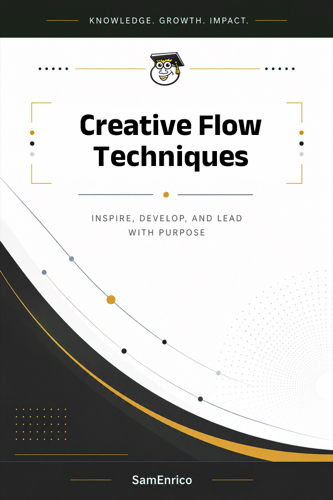
Creative Flow Techniques Audiobook
Access flow states for writing, art, music, and de
Access flow states for writing, art, music, and design work.
Formats
Free sample
Chapter 1: The Paradox Paradox--–- The first lie we tell ourselves about creativity is that it should feel easy. The second lie is that when it doesn't, something is wrong with us. You have felt this lie in your bones: staring at a blank page at 11 PM, a deadline looming, wondering why the words won't come. You have felt it at your easel, your piano, your design software, your pottery wheel. The idea is right there, shimmering just out of reach, but your hands won't obey.
So you push harder. You try to force the door open. And the door, perversely, seals itself tighter.Welcome to the Paradox of Flow.For the past thirty years, psychologists, neuroscientists, and elite performers have studied a peculiar state of human consciousness. In this state, action and awareness merge. Time dilates or collapses.
Self-criticism goes silent. What was difficult becomes not exactly easy, but effortless in a way that defies explanation. Athletes call it "the zone." Musicians call it "the pocket." Writers call it "being in the flow." Mihaly Csikszentmihalyi, the Hungarian-American psychologist who spent decades researching this phenomenon, gave it the name that stuck: flow.Here is the paradox that opens this chapter and this book: flow, the state of deepest ease, requires the most deliberate, strategic effort to access. You cannot will yourself into flow. You cannot command it to appear.
But you can build a door, oil its hinges, clear the path to it, and learn to recognize its shape in the dark. That is what this book teaches. And it begins here, with a question that sounds simple but is not: what is flow, really?Most people who have experienced flow cannot describe it accurately. They say "I lost myself in the work" or "time flew by" or "everything just clicked." These are not wrong, but they are incomplete. To access flow reliably, you need a precise map of its territory.
You need to know its eight dimensions, its neurological signature, and—most critically—the conditions that produce it versus the conditions that produce anxiety, boredom, or apathy. This chapter provides that map.We will cover the eight characteristics of flow as identified by Csikszentmihalyi, each illustrated with examples from writing, art, music, and design. We will explore the neuroscience of what happens inside your brain during flow—including the fascinating phenomenon of "transient hypofrontality," where the judgment centers of your brain actually quiet…
This is the end of the free sample. Get the Audiobook to keep going. Buy now
About this book
Details
- Author
- Cotter Ignacia
- Publisher
- SamEnrico
- Language
- English
- Genre
- Non-Fiction, Self-Help, Creativity
- Released
- 2026-06-10
- Pages (approx.)
- 132
- Available as
- eBook, Audiobook

Listen in the VoxFlicks app
Audiobooks and audio dramas wherever you go. Sign in with your SamEnrico account and press play.
More by Cotter Ignacia
 Red Cross Hurricane Fraud Investigation CourseCotter Ignacia$11.99
 Meal Planning for Binge PreventionCotter Ignacia$11.99
 The Concept Mapping Study GuideCotter Ignacia$11.99
 Decision Making Under Stress TogetherCotter Ignacia$11.99
 The Billionaire's Shadow: The Untold Story of the Failed Kidnapping of Mukesh AmbaniCotter Ignacia$11.99
 How to Start a Barge Business (Beginners Guide)Cotter Ignacia$11.99
 Canada via Madrid SystemCotter Ignacia$12.99
 Angel Investor Success StoriesCotter Ignacia$12.99
 Software Development Team LeadCotter Ignacia$11.99
 Understanding Weaver–Williams SyndromeCotter Ignacia$17.99
You may also like
 Trance for Creativity BoostEngel Colene$11.99
 Self Hypnosis for Creativity HabitsGerman Bernetta$11.99
 Mindfulness Meditation for Creativity BlockPage Duane$11.99
 Joyful Creativity Through GratitudeJacob Antoine$11.99
 Ideation Techniques For SolutionsKim Vincent$11.99
 Fear Of Failure In CreativityCrean Fairy$11.99
 EQ For Creative Professionals GuideGilley Elanor$11.99
 Creative Legacy GuideHooker Georgiana$11.99
 Alcoholism Recovery for Creative Souls WorkbookCompton Leota$11.99
 Creativity Trance MethodLy Morgan$11.99
 Creative Morning Routine GuideBetancourt Jacquelynn$11.99
 Walking Meditation For Creative BlockStevens Irvin$11.99