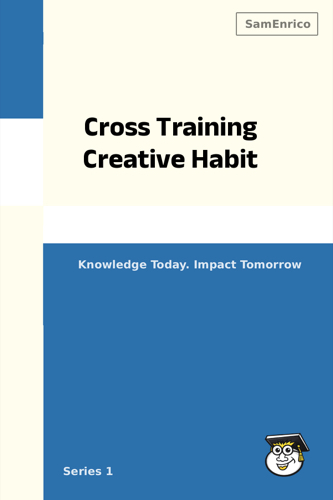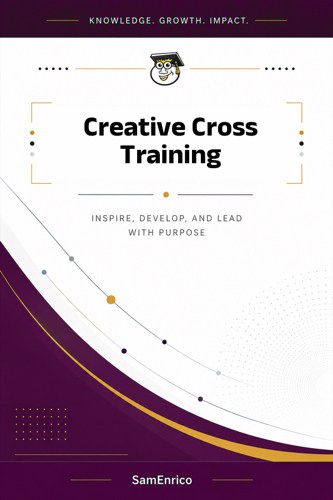
Creative Cross Training eBook
Boost one art form by practicing another unrelated
Boost one art form by practicing another unrelated creative discipline.
Formats
Free sample
Chapter 1: The Adjacent Alien--The most creative people you have ever heard of were lying to you. Not maliciously. Not intentionally. But they were lying nonetheless. They let you believe that their genius emerged fully formed from a single discipline—that Picasso was simply a painter, that Einstein was simply a physicist, that Steve Jobs was simply a tech entrepreneur.
The truth is far messier, far more interesting, and far more useful to anyone who has ever felt stuck, repetitive, or afraid of the blank page.The truth is that geniuses cross-train.They steal from disciplines that have nothing to do with their day job. They practice skills they are embarrassingly bad at. They build neural pathways their specialized peers never develop. And they do this not in spite of their primary work but because of it. The calligraphy class Steve Jobs audited after dropping out of Reed College did not teach him how to write code.
It taught him how to see typography. And that seeing became the Macintosh's defining feature—proportionally spaced fonts, multiple typefaces, a computer that looked like a work of art. "If I had never dropped in on that single calligraphy course in college," Jobs said, "the Mac would have never had multiple typefaces or proportionally spaced fonts."A class he took for no reason. A skill he never intended to use. And a billion-dollar company built on the transfer.This chapter introduces the central mechanism of Creative Cross Training: cognitive transfer, the brain's ability to take a skill learned in one context and apply it to another.
It introduces the Adjacent Alien Rule—the principle that the most valuable secondary art is one that feels both foreign and strangely connected to your primary work. And it proves, through studies and stories, that the most innovative people in history were not single-discipline specialists. They were thieves. And you need to become one too.The Smithsonian Study That Proves Your Hobbies Matter In 2014, researchers at the Smithsonian Institution published a study that should have changed every business school curriculum and every creative writing program in America. They examined the life histories of Nobel Prize-winning scientists from 1901 to 2005 and compared them to less decorated peers.
The finding was staggering: Nobel laureates were significantly more likely to engage in arts and crafts than the average scientist. Not as a hobby. Not as a weekend distraction. As a core part of their innovative process.These were not scientists who painted on weekends to relax. These were scientists who explicitly credited their artistic practice with their scientific breakthroughs.
The physicist Richard Feynman played the bongos and sketched nude models. He said that drawing taught him to notice details he would have otherwise missed—and that noticing details was 90% of physics. The chemist Roald Hoffmann wrote poetry and said that poetry taught him to see the world in metaphors, and that metaphors were how he discovered new molecular structures. The neurologist Santiago Ramón y Cajal won a Nobel Prize for his drawings of brain cells—not his descriptions, not his theories, but his drawings.Here is what the Smithsonian study revealed that most people miss: the Nobel laureates were not more creative despite their hobbies. They were more creative because of them.
The arts and crafts were building neural pathways that their specialized peers never developed. A scientist who practices painting develops the "eagle eye"—the ability to see minute variations in visual data. That skill transfers directly to spotting anomalies in experimental data. A scientist who practices music develops the "metronome"—the ability to feel rhythm and timing. That skill transfers directly to designing experiments with precise temporal controls.Your hobby is not a distraction from your creative work.
Your hobby is your secret lab. Your R&D department. Your competitive advantage.The Darwin Effect: How Looking at Birds Changed Evolution Charles Darwin is famous for the finches of the Galápagos Islands. But here is what the textbooks do not tell you: Darwin spent hours every week studying lithographs of birds and landscapes. He was not a trained artist.
His drawings were, by all accounts, terrible. But he drew anyway. He traced the contours of feathers, the angles of beaks, the shapes of wings.Why would one of the most important scientists in history waste time on bad drawings?Because drawing taught him to see.When you draw something, you cannot rely on your brain's shortcuts. Your brain wants to tell you that a bird's beak is "pointy" and a bird's wing is "feathered." Those are categories, not observations. But when you force your hand to trace the actual contour of the beak—the curve, the angle, the relationship to the eye—you bypass your brain's labeling system.
You stop naming things and start seeing things. And what Darwin saw, because he drew, were minute variations in beak size and shape that his colleagues had overlooked. Those variations became the evidence for natural selection.This is the Darwin Effect: training your eye trains your theory. The visual discipline of drawing transfers directly to the intellectual discipline of observation. You cannot see what you cannot look for.
And you cannot look for what you have never learned to see.The Darwin Effect applies far beyond biology. A writer who studies photography learns to see the light in a room—the way shadows fall, the way colors shift. That visual attention transfers to setting description. A musician who studies drawing learns to see the shape of a melody—the contour, the peaks and valleys, the negative space between notes. A coder who studies architecture learns to see the structure of a program—the load-bearing walls, the circulation paths, the places where the user will get lost.The lesson is simple but profound: training your eye trains your everything.The Lego Principle: Why Architects Who Play with Blocks Solve Better Problems The chapter you are reading mentions Lego exactly once.
This is that once. Lego is a metaphor here, not a workout. (The hands-on sculpting workout appears in Chapter 5, and it uses clay—malleable, squishable, shapable clay, not rigid blocks. There is a reason for that distinction, and we will get to it.)The Lego Principle is this: architects who build physical models—even with children's toys—solve spatial problems faster and more elegantly than architects who stay in CAD software. A 2012 study from the University of Toronto found that architects who built physical models were able to identify structural flaws in their designs 40% faster than those who worked exclusively on screens.
Why? Because physical models have gravity. They have weight. They have balance. A CAD model can float in perfect defiance of physics.
A Lego tower cannot.But the Lego Principle is not about architecture. It is about transfer.When a novelist feels stuck on a plot's emotional geography—when she knows that the relationship between two characters is wrong but cannot articulate why—building a physical model of that relationship can unlock the solution. She assigns each character a block. She stacks them to represent proximity and distance. She builds a tower where each floor is a chapter.
She knocks it over. She rebuilds. And in the physical act of building and destroying, she sees what she could…
This is the end of the free sample. Get the eBook to keep going. Buy now
About this book
Details
- Author
- Crandall Branda
- Publisher
- SamEnrico
- Language
- English
- Genre
- Non-Fiction, Self-Help, Cross Training
- Released
- 2026-06-08
- Pages (approx.)
- 131
- Available as
- eBook, Audiobook

Read better in the ZLOADR app
Your eBooks on your phone or tablet. Sign in with your SamEnrico account and start reading.
More by Crandall Branda
 Cut Off Response PlanCrandall Branda$11.99
 Mindful Evenings Stress ResetCrandall Branda$11.99
 The Mother Who Never YelledCrandall Branda$11.99
 Medical Active Listening GuideCrandall Branda$11.99
 Strength Training for Injury PreventionCrandall Branda$11.99
 Mentorship for FreelancersCrandall Branda$11.99
 Huston DynastyCrandall Branda$11.99
 Assertiveness For DiplomatsCrandall Branda$11.99
 The Alchemist and the Jungle: Tin’s Hidden Secret in Southeast AsiaCrandall Branda$11.99
 Love and Loyalty in the Bush: The Romance of the East African CampaignCrandall Branda$11.99
 The Great Pacific Puzzle: How a 12-Year-Old Solved a 200-Year-Old Ocean MysteryCrandall Branda$11.99
 SEO Strategy with Google Search ConsoleCrandall Branda$11.99