
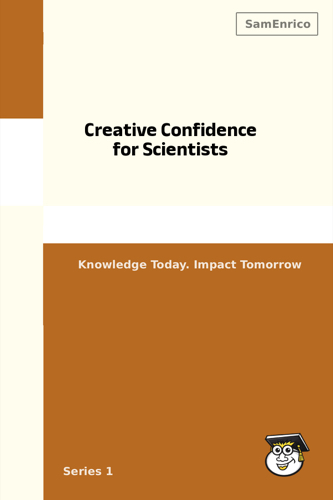
Creative Confidence for Scientists eBook
Imaginative research and hypothesis generation.
Imaginative research and hypothesis generation.
Formats
Free sample
Chapter 1: The Curiosity Trap--–- Every scientist remembers the moment they fell in love with discovery. For some, it was a childhood microscope revealing a hidden universe in a drop of pond water. For others, it was the elegant logic of a physics equation that seemed to describe the entire cosmos. For me, it was watching a caterpillar transform into a butterfly and asking a question that had no immediate answer: How does the caterpillar know to build a cocoon when it has never seen one before?That question led me to a career in science. And for the first few years, I was rewarded for asking such questions.
In graduate school, my advisors praised my "curiosity-driven approach." My committee told me I had a "natural instinct for interesting problems." I believed that science valued the ability to wonder.Then came the post-doc. Then came the grant applications. Then came the peer review.And somewhere along the way, I stopped asking interesting questions. I started asking safe ones. I stopped chasing "what if" and started calculating p-values.
I stopped wondering how the caterpillar knew and started wondering how to get another figure for the paper. I had fallen into what I now call the curiosity trap—the slow, stealthy erosion of imaginative inquiry by the very systems designed to validate it.This chapter is about that trap. It is about how the most curious minds in the world become, over time, the most conservative. It is about the paradox that the more expert you become, the less likely you are to have a truly original idea. And it is about the first and most important step toward reclaiming your creative confidence: understanding that you are not broken.
You are just trapped. And traps can be dismantled.The Paradox of Expertise Let me start with a disturbing finding from the psychology of creativity. In a landmark study published in the journal Creativity Research, researchers tracked the career trajectories of over 2,000 scientists across four decades. They measured two things: the number of papers each scientist published and the "novelty score" of those papers (how often they cited combinations of journals that rarely cited each other—a proxy for creative recombination of ideas).The results were clear and unsettling. Early-career scientists—graduate students and post-docs—produced the most novel work.
Their papers were more likely to combine disparate fields, challenge established assumptions, and propose unexpected mechanisms. But as those same scientists advanced—as they secured tenure, as they became PIs, as they joined grant review panels—their novelty scores declined steadily. By twenty years post-Ph D, the average scientist was producing work that was less novel than the work they had produced as a student.The researchers called this the expertise paradox: the more you know, the less you explore.Why does this happen? The answer is not that scientists become lazy or complacent. The answer is more subtle and more disturbing.
Expertise creates invisible cognitive prisons. When you have spent fifteen years learning that X causes Y through mechanism Z, your brain optimizes for that pathway. It stops seeing alternatives not because you are stubborn but because your neural architecture has literally been shaped by what you already know.This is not a moral failing. It is a feature of how the human brain works. The brain is a prediction engine.
It builds models of the world based on past experience, and those models become faster and more efficient over time. But efficiency comes at a cost: the models also become filters. You stop seeing what doesn't fit.I once watched a senior biochemist review a junior colleague's data. The junior scientist had found something genuinely weird—an enzyme that seemed to work in reverse under certain conditions. The senior scientist dismissed it immediately.
"That can't be right," he said. "I've studied this pathway for twenty years, and it doesn't work that way."He was not being mean. He was being expert. His twenty years of knowledge told him that the junior's observation was impossible. Except it wasn't.
The junior scientist pursued the anomaly after the senior left the lab, and it led to a paper in Cell that redefined the pathway. The senior scientist's expertise had become a prison. He knew too much to see what was right in front of him.This is the first layer of the curiosity trap: expertise curates what you are willing to see.The Hidden Curriculum of Peer Review But expertise alone does not explain the full erosion of creative confidence. There is a second, more powerful force at work: the hidden curriculum of peer review.Peer review is the foundation of scientific quality control. In principle, it ensures that published work is rigorous, reproducible, and meaningful.
In practice, it has become the single greatest suppressor of creative risk-taking in modern science.Let me be precise about what I mean. When you submit a paper to a journal, reviewers are asked to evaluate your work. They are typically not asked to evaluate whether it is interesting. They are asked whether it is correct. The questions reviewers ask are: Are the controls adequate?
Are the statistics sound? Are the conclusions supported by the data? These are important questions. But they are defensive questions. They ask: Did you make a mistake?The problem is that creative science is almost always wrong in its first iteration.
Bold hypotheses are rarely perfectly supported by clean data. The experiment that challenges a paradigm usually has a flaw—a missing control, a small sample size, an alternative explanation. And reviewers, trained to enforce rigor, will catch those flaws. They will ask for more experiments, more replicates, more controls.On its face, this seems reasonable. But here is what actually happens: scientists learn to anticipate what reviewers will ask for.
They learn to avoid hypotheses that will generate "difficult" reviewer questions. They learn to stick to safe, incremental claims that can be supported with clean, unambiguous data. They learn, in short, to pre-edit their own creativity.I have sat on grant review panels where this dynamic plays out in real time. A young investigator proposes a bold, risky, potentially transformative idea. The panel reads the proposal.
Then someone says: "This is interesting, but there's no preliminary data." Someone else says: "The approach is innovative, but it might not work." A third says: "I'd like to see more validation of the model before we fund this."Each comment is reasonable. Each comment is also a death knell for the bold idea. The proposal is scored low. The young investigator learns: Don't propose bold ideas. Propose safe ones.A study in the journal e Life quantified this effect.
Researchers analyzed over 100,000 grant applications to the NIH and correlated the "novelty score" of each application (based on the combination of keywords) with its funding outcome. The results were stark: the most novel proposals were significantly less likely to be funded than the least novel ones. The system explicitly penalized creativity.This is the second layer of the curiosity trap: peer review rewards safety and punishes risk.The Fear Loop Now we come to the third layer, and perhaps the most insidious: the internalization of these external…
This is the end of the free sample. Get the eBook to keep going. Buy now
About this book
Details
- Author
- Applegate Pok
- Publisher
- SamEnrico
- Language
- English
- Genre
- Non-Fiction, Self-Help, Science
- Released
- 2026-06-06
- Pages (approx.)
- 143
- Available as
- eBook, Audiobook

Read better in the ZLOADR app
Your eBooks on your phone or tablet. Sign in with your SamEnrico account and start reading.
More by Applegate Pok
 Postnatal Body Scan RecoveryApplegate Pok$11.99
 The Foot in Door TechniqueApplegate Pok$11.99
 Competitive Cluster MappingApplegate Pok$11.99
 Prostate Cancer Support GroupsApplegate Pok$11.99
 Hair Tribe Off BroadwayApplegate Pok$11.99
 Teen Defiance Parent AngerApplegate Pok$11.99
 Joyful Parenting GuideApplegate Pok$11.99
 The Miracle on the Hudson: Resilience After Disaster (2009)Applegate Pok$11.99
 The Diamond Dynasty: How One Family Mined a Fortune and a CurseApplegate Pok$11.99
 How to Become a Hand Sewer - ShoesApplegate Pok$11.99
 How to Produce a Combo Washer DryerApplegate Pok$11.99
 Low GPA Scholarship GuideApplegate Pok$12.99
You may also like
 Hong Kong Handover 1997Dunn Johnnie$11.99
 Zumba For Postnatal Recovery CourseNeal Christian$11.99
 Zumba for BeginnersLadner Nikia$11.99
 YouTube Comment Mining GuideHumes Pandora$12.99
 Worry Box MeditationCarlin Rudy$11.99
 Workplace Stress MeditationNguyen Lynn$11.99
 Workplace Stress and Sleep RepairHawley Ivory$11.99
 Workplace Perfectionism CureDelaney Jeffry$11.99
 Workplace Injustice Anger GuideWallen Isabelle$11.99
 Work Addiction and Burnout LinkGreenwood Ester$11.99
 Women in Yoga and WellnessBeattie Galina$11.99
 Women in Stand Up ComedyChun Evangeline$11.99