
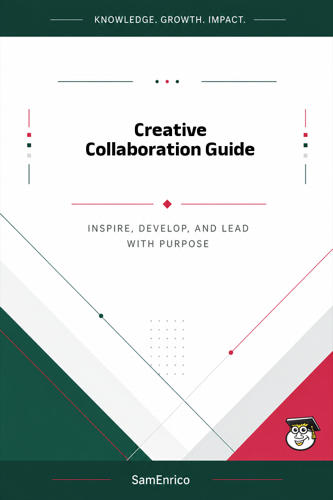
Non-FictionSelf-HelpCollaboration
Creative Collaboration Guide eBook
Builds confidence through teamwork.
Builds confidence through teamwork.
Formats
Free sample
Chapter 1: The Collaboration Lie––You have been lied to. Not maliciously, and not by any single person. The lie is woven into the fabric of how we tell stories about success, genius, and creativity. It appears in the movies you watch—the lone inventor hunched over a workbench until the lightning bolt strikes. It appears in the biographies you read—the tormented artist, the solitary CEO, the coder who built a billion-dollar company in a dorm room.
It appears in the way performance reviews are written, in the way bonuses are awarded, and in the way we quietly judge ourselves when we cannot figure something out alone.The lie is this: Great ideas come from great individuals working in isolation.Everything about this lie is seductive because it promises that if you just try harder, think deeper, or stay later, you too can be the genius. But the lie is also destructive. It breeds collaboration anxiety—the quiet, gnawing fear that asking for help is a confession of incompetence. It convinces you that sharing a rough idea before it is fully formed will make you look stupid. It whispers that group work will erase your unique contribution, that your voice will be diluted, that your best thinking will be lost in the noise of other people.This book exists to dismantle that lie, piece by piece, and to replace it with a more useful, more liberating, and more effective truth: Great ideas emerge from the space between people.The difference between these two truths is not academic.
It is the difference between grinding alone in anxious isolation and building confidence through the simple, radical act of creating with others. This chapter introduces the foundational concepts that make creative collaboration possible: the myth of the lone genius, the reality of distributed creativity, and the recognition that your best ideas have never been yours alone.The Loneliest Genius in the Room Let us start with a story.In 1905, Albert Einstein published four papers that fundamentally changed physics. He was twenty-six years old, working as a patent clerk in Bern, Switzerland. The popular image is romantic: Einstein alone, walking home through the cobblestone streets, suddenly seeing the theory of relativity unfold in his mind like a gift from the universe. That image is almost entirely wrong.Einstein did not work alone.
During these same years, he was part of a small, intense discussion group that he and two friends—Conrad Habicht and Maurice Solovine—called the "Olympia Academy." They met regularly to read philosophy, physics, and literature. They argued about David Hume's empiricism, Ernst Mach's critique of Newtonian mechanics, and the nature of time and space. They ate cheap sausage and drank terrible coffee, and they talked until late into the night. The ideas that became the 1905 papers did not spring fully formed from Einstein's solitary mind. They emerged from years of dialogue, challenge, and shared confusion.Einstein himself acknowledged this.
In a letter to Solovine years later, he wrote: "Your mocking of the Olympia Academy is unjustified. It has been the source of all my later achievements." The lone genius credited his ideas to a three-person book club.Einstein is not an exception. He is the rule.Consider Marie Curie, often portrayed as a solitary scientist laboring alone in a leaky shed. She worked in constant collaboration with her husband Pierre, keeping detailed laboratory notebooks that remain radioactive to this day—and that show, in their dual handwriting, a relentless back-and-forth of hypothesis, experiment, and revision. Consider Picasso and Braque, who invented cubism together, painting in near-silence, finishing each other's canvases, and refusing to sign their work because they believed the collaboration was the signature.
Consider Steve Jobs, often credited as the lone visionary of Apple. His own biographer, Walter Isaacson, concluded that Jobs's genius was not his technical ability but his capacity to provoke genius in others—to ask questions that forced people to think differently.The pattern is consistent. Behind every "solo" breakthrough, there is a network: mentors who asked the right question, rivals who sharpened the thinking, collaborators who filled the blind spots, and critics who refused to let mediocrity pass.Yet our stories continue to erase these collaborations. Why?The Function of the Lone Genius Myth The myth of the lone genius serves three psychological functions, none of which serve you.First, it simplifies storytelling. A single hero is easier to write about than a messy network of influences, conversations, and shared struggles.
Biographies sell better when they promise that one person had the answer. Movies are shorter when one character has the revelation.Second, it flatters the audience. If great ideas come from lone geniuses, then the rest of us are off the hook. We do not need to collaborate; we just need to wait for inspiration. This is comforting but paralyzing.
It turns creativity into a lottery rather than a practice.Third, and most damagingly, it creates collaboration anxiety. The myth teaches us that asking for help is a sign of weakness. It tells us that sharing an unfinished idea is dangerous because someone might steal it—or, worse, think less of us. It convinces us that our value as professionals depends on our ability to solve problems alone.Collaboration anxiety is the hidden tax on modern work. It shows up in the meeting where no one speaks because everyone is waiting for someone else to risk being wrong.
It shows up in the email that was written and deleted three times before being sent. It shows up in the late nights spent polishing a presentation that could have been finished in an hour if you had simply asked a colleague for help.You have felt this anxiety. Everyone has. The question is not whether you experience it but whether you let it control you.The first step to breaking free is understanding what creativity actually is—and where it actually comes from.Distributed Creativity: The Science of Ideas Between People Vera John-Steiner, a developmental psychologist who spent decades studying creative partnerships, coined the term "distributed creativity" to describe what she observed in the most productive collaborations she studied. Her research, published in Creative Collaboration (Oxford University Press, 2000), analyzed the working relationships of artists, scientists, and writers, including the correspondence of Freud and Jung, the collaboration of the Marx brothers, and the creative networks of the French impressionists.Her conclusion was unambiguous: creativity is not a property of individual minds.
It is a property of interactions.When John-Steiner and her colleagues analyzed the working methods of highly creative pairs and groups, they found that the most productive collaborations shared a specific structure. Partners did not simply divide tasks and work separately. Instead, they engaged in what John-Steiner called "joint thinking"—a state in which ideas flowed between people so fluidly that it became impossible to trace which person originated which insight. The collaborators themselves often could not remember who said what first. The idea belonged to the space between them.This is distributed creativity.
It is not a metaphor. It is a measurable phenomenon.Neuroscientific research supports the concept. In a 2018 study published in Neuro Image, researchers used functional near-infrared spectroscopy (f NIRS) to measure the…
This is the end of the free sample. Get the eBook to keep going. Buy now
About this book
Details
- Author
- Gilley Victorina
- Publisher
- SamEnrico
- Language
- English
- Genre
- Non-Fiction, Self-Help, Collaboration
- Released
- 2026-06-06
- Pages (approx.)
- 147
- Available as
- eBook, Audiobook

Read better in the ZLOADR app
Your eBooks on your phone or tablet. Sign in with your SamEnrico account and start reading.
More by Gilley Victorina
 Digital Prototyping ToolsGilley Victorina$11.99
 Administrative Job LossGilley Victorina$11.99
 Virtual Presentation SkillsGilley Victorina$11.99
 The Difficult Boss ConversationGilley Victorina$11.99
 Carson Edge Of Sea ConservationGilley Victorina$11.99
 Anger After Childs DiagnosisGilley Victorina$11.99
 Joy in Chronic IllnessGilley Victorina$11.99
 The Suit That Stole the Ring: How Henry Cooper’s Style Defined Boxing’s Golden AgeGilley Victorina$11.99
 The Green Thumb of Timbuktu: The Botanical Wonders of Al-Hassan ibn Muhammad al-WazzanGilley Victorina$11.99
 How to Produce Other Mechanical PartsGilley Victorina$11.99
 How to Produce a Comparison of Net-connected Media PlayersGilley Victorina$11.99
 A Collector's Handbook to the Sunbeam Rapier VGilley Victorina$11.99
You may also like
 Hong Kong Handover 1997Dunn Johnnie$11.99
 Zumba For Postnatal Recovery CourseNeal Christian$11.99
 Zumba for BeginnersLadner Nikia$11.99
 YouTube Comment Mining GuideHumes Pandora$12.99
 Worry Box MeditationCarlin Rudy$11.99
 Workplace Stress MeditationNguyen Lynn$11.99
 Workplace Stress and Sleep RepairHawley Ivory$11.99
 Workplace Perfectionism CureDelaney Jeffry$11.99
 Workplace Injustice Anger GuideWallen Isabelle$11.99
 Work Addiction and Burnout LinkGreenwood Ester$11.99
 Women in Yoga and WellnessBeattie Galina$11.99
 Women in Stand Up ComedyChun Evangeline$11.99