
Non-FictionSelf-HelpFrugal Living
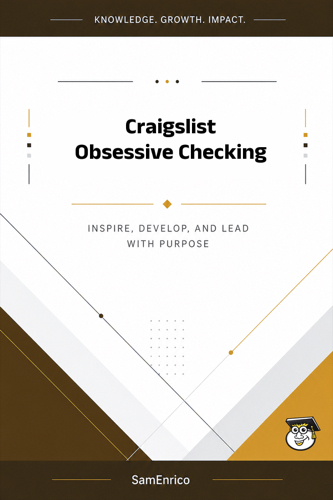
Craigslist Obsessive Checking eBook
Sets browsing limits for free and cheap listings t
by Ahern Deeann
Sets browsing limits for free and cheap listings to avoid impulsive pickups.
Formats
Free sample
Chapter 1: The Dopamine Hook--–- The first time I realized I had a problem, I was sitting in a Mc Donald's parking lot at 11:30 on a Wednesday night, waiting to meet a stranger who was giving away a "slightly used" elliptical machine. I did not need an elliptical machine. I did not have room for an elliptical machine. I already owned a perfectly good bicycle that I had not touched in eighteen months. But the listing said "free – must pick up tonight or it goes to the curb," and something in my brain had clicked into gear before my rational mind could object.
As I sat there, engine running, phone in hand, refreshing the Craigslist app every thirty seconds to make sure the seller had not changed their mind, I asked myself a question that would eventually lead to this book: Why can't I stop? The answer, as I would learn over years of research and hundreds of conversations with people just like me, lies deep within the oldest and most powerful reward system in the human brain.The Molecule of More To understand why you refresh Craigslist forty-seven times in a single evening, you have to forget almost everything you think you know about dopamine. Most people believe dopamine is the chemical of pleasure – that it floods your brain when you eat good food, have great sex, or finally bring home that "free" mid-century modern lamp. This is not correct. Dopamine is not about pleasure.
It is about anticipation. It is about wanting, not liking. This distinction, first clarified by neuroscientist Kent Berridge and his colleagues at the University of Michigan, is the single most important fact you will learn in this book.Here is what the research shows. When you actually receive a reward – when you take a bite of chocolate, when you get a promotion, when you successfully load a free sofa into your truck – your brain releases a relatively modest amount of dopamine. The actual experience of pleasure involves different chemicals entirely, primarily endorphins and anandamide.
But when you anticipate a reward – when you see the chocolate wrapper, when you refresh your email waiting for news about the promotion, when you click "refresh" on Craigslist – your brain floods your system with dopamine. The anticipation is up to five times more chemically intense than the acquisition.This is why the thrill of the hunt often exceeds the satisfaction of the catch. That is not a metaphor. It is a literal description of your neurochemistry. The moment you actually bring the item home, your dopamine levels plummet back to baseline.
And what does your brain want when it returns to baseline? More dopamine. More anticipation. More refreshing. The cycle does not end with acquisition; the cycle ends with the next search.The psychologist and author Daniel Z.
Lieberman, co-writer of The Molecule of More, puts it this way: "Dopamine is not the chemical of happiness. It is the chemical of the pursuit of happiness." When you are scrolling Craigslist, you are not seeking a sofa or a lamp or a set of free mason jars. You are seeking the feeling of seeking itself. The object is almost incidental. This explains a phenomenon that every Craigslist obsessive knows but rarely admits: you can spend hours scrolling, find nothing you want, and still feel strangely satisfied.
The dopamine came from the search. The outcome did not matter.Variable Rewards: The Slot Machine in Your Pocket If dopamine is the engine of compulsive behavior, variable ratio rewards are the accelerator pedal. A variable ratio reward schedule means that a reward is delivered after an unpredictable number of responses. The classic example is a slot machine. You pull the lever.
Sometimes you win. Sometimes you lose. You never know when the win will come. This unpredictability is not a bug; it is the feature that makes slot machines addictive. If you won every time, you would get bored.
If you never won, you would stop playing. But the unpredictable, intermittent delivery of rewards produces the highest rates of responding and the greatest resistance to extinction of any reinforcement schedule known to psychology.B.F. Skinner, the father of behaviorism, discovered this in the 1950s when he placed hungry rats in a box with a lever. When the lever was pressed, food was delivered every single time. The rats learned to press the lever, but they pressed at a steady, predictable rate.
Then Skinner changed the schedule. Now, the lever produced food after an unpredictable number of presses – sometimes one press, sometimes ten, sometimes twenty. The rats went wild. They pressed the lever frantically, obsessively, pressing hundreds of times per hour. They pressed until they collapsed from exhaustion.
They pressed even when the food dispenser was empty. They could not stop because the unpredictability had hijacked their dopamine systems.Craigslist is a variable ratio slot machine. Each refresh is a pull of the lever. Most refreshes deliver nothing – a screen full of listings you have already seen, or items you do not want, or obvious scams. But occasionally, unpredictably, a refresh delivers a jackpot: a "mint condition leather sofa – free," a "vintage dresser – must go today," a "working washer and dryer – curb alert." The unpredictability is what makes it potent.
If every refresh delivered a perfect item, you would become bored and stop checking. If no refresh ever delivered anything, you would stop. But the intermittent, unpredictable delivery of a "treasure" – even when that treasure is objectively junk – hooks your dopamine system in a way that is biologically identical to how slot machines hook gamblers.This is why you can scroll for forty-five minutes without messaging anyone. The scrolling itself, the act of refreshing, the possibility that the next click might reveal something amazing – that is where the dopamine lives. The acquisition is almost beside the point.
The real addiction is to the variable reward schedule of the search.The Zero Price Anomaly As if variable ratio rewards were not enough, Craigslist adds another psychological weapon: the price tag of zero dollars. Behavioral economist Dan Ariely has spent years studying what he calls the "zero price effect" – the irrational preference people show for free items even when paying a small amount would get them something significantly better.In one classic experiment, Ariely and his colleague Kristina Shampanier offered subjects a choice between two chocolates: a high-quality Lindt truffle for 15 cents, and a low-quality Hershey's Kiss for 1 cent. When faced with this choice, about 73% of subjects chose the Lindt truffle. They were willing to pay a little more for much higher quality. But when the researchers reduced the price of the Hershey's Kiss to free (0 cents) while keeping the Lindt truffle at 14 cents (a one-cent reduction from the original 15 cents), the results flipped dramatically.
Now, 69% of subjects chose the free Hershey's Kiss, even though it was objectively worse chocolate and the savings compared to the original scenario were only one cent.Why does this happen? Ariely identified two mechanisms. First, "free" triggers an emotional, almost visceral response that bypasses the rational cost-benefit calculations of the prefrontal cortex. When you see a price tag of zero, you do not think; you feel. Second, "free" creates…
This is the end of the free sample. Get the eBook to keep going. Buy now
About this book
Details
- Author
- Ahern Deeann
- Publisher
- SamEnrico
- Language
- English
- Genre
- Non-Fiction, Self-Help, Frugal Living
- Released
- 2026-06-09
- Pages (approx.)
- 125
- Available as
- eBook, Audiobook

Read better in the ZLOADR app
Your eBooks on your phone or tablet. Sign in with your SamEnrico account and start reading.
More by Ahern Deeann
 Challenging Angry ThoughtsAhern Deeann$11.99
 Body Scan Mindfulness WorkbookAhern Deeann$11.99
 Vault Security DesignAhern Deeann$11.99
 Unidentified Remains Clothing AnalysisAhern Deeann$11.99
 Homicide Cold Case SquadAhern Deeann$11.99
 Atomic Habits For AutomationAhern Deeann$11.99
 Cronometer GuideAhern Deeann$11.99
 Wild Thing: The Untold Story of New Zealand's Rock 'n' Roll RevolutionAhern Deeann$11.99
 Whispers of the First Oracle: The Riddle That Shaped CivilizationAhern Deeann$11.99
 How to Produce Natural CraftsAhern Deeann$11.99
 Growing CallianthemumAhern Deeann$11.99
 A Collector's Handbook to the Simca 1501Ahern Deeann$11.99
You may also like
 Hong Kong Handover 1997Dunn Johnnie$11.99
 Zumba For Postnatal Recovery CourseNeal Christian$11.99
 Zumba for BeginnersLadner Nikia$11.99
 YouTube Comment Mining GuideHumes Pandora$12.99
 Worry Box MeditationCarlin Rudy$11.99
 Workplace Stress MeditationNguyen Lynn$11.99
 Workplace Stress and Sleep RepairHawley Ivory$11.99
 Workplace Perfectionism CureDelaney Jeffry$11.99
 Workplace Injustice Anger GuideWallen Isabelle$11.99
 Work Addiction and Burnout LinkGreenwood Ester$11.99
 Women in Yoga and WellnessBeattie Galina$11.99
 Women in Stand Up ComedyChun Evangeline$11.99