
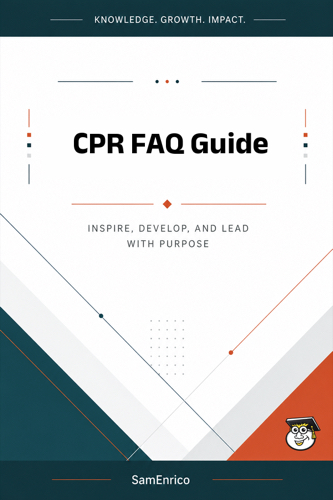
CPR FAQ Guide eBook
Answers to common questions about resuscitation.
Answers to common questions about resuscitation.
Formats
Free sample
Chapter 1: The Frozen Ten Seconds...--–- The fluorescent lights of the grocery store hummed their usual indifferent song. You are walking down the frozen foods aisle, mentally checking off a list—milk, bread, eggs—when a sound interrupts the rhythm of your day. It is not a scream, not a crash, but something far more unsettling: the wet, heavy thud of a human body collapsing onto a linoleum floor.You turn. A man in his sixties, who moments ago was comparing prices on orange juice, is now lying face down. His shopping cart rolls lazily into a display of canned soup.
A woman nearby gasps. Someone says, "Call 911." Someone else says, "Does anyone know CPR?" And you—you freeze.Your mind becomes a courtroom. Is this real? Is he joking? Did he just faint?
What if I hurt him? What if I do it wrong? What if he sues me? The questions arrive not one at a time, but all at once, a cascade of panic that pins your feet to the floor. Ten seconds pass.
Twenty. The man is turning blue. And in that moment, your inaction is not born of laziness or cruelty. It is born of uncertainty.This chapter exists to destroy that uncertainty. By the time you finish reading, you will never again ask, "Is this really happening?" You will know exactly how to answer that question in less than ten seconds.
You will understand the difference between a heart attack and cardiac arrest, between fainting and dying, between agonal gasping and actual breathing. And most importantly, you will know when to act—not with fear, but with the quiet confidence of someone who has already made the decision.The Most Dangerous Question Let us begin with a confession: the single most dangerous moment in any emergency is not the lack of medical knowledge. It is the question "Is this real?" Because while you are asking it, the victim's brain is starving for oxygen. Every second without blood flow destroys approximately 1.9 million neurons. By the time you finish reading this paragraph, a cardiac arrest victim left untreated has lost a small universe of memories, personality, and life.This is not meant to scare you into reckless action.
It is meant to reframe the question. The correct question is not "Is this real?" but rather "Is there a downside to acting if I am wrong?" The answer, as you will learn in Chapter 2, is almost always no. The downside of performing CPR on someone who does not need it (a person who has simply fainted, for example) is minor: a few bruised ribs at worst. The downside of doing nothing on someone who does need it is death.Therefore, the default stance of any bystander should shift from prove that CPR is needed to prove that CPR is NOT needed. This chapter gives you the tools to make that proof—or to accept its absence and act.The Four Faces of Collapse When a person falls to the ground unconscious, there are four common explanations.
Three of them require very different responses. One of them requires CPR. Your job in the first ten seconds is to sort these possibilities. Let us walk through them one by one.Scenario One: The Faint (Syncope)Fainting, medically known as syncope, is the sudden but temporary loss of consciousness caused by a drop in blood flow to the brain. It is the bodys equivalent of a circuit breaker tripping.
Common triggers include dehydration, sudden pain, standing up too quickly, or the sight of blood.How to recognize it: A person who has fainted will typically be unconscious for only a few seconds to a minute. Their breathing will be normal—steady, rhythmic, and quiet. Their skin may be pale and cool, but their color will return quickly as they wake up. Most importantly, when you tap them and shout, they will eventually stir and become confused but alert.What to do: If the person is breathing normally and begins to wake up, do not start CPR. Instead, elevate their legs to help blood return to the heart.
Keep them lying down. Offer water once they are fully conscious. And if they hit their head during the fall, encourage them to seek medical evaluation.The trap: Never assume that any collapse is just a faint. If the person does not wake up within one minute, or if their breathing is not normal, you have moved out of the fainting category and into something more serious.Scenario Two: The Heart Attack (Myocardial Infarction)This is perhaps the most misunderstood term in all of emergency medicine. A heart attack is NOT the same as cardiac arrest.
In fact, most heart attack victims are awake, breathing, and talking throughout the event.A heart attack occurs when a blocked artery prevents oxygen-rich blood from reaching a section of the heart muscle. The heart itself continues to beat—often very hard and very irregularly—but a part of it is dying. The victim feels crushing chest pain, often radiating to the left arm or jaw. They may sweat profusely, feel nauseous, or describe a sense of doom.How to recognize it: The person is conscious and breathing. They are clutching their chest.
They may say it feels like an elephant is sitting on them. They may vomit. They are terrified.What to do: Do not perform CPR on a conscious, breathing person. CPR is for cardiac arrest, not heart attacks. Instead, have them sit down and rest.
Call 911 immediately. If they have prescribed nitroglycerin, help them take it. If they become unconscious and stop breathing normally, then you transition to CPR.The trap: Some heart attacks present without chest pain, especially in women, diabetics, and the elderly. Look for unexplained shortness of breath, extreme fatigue, nausea, or pain in the back or shoulders. When in doubt, call 911.Scenario Three: The Choking (Airway Obstruction)Choking is dramatic, terrifying, and unmistakable—until it is not.
The classic sign of severe choking is the universal distress signal: both hands clutching the throat. The victim cannot speak, cannot cough effectively, and cannot breathe.How to recognize it: Silence. A choking person makes no sounds because no air is passing through their vocal cords. Their face may turn red, then purple, then blue. They may look panicked.
If they can cough loudly, they are not fully obstructed—encourage them to keep coughing. If they cannot make a sound, act immediately.What to do: This chapter focuses on recognition. The full choking protocol is covered in Chapter 8. For now, know that a conscious choking victim needs abdominal thrusts (the Heimlich maneuver) or back blows, not CPR. However, if the choking victim becomes unconscious, they then require CPR—starting with chest compressions, which can sometimes dislodge the object.The trap: Partial choking where the victim can still whisper or cough weakly is still an emergency.
Do not assume that any sound means they are safe. If they cannot speak in full sentences, intervene.Scenario Four: The Cardiac Arrest (The Actual Target of CPR)This is the event for which CPR was designed. Cardiac arrest occurs when the hearts electrical system malfunctions, causing the heart to…
This is the end of the free sample. Get the eBook to keep going. Buy now
About this book
Details
- Author
- Zimmerman Hubert
- Publisher
- SamEnrico
- Language
- English
- Genre
- Non-Fiction, Health & Wellness, Reference
- Released
- 2026-06-07
- Pages (approx.)
- 159
- Available as
- eBook, Audiobook

Read better in the ZLOADR app
Your eBooks on your phone or tablet. Sign in with your SamEnrico account and start reading.
More by Zimmerman Hubert
 The Adoption Rehoming VictimZimmerman Hubert$11.99
 Tummo Inner Fire BreathingZimmerman Hubert$11.99
 Persuasive Grant Writing PrimerZimmerman Hubert$11.99
 The Southern OceanZimmerman Hubert$11.99
 The Headache Stress ConnectionZimmerman Hubert$11.99
 Larry King SuspendersZimmerman Hubert$11.99
 Indiegogo Success StoryZimmerman Hubert$11.99
 Blue Zone Herbal TeasZimmerman Hubert$11.99
 The Wealth Architects of Timbuktu: Gold, Knowledge, and the Rise of the Mali EmpireZimmerman Hubert$11.99
 Echoes of the Last Speakers: The Vanishing Tongues of the AmazonZimmerman Hubert$11.99
 Quantum Waves: The Pacific Experiment That Redefined RealityZimmerman Hubert$11.99
 How to Start a Hobby in Diecast CollectiblesZimmerman Hubert$11.99
You may also like
 Mediterranean FAQCasillas Ruthann$11.99
 Food Intolerance FAQBader Chrissy$11.99
 Aging Planning FAQMcgee Kathleen$11.99
 Circadian Rhythm GlossaryBright Malisa$11.99
 Neuropathic Pain FAQClifton Lindsey$11.99
 Intermittent Fasting FAQDix Rebbecca$11.99
 Sports Nutrition FAQCochran Odell$11.99
 Nap FAQ GuideWaggoner Fausto$11.99
 Social Anxiety FAQ GuideWimberly Randell$11.99
 Behavioral Weight FAQCopley Sharlene$11.99
 Endometriosis FAQ GuideRamey Mac$11.99
 Massage Complete EncyclopediaQuinones Sheilah$11.99