
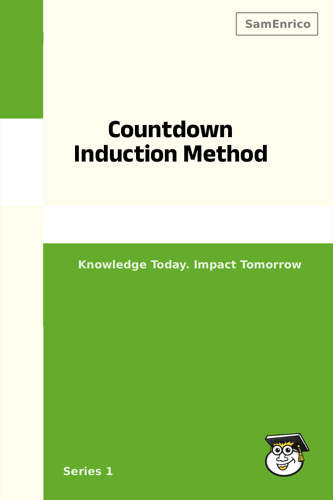
Non-FictionSelf-HelpNumber Induction
Countdown Induction Method eBook
Use descending numbers to enter trance with this p
Use descending numbers to enter trance with this practical self hypnosis workbook.
Formats
Free sample
Chapter 1: The Counting Cure...--Imagine standing at the top of a long staircase. Ten steps below you is a door. You don't know what is behind that door, but you know something is waiting there—something you have wanted to change for months, maybe years. Maybe it is freedom from a habit that owns you. Maybe it is relief from a background hum of anxiety that you have learned to live with but never learned to silence.
Maybe it is simply the ability to close your eyes and feel something other than the relentless chatter of your own mind.Now imagine that the only instruction you need to reach that door is this: count backward from ten. No meditation cushions. No chanting. No expensive apps. No need to believe in anything supernatural, mystical, or even particularly unusual.
Just numbers. Descending numbers.This book is built on a deceptively simple claim: counting backward from ten to one is one of the most powerful, underutilized tools for changing your own brain. It is not magic. It is not a gimmick. It is a precise neurological lever—a way of using the brain's own architecture to bypass the parts of you that resist change and speak directly to the parts that actually run the show.If that sounds too good to be true, good.
You should be skeptical. This chapter is going to honor that skepticism by dismantling everything you think you know about hypnosis, explaining why counting backward works where counting forward fails, and setting the stage for a twenty-one-day journey that will turn a simple sequence of numbers into a lifelong skill.The Problem with Willpower Let us start with a truth that most self-help books dance around but rarely state directly: willpower is a liar.Not intentionally. Not maliciously. But reliably, predictably, almost mathematically limited. The scientific literature on ego depletion—however much it has been refined and debated in recent years—points to a consistent finding: conscious effort exhausts itself.
You wake up with a finite reservoir of mental energy, and every decision, every temptation resisted, every moment of forced focus drains that reservoir a little more. By late afternoon, the same person who swore at breakfast that they would not eat the office donuts is chewing glazed surrender. By evening, the same person who promised themselves they would meditate, exercise, or write that difficult email is scrolling mindlessly through a screen, wondering where their resolve went.This is not a character flaw. It is a design feature of the human brain. The conscious mind—the part that makes plans, sets goals, and lectures itself about better habits—has a small capacity.
Psychologists sometimes compare it to a computer's RAM: fast, flexible, but limited. You can hold perhaps four to seven discrete pieces of information in conscious awareness at any given moment. You can sustain focused effort for a while, but eventually, the system overheats.The subconscious mind, by contrast, is more like a hard drive. Vast. Automatic.
Efficient. It runs habits, emotional responses, bodily functions, and deeply ingrained beliefs without requiring any conscious effort at all. You do not decide to feel anxious when you see a spider. You do not decide to reach for your phone when you feel bored. You do not decide to tense your shoulders when a stressful email arrives.
These responses are programmed into the subconscious, and they run on autopilot, faster than conscious thought can intervene.Here is the problem that every personal goal eventually crashes into: you cannot use willpower to reprogram autopilot. Trying to override a subconscious habit with conscious effort is like trying to stop a river with your bare hands. You might slow a few gallons, but the current keeps moving. The smoker who quits through sheer determination is fighting not just a chemical addiction but a subconscious program that has linked cigarettes to relief, to breaks, to social connection, to thousands of tiny cues embedded in daily life. The anxious person who tells themselves "just relax" is giving instructions to a part of the brain that does not speak the language of commands.What you need is not more willpower.
What you need is a way to bypass the conscious mind altogether and communicate directly with the subconscious. That is exactly what the Countdown Induction Method is designed to do.What Hypnosis Actually Is (And What It Is Not)The word "hypnosis" conjures strange images. A swinging pocket watch. A stage performer making someone bark like a dog. A therapist saying, "You are getting very sleepy." These images are not just misleading; they are actively harmful because they prevent intelligent, skeptical people from using one of the most well-researched tools for personal change.Let us clear the debris.Hypnosis is not sleep.
In fact, brain wave patterns during hypnosis show a state of focused, alert attention—different from both waking consciousness and sleep. You are not unconscious. You are not unaware. You are not under anyone's control. If a hypnotist on stage tells someone to do something wildly against their values—remove clothing, harm themselves, betray a confidence—that person will simply refuse or emerge from the trance.
The stage performer selects for highly suggestible volunteers who are willing to play along, then calls it mind control. It is entertainment, not neuroscience.Hypnosis is not magical. There is nothing supernatural about it. It is a naturally occurring state of focused attention that most people enter multiple times a day without recognizing it. Have you ever driven home from work and realized you remember nothing about the last ten minutes of highway?
That is a light trance. Have you ever become so absorbed in a movie, a book, or a video game that you lost track of time and did not hear someone call your name? That is a trance. Have you ever daydreamed so vividly that you momentarily forgot where you were? That is also a trance.What all these experiences share is a narrowing of attention.
The conscious mind, normally scanning the environment, monitoring threats, evaluating options, and rehearsing social scripts, becomes occupied with a single focus—the road, the story, the game, the daydream. When the conscious mind is thus occupied, the critical factor relaxes.The critical factor is the part of your mind that evaluates incoming information against existing beliefs. It is the gatekeeper. When someone says, "You can change your habit in twenty-one days," your critical factor immediately jumps in: That sounds like a scam. I have tried before and failed.
Who is this person to tell me what is possible? This is not cynicism; it is a protective mechanism. The critical factor prevents you from believing everything you hear.But the critical factor can only evaluate one thing at a time. When you occupy it with a simple, repetitive task—such as counting backward from ten—it lowers its guard. And in that moment of lowered guard, suggestions can pass directly to the subconscious without being filtered, rejected, or argued with.That is hypnosis.
That is all hypnosis is. Occupying the conscious mind so the subconscious becomes receptive.The Number Ten: Why This Sequence and Not Another You might ask: why ten? Why…
This is the end of the free sample. Get the eBook to keep going. Buy now
About this book
Details
- Author
- Quarles Elodia
- Publisher
- SamEnrico
- Language
- English
- Genre
- Non-Fiction, Self-Help, Number Induction
- Released
- 2026-06-07
- Pages (approx.)
- 134
- Available as
- eBook, Audiobook

Read better in the ZLOADR app
Your eBooks on your phone or tablet. Sign in with your SamEnrico account and start reading.
More by Quarles Elodia
 The Father PPD GuideQuarles Elodia$11.99
 Body Language in RelationshipsQuarles Elodia$11.99
 Senior Guardianship GuideQuarles Elodia$11.99
 Compulsive Spending and BoredomQuarles Elodia$11.99
 SSRI for Menopause InsomniaQuarles Elodia$11.99
 OKR Grading and ScoringQuarles Elodia$11.99
 Self Hypnosis for SmokingQuarles Elodia$11.99
 The Pink Panther's Shadow: The Real-Life Jewel Thief Who Inspired a LegendQuarles Elodia$11.99
 The Black Eagle Conspiracy: Frederick the Great's Secret War of EnlightenmentQuarles Elodia$11.99
 A Collector's Handbook to the Vauxhall Royale SaloonQuarles Elodia$11.99
 Mandrills: Colorful PrimateQuarles Elodia$11.99
 How to Produce Pencil Cases and BagsQuarles Elodia$11.99
You may also like
 Hong Kong Handover 1997Dunn Johnnie$11.99
 Zumba For Postnatal Recovery CourseNeal Christian$11.99
 Zumba for BeginnersLadner Nikia$11.99
 YouTube Comment Mining GuideHumes Pandora$12.99
 Worry Box MeditationCarlin Rudy$11.99
 Workplace Stress MeditationNguyen Lynn$11.99
 Workplace Stress and Sleep RepairHawley Ivory$11.99
 Workplace Perfectionism CureDelaney Jeffry$11.99
 Workplace Injustice Anger GuideWallen Isabelle$11.99
 Work Addiction and Burnout LinkGreenwood Ester$11.99
 Women in Yoga and WellnessBeattie Galina$11.99
 Women in Stand Up ComedyChun Evangeline$11.99