
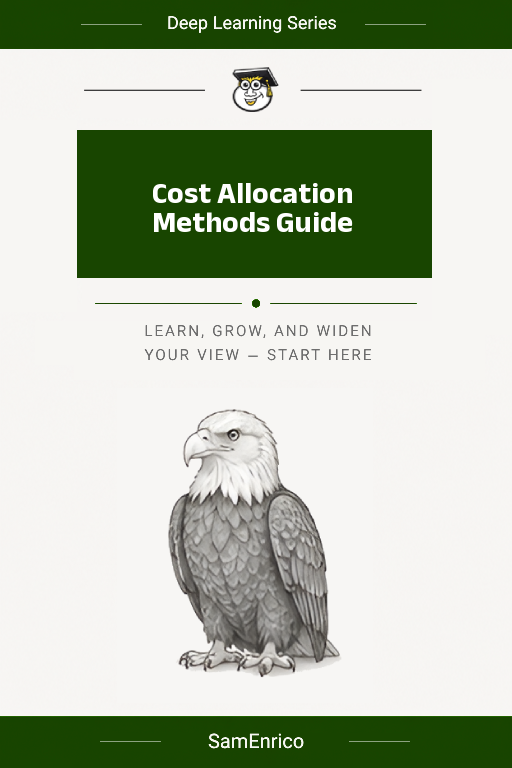
Cost Allocation Methods Guide eBook
Apply direct, step down, and reciprocal methods fo
by Skelton Reda
Apply direct, step down, and reciprocal methods for overhead allocation. Calculate departmental rates and activity based costing rates.
Formats
Free sample
Chapter 1: The Hidden Ledger--–- Every month, in companies across the world, a quiet ritual takes place. In a fluorescent-lit office, an accountant presses a button, and software allocates thousands—sometimes millions—of dollars of overhead costs to products, departments, and customers. The manager of a high-volume production line sees her costs rise by 8 percent, though she has used no more electricity, floor space, or supervision than last month. The manager of a low-volume custom shop breathes a sigh of relief—his costs stayed flat. Neither manager knows that the allocation method chosen by corporate finance just shifted $240,000 from the custom shop to the high-volume line.
Neither knows that the custom product they think is profitable is actually a money loser. And neither knows that next quarter, when a different method is used for budgeting, the numbers will flip again.This is the hidden ledger—the invisible system of arbitrary rules, political compromises, and mathematical shortcuts that determines which products appear profitable, which managers receive bonuses, and ultimately, which companies survive. Cost allocation is not a dull back-office exercise. It is a strategic weapon, a behavioral lever, and often, a trap.The purpose of this chapter is to fundamentally reframe how you think about cost allocation. If you expect a dry recitation of accounting rules, put this book down and walk away.
If, however, you want to understand why your manufacturing costs never seem to match reality, why your service department managers fight every budget cycle, and why your most loyal customers might actually be your least profitable ones—then read on. This chapter establishes the philosophical, psychological, and ethical foundations for everything that follows. By the end, you will never look at an overhead rate the same way again.The Central Paradox: Different Costs for Different Purposes The first and most important truth of cost allocation is also its most frustrating: there is no single correct way to allocate overhead. A dollar of rent on a factory building is objectively real. But deciding how much of that dollar belongs to Product A versus Product B is a matter of judgment, not fact.This is the central theme of cost accounting, articulated best by the accounting scholar Charles Horngren: different costs for different purposes.
The same overhead cost can be legitimately allocated in three different ways depending on what you are trying to accomplish.Consider a simple example. A company spends $100,000 annually on its human resources department. For external financial reporting under generally accepted accounting principles (GAAP), the company might allocate HR costs based on direct labor hours because that is simple and auditors accept it. For internal pricing decisions, the same company might allocate based on headcount because that better reflects resource consumption. And for performance evaluation of division managers, the company might exclude HR costs entirely because managers cannot control them.All three approaches are simultaneously correct for their respective purposes.
All three are also simultaneously wrong if used for a different purpose. The tragedy is that most organizations pick one allocation method—usually the one that minimizes bookkeeping—and use it for everything: inventory valuation, pricing, budgeting, performance evaluation, and even customer profitability analysis. This is like using a wrench to hammer a nail. It works poorly, but it is the only tool in the box.This book will teach you to match the method to the decision. But first, you must accept that allocation is an art supported by mathematics, not a science that produces a single right answer.
The moment you believe you have found the objectively correct allocation, you have stopped thinking.The Psychology of Allocation: Why Managers Fight and How to Stop It If allocation were purely mathematical, no one would argue about it. But in every organization where the author has consulted, cost allocation is a source of chronic conflict. Department managers accuse finance of "pinning overhead on us that we don't control." Plant managers claim corporate is "padding our costs to make us look bad." And salespeople refuse to believe that certain customers cost more to serve than others.This conflict is not irrational. It is a predictable response to a system that violates fundamental principles of fairness and controllability.The Controllability Principle Research in management accounting consistently shows that people accept responsibility only for costs they can influence. When a factory manager receives an allocated charge for corporate IT support, and the IT budget is set by a corporate committee the manager does not serve on, that manager will reject the allocation as unfair—regardless of how mathematically accurate it is.The solution is not to eliminate allocations but to make them transparent and, where possible, controllable.
This means:Separating fixed from variable allocations. Managers accept variable charges (e.g., 5persupportticket)morereadilythanfixedcharges(e.g.,5 per support ticket) more readily than fixed charges (e.g., 5persupportticket)morereadilythanfixedcharges(e.g.,10,000 per month for "available capacity").Providing advance notice of allocation rates. When managers know next quarter's rates before the quarter begins, they can plan. Surprise allocations generate rage.Creating feedback loops. If a manager can demonstrate that an allocation base is inaccurate (e.g., headcount is used but the manager's department uses no HR services), there must be a mechanism to adjust.The Fairness Heuristic Behavioral economists have shown that humans evaluate allocations using a simple heuristic: was the process fair?
Even people who receive a smaller share of a resource will accept the outcome if they believe the allocation process was transparent, consistent, and based on legitimate criteria.In one famous study, participants allocated a windfall to themselves and others. When the allocation was decided by a random lottery, recipients who received less still rated the process as fair. When the same unequal outcome was decided arbitrarily by one person, recipients rated it as deeply unfair.For cost allocation, this means that the method matters as much as the result. A step-down method that is clearly documented and consistently applied will generate less resistance than a reciprocal method that is mathematically superior but opaque—even if the step-down method produces larger allocations to some departments.Practical Techniques to Reduce Conflict Based on the controllability principle and fairness heuristic, here are proven techniques to reduce allocation conflict:The Budget Committee Method: Involve department managers in selecting allocation bases before the fiscal year begins. When managers choose the bases, they cannot later complain about the results.The Two-Rate System: Allocate fixed overhead using planned capacity (not actual usage) so that managers are not penalized for volume fluctuations outside their control.
Allocate variable overhead using actual usage. This separation dramatically reduces conflict.The Threshold Rule: Do not allocate costs below a certain materiality threshold. If an allocation would change a department's apparent costs by less than 2 percent, consider absorbing it at the corporate level. Small allocations create disproportionate conflict.The Appeal Process: Establish a formal mechanism for managers to challenge allocation assumptions. The mere existence of an appeal process increases perceived fairness, even if appeals are rarely granted.Strategic Alignment: Allocation as a Behavioral Weapon Most managers think of allocation as a passive reporting mechanism.
The smartest managers think of it as an active tool to shape behavior.Consider two companies. Both have an IT help…
This is the end of the free sample. Get the eBook to keep going. Buy now
About this book
Details
- Author
- Skelton Reda
- Publisher
- SamEnrico
- Language
- English
- Genre
- Non-Fiction, Student's Shortcut, Cost Allocation
- Released
- 2026-06-01
- Pages (approx.)
- 158
- Available as
- eBook, Audiobook

Read better in the ZLOADR app
Your eBooks on your phone or tablet. Sign in with your SamEnrico account and start reading.
More by Skelton Reda
 Romance Scandals Child StarsSkelton Reda$11.99
 Scheduling for Single ParentsSkelton Reda$11.99
 Citation Rules Cheat Sheet WorkbookSkelton Reda$11.99
 Temp Work During Career TransitionSkelton Reda$11.99
 Upwork Long Term Client GuideSkelton Reda$11.99
 The Monroe Motivated SequenceSkelton Reda$11.99
 Buffett DuracellSkelton Reda$11.99
 UK VAT Registration for Limited Companies CourseSkelton Reda$11.99
 Interspersal TechniqueSkelton Reda$11.99
 The Golden Tongue of the Nile: The Philosophical Pirates of Ancient EgyptSkelton Reda$11.99
 Love Letters from the Pacific: The Secret Correspondence of a WWII Pilot and His Pen PalSkelton Reda$11.99
 The Lost Symphony of the Ice QueenSkelton Reda$11.99