
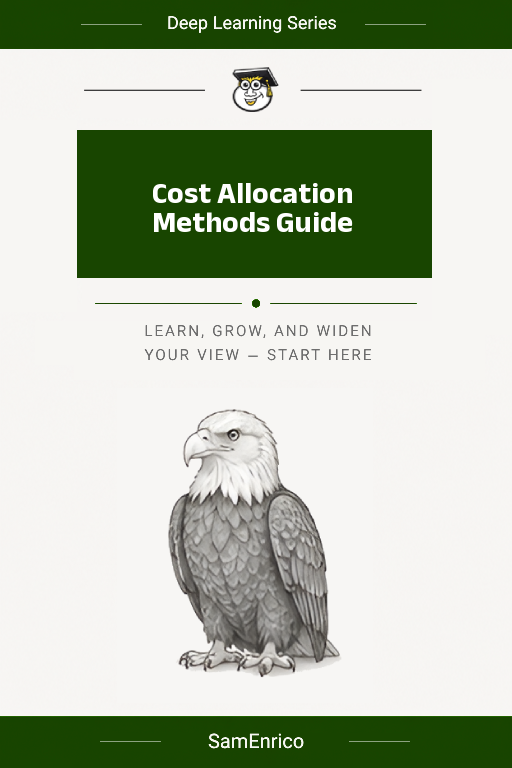
Cost Allocation Methods Guide
Apply direct, step down, and reciprocal methods fo
by Skelton Reda
Apply direct, step down, and reciprocal methods for overhead allocation. Calculate departmental rates and activity based costing rates.
Formats
About this book
Free sample
Chapter 1: The Hidden Ledger--–- Every month, in companies across the world, a quiet ritual takes place. In a fluorescent-lit office, an accountant presses a button, and software allocates thousands—sometimes millions—of dollars of overhead costs to products, departments, and customers. The manager of a high-volume production line sees her costs rise by 8 percent, though she has used no more electricity, floor space, or supervision than last month. The manager of a low-volume custom shop breathes a sigh of relief—his costs stayed flat. Neither manager knows that the allocation method chosen by corporate finance just shifted $240,000 from the custom shop to the high-volume line.
Neither knows that the custom product they think is profitable is actually a money loser. And neither knows that next quarter, when a different method is used for budgeting, the numbers will flip again.This is the hidden ledger—the invisible system of arbitrary rules, political compromises, and mathematical shortcuts that determines which products appear profitable, which managers receive bonuses, and ultimately, which companies survive. Cost allocation is not a dull back-office exercise. It is a strategic weapon, a behavioral lever, and often, a trap.The purpose of this chapter is to fundamentally reframe how you think about cost allocation. If you expect a dry recitation of accounting rules, put this book down and walk away.
If, however, you want to understand why your manufacturing costs never seem to match reality, why your service department managers fight every budget cycle, and why your most loyal customers might actually be your least profitable ones—then read on. This chapter establishes the philosophical, psychological, and ethical foundations for everything that follows. By the end, you will never look at an overhead rate the same way again.The Central Paradox: Different Costs for Different Purposes The first and most important truth of cost allocation is also its most frustrating: there is no single correct way to allocate overhead. A dollar of rent on a factory building is objectively real. But deciding how much of that dollar belongs to Product A versus Product B is a matter of judgment, not…
This is the end of the free sample. Get the eBook to keep going. Buy now
Contents
- Chapter 1
- Chapter 2
- Chapter 3
- Chapter 4
- Chapter 5
- Chapter 6
- Chapter 7
- Chapter 8
- Chapter 9
- Chapter 10
- Chapter 11
- Chapter 12
Details
- Author
- Skelton Reda
- Publisher
- SamEnrico
- Language
- English
- Genre
- Non-Fiction, Student's Shortcut, Cost Allocation
- Released
- 2026-06-01
- Pages (approx.)
- 158
- Available as
- eBook, Audiobook

Read better in the ZLOADR app
Your eBooks on your phone or tablet. Sign in with your SamEnrico account and start reading.
More by Skelton Reda
 Romance Scandals Child StarsSkelton Reda$11.99
 Scheduling for Single ParentsSkelton Reda$11.99
 Citation Rules Cheat Sheet WorkbookSkelton Reda$11.99
 Temp Work During Career TransitionSkelton Reda$11.99
 Upwork Long Term Client GuideSkelton Reda$11.99
 The Monroe Motivated SequenceSkelton Reda$11.99
 Buffett DuracellSkelton Reda$11.99
 UK VAT Registration for Limited Companies CourseSkelton Reda$11.99
 Interspersal TechniqueSkelton Reda$11.99
 The Golden Tongue of the Nile: The Philosophical Pirates of Ancient EgyptSkelton Reda$11.99
 Love Letters from the Pacific: The Secret Correspondence of a WWII Pilot and His Pen PalSkelton Reda$11.99
 The Lost Symphony of the Ice QueenSkelton Reda$11.99