
Non-FictionHealth & WellnessEndocrinology
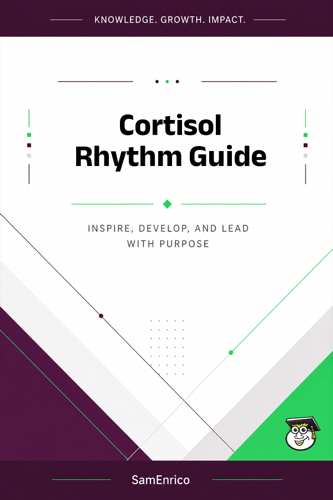
Cortisol Rhythm Guide eBook
Teaches diurnal curve and morning peak evening tro
by Singer Lue
Teaches diurnal curve and morning peak evening trough.
Formats
Free sample
Chapter 1: The Symphony You Never Hear--It is happening right now, inside your body, as you read these words. A symphony is playing—a complex, precisely timed cascade of chemical signals that rises and falls across every hour of your day. You cannot hear it. You cannot feel it. But if you knew how to listen, you would recognize its rhythm immediately: the quiet hum of your first waking thought, the sharp crescendo of alertness that should arrive with breakfast, the gentle decrescendo that settles over you at dinner, and the near-silence of deep midnight rest.This symphony has a name.
It is called your diurnal cortisol rhythm, and for the vast majority of modern humans, it is playing the wrong music.You may have attributed your struggles to something else. You told yourself you are "not a morning person." You blamed your 3:00 PM crash on lunch. You convinced yourself that lying awake at midnight, mind racing, is just anxiety. But what if none of those explanations are correct? What if the root cause is something more fundamental—something that every cell in your body already knows how to do, but that your modern lifestyle has systematically silenced?Welcome to the first chapter of The Cortisol Rhythm Guide.
Before we fix your curve, before we give you the protocols, the supplements, and the meal plans, you must understand what you are working with. You must meet the conductor of your internal orchestra. You must learn the language of the symphony.This chapter will take you on a journey from the ancient origins of your stress response to the microscopic machinery inside your brain that keeps time. By the end, you will never look at your morning coffee, your evening screen, or your midnight ceiling the same way again.The Saber-Toothed Tiger in Your Inbox To understand why your cortisol rhythm matters, you must first understand what cortisol is—and what it is not.Cortisol is a glucocorticoid hormone produced by your adrenal glands, two small pyramid-shaped organs that sit atop your kidneys like tiny hats. Despite its reputation as a villain in wellness culture, cortisol is not inherently bad.
In fact, you would die without it. People with Addison's disease, who cannot produce enough cortisol, experience profound fatigue, dangerous drops in blood pressure, and can slip into a life-threatening crisis called adrenal insufficiency. Cortisol keeps you alive.But here is the distinction that changes everything: cortisol is designed to be an emergency broadcaster, not a background drone. It evolved to solve a very specific problem.Imagine your ancient ancestor, walking across the savanna 100,000 years ago. She is looking for berries when suddenly, a saber-toothed tiger emerges from the tall grass.
In that instant, her brain triggers a cascade that would become the most famous stress response in biology. The hypothalamus releases CRH (corticotropin-releasing hormone). The pituitary releases ACTH (adrenocorticotropic hormone). And the adrenals release cortisol.Within seconds, cortisol transforms her body. Blood sugar rises, flooding her muscles with fuel.
Blood pressure increases, sending oxygen to her brain. Digestion halts—she does not need to process lunch right now. Inflammation is suppressed. The immune system stands down. Reproductive hormones are temporarily silenced.
Every non-essential system is deprioritized so that every essential system can perform a single task: survive the next three minutes.She runs. She escapes. The tiger moves on. And within an hour, her cortisol levels return to baseline. The emergency is over.
The symphony resumes its normal rhythm.Now consider your own life. Open your email inbox. Look at your calendar. Check your text messages.There is no tiger. But your brain does not know the difference.The modern world has replaced discrete, resolvable threats with a continuous, low-grade hum of demand.
An angry email from your boss. A notification about a late bill. Traffic on the way to work. News about politics, the economy, a pandemic, a war. Your child's school calling.
A deadline that moved up. A text message that requires a response.None of these are tigers. But each one triggers the same ancient machinery. And unlike your ancestor, who faced one tiger and then rested, you face fifty "tigers" every day, stacked on top of each other, with no rest in between.The result is not a spike. The result is a steady, unrelenting elevation of cortisol that never fully returns to baseline.
And over months and years, that steady elevation does something sinister: it flattens your curve.The Master Clock: Your Suprachiasmatic Nucleus Somewhere deep inside your brain, behind your eyes and slightly above the roof of your mouth, there is a cluster of approximately twenty thousand neurons called the Suprachiasmatic Nucleus (SCN). It is about the size of a grain of rice. And it is the most important timekeeper you will never see.The SCN is your body's master clock. It does not merely track time—it creates time, imposing a 24-hour rhythm onto every organ, every tissue, and nearly every cell in your body. Without the SCN, your liver would pulse on its own schedule, your pancreas would release insulin randomly, and your heart rate would drift without pattern.
You would not die immediately, but you would descend into a state of internal chaos that no amount of external scheduling could fix.Here is what makes the SCN remarkable: it runs on genetics. Inside each of those twenty thousand neurons, a set of "clock genes" (CLOCK, BMAL1, PER, CRY) engage in a beautiful, self-perpetuating feedback loop. During the day, CLOCK and BMAL1 activate the production of PER and CRY proteins. As PER and CRY accumulate, they eventually shut down CLOCK and BMAL1. Then, as PER and CRY break down, CLOCK and BMAL1 become active again.
This cycle takes approximately twenty-four hours and eleven minutes—slightly longer than a calendar day.Without external input, your internal clock runs long. Left to its own devices, you would drift later and later each day, becoming a permanent night owl even if you prefer mornings. But you do not live in a sealed chamber. You live in a world with light, temperature, food, and social cues—all of which can reset your clock. The most powerful of these cues is light.The Light Connection That Changes Everything Your SCN sits directly above the optic chiasm, the point where the optic nerves from your eyes cross.
This is not an accident. The SCN receives direct input from a special class of retinal cells called intrinsically photosensitive retinal ganglion cells (ip RGCs). These cells do not help you see shapes or colors. They contain a photopigment called melanopsin that detects the presence of blue-wavelength light (approximately 480 nanometers). When these cells detect blue light, they send a direct signal to your SCN: "It is daytime.
Begin the cortisol rise."This is why looking at your phone at night is not just "bad for sleep"—it is biologically confusing. You are telling your master clock that the sun is still up, even as your body is trying to wind down. And because the SCN cannot distinguish between sunlight and a smartphone screen (both contain blue wavelengths), it obediently delays the evening drop in cortisol and the evening rise in melatonin.The reverse is also…
This is the end of the free sample. Get the eBook to keep going. Buy now
About this book
Details
- Author
- Singer Lue
- Publisher
- SamEnrico
- Language
- English
- Genre
- Non-Fiction, Health & Wellness, Endocrinology
- Released
- 2026-06-07
- Pages (approx.)
- 160
- Available as
- eBook, Audiobook

Read better in the ZLOADR app
Your eBooks on your phone or tablet. Sign in with your SamEnrico account and start reading.
More by Singer Lue
 Niki Lauda Comeback StorySinger Lue$11.99
 Assertiveness Teen GuideSinger Lue$11.99
 DBT For Bipolar EmotionSinger Lue$11.99
 Nicotine Metabolite Testing GuideSinger Lue$11.99
 Wine Club Membership ChurnSinger Lue$11.99
 Polydrug Dependency RecoverySinger Lue$11.99
 Inlaw Impact StatementSinger Lue$11.99
 The Phantom Key: How a European Police Hacking Unit Cracked the Luxury Car Theft RingSinger Lue$11.99
 The Maroons of the Deep: How Enslaved Africans Charted the Caribbean SeasSinger Lue$11.99
 How to Produce Food, Beverages and TobaccoSinger Lue$11.99
 How to Become a Hooking-machine OperatorSinger Lue$11.99
 Company Registration South AfricaSinger Lue$12.99
You may also like
 Hong Kong Handover 1997Dunn Johnnie$11.99
 Zumba For Postnatal Recovery CourseNeal Christian$11.99
 Zumba for BeginnersLadner Nikia$11.99
 YouTube Comment Mining GuideHumes Pandora$12.99
 Worry Box MeditationCarlin Rudy$11.99
 Workplace Stress MeditationNguyen Lynn$11.99
 Workplace Stress and Sleep RepairHawley Ivory$11.99
 Workplace Perfectionism CureDelaney Jeffry$11.99
 Workplace Injustice Anger GuideWallen Isabelle$11.99
 Work Addiction and Burnout LinkGreenwood Ester$11.99
 Women in Yoga and WellnessBeattie Galina$11.99
 Women in Stand Up ComedyChun Evangeline$11.99